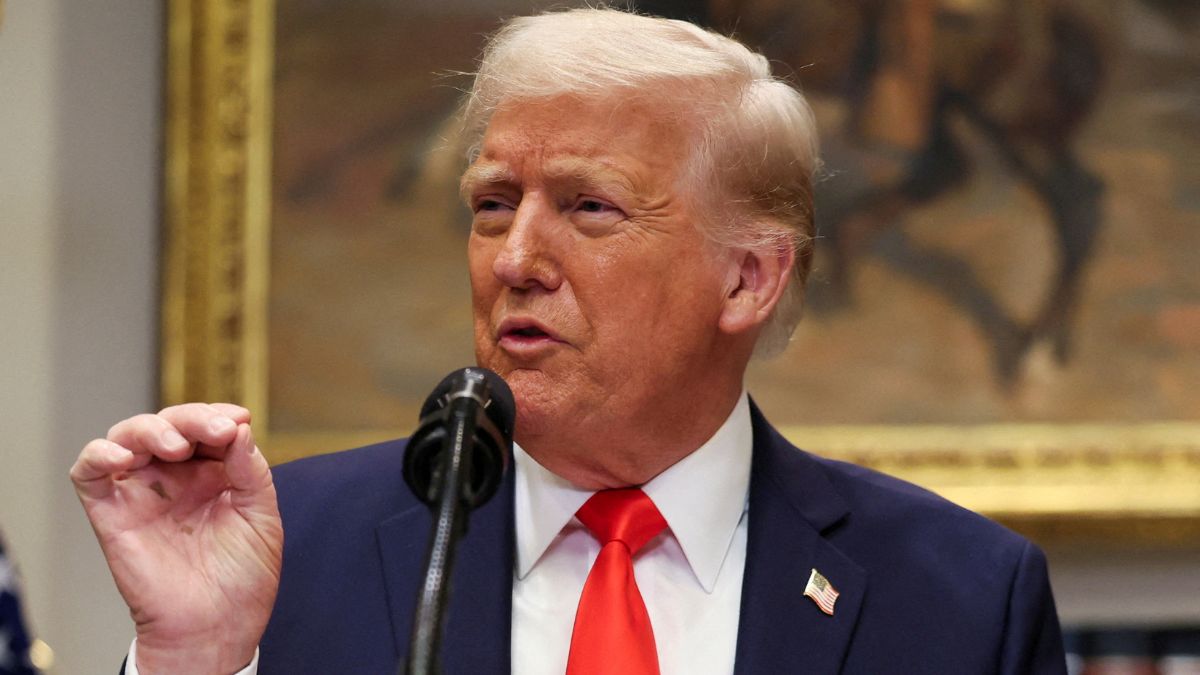
 "US President Donald Trump in the Roosevelt Room at the White House. Reuters")
Donald Trump’s return to his America First policy has once again created uncertainty about the transatlantic alliance. This has made European nations rethink their security plans. His recent remarks questioning Nato’s promise to defend all its members and his decision to stop military aid to Ukraine have made European leaders more worried about their continent’s safety. As a result, Europe is moving faster toward building its own defence system leading to a major change in global politics.
Trump’s Nato rhetoric
Trump again expressed his long-standing doubts about Nato’s financial burden-sharing, Reuters reported on Thursday. He made it clear that if European nations do not pay enough for their defence, the US would not help them. While this is not a new stance, it has become more serious as tensions with Russia grow.
European leaders, already unsure about Washington’s commitment under Trump, are now forced to think about a future where Nato might not guarantee their protection.
Nato Secretary-General Mark Rutte tried to reassure allies saying that the transatlantic partnership remains the “bedrock” of the alliance. However, Trump’s comments have already created uncertainty in European capitals leading to a rethink of strategic priorities.
French President Emmanuel Macron reminded Washington that Europe had stood by the US in the past such as after 9/11 when it joined the war in Afghanistan subtly pointing out that Nato works both ways.
Impact Shorts
More ShortsThe Ukraine factor
Trump’s decision to stop military aid to Ukraine making it conditional on Kyiv agreeing to peace talks with Moscow has further damaged US-European relations. Along with this, reports that his administration is considering lifting some sanctions on Russia have made European leaders see this as a major change in Washington’s foreign policy.
European leaders, realising the need for quick action, held emergency talks in Brussels to strengthen defence cooperation. European Commission President Ursula von der Leyen called the moment historic stressing that the EU is “determined to ensure Europe’s security and to act with the scale, the speed and the resolve that this situation demands”.
Europe’s financial and strategic response
In response to Trump’s unpredictable stance, the EU has started taking steps to ease budget rules making it easier for countries to increase defence spending. European nations, which Trump has often criticised for not spending enough on their militaries are now making serious efforts to close the gap. The European Commission estimates that these reforms could help raise about 650 billion euros ($702 billion).
The EU has also proposed loans worth 150 billion euros ($162 billion) to speed up military purchases aiming to reduce dependence on American weapons. German politician Friedrich Merz, who is likely to be the next chancellor, has supported easing Germany’s strict debt rules to allow more defence spending.
Likewise, Danish Prime Minister Mette Frederiksen stressed the urgency of the situation, saying that Europe must “spend, spend, spend on defence and deterrence.”
A shift toward European strategic autonomy
Europe’s reaction to Trump’s policies highlights a growing push for strategic independence, a concept long supported by France and now gaining wider acceptance across the EU. As the US shifts toward a more transactional approach to alliances, European leaders are looking for ways to rely less on Washington.
Macron has been a strong supporter of European defence independence repeatedly saying that Europe must “take its destiny into its own hands.” His views now have more support, especially as the US seems closer to Moscow on Ukraine than to its traditional European allies. The creation of a European Defence Fund and ongoing talks about an EU army reflect this major shift.
Public opinion in Europe is also moving toward self-reliance. Many Europeans see Trump’s actions as a warning that the US may no longer be a dependable security partner. In Germany, Poland and France, recent polls show strong public support for increased defence spending and independent military forces. The European Parliament, which has usually been cautious about defence issues, is now speeding up discussions on a joint security strategy.
Political shifts within Europe further highlight this change. The Associated Press reported that countries like Poland, which have long depended on US security, are now strengthening ties with Germany and France.
Meanwhile, Hungary’s Viktor Orban, who has been openly pro-Trump, is becoming more isolated within the EU as other member states come together around the idea of strategic independence.
Future of transatlantic relations
Despite Trump’s America First stance, the US and Europe still share strong economic, cultural and strategic ties. However, the changing global situation suggests that the post-World War II transatlantic order may not be sustainable in its current form. The key question now is whether Europe can build its own defence system without weakening Nato’s core structure.
Some experts believe that Europe’s move towards independence could actually make Nato stronger by creating a more balanced alliance where responsibilities are shared more fairly. Others worry that a divided security approach could weaken collective defence making Europe more vulnerable to external threats.
Trump’s America First policy has clearly sped up Europe’s push for a more independent security strategy. His repeated doubts about Nato’s importance and his decision to stop military aid to Ukraine have forced European nations to take defence matters into their own hands. The EU’s quick response—raising funds, boosting military cooperation and rethinking its security priorities—marks a historic shift in transatlantic relations.
Whether Europe’s new determination leads to a lasting and effective defence strategy is yet to be seen. However, one thing is certain: Europe’s unquestioned reliance on US military support is fading, marking the beginning of a new geopolitical era where Europe is set on shaping its own future.