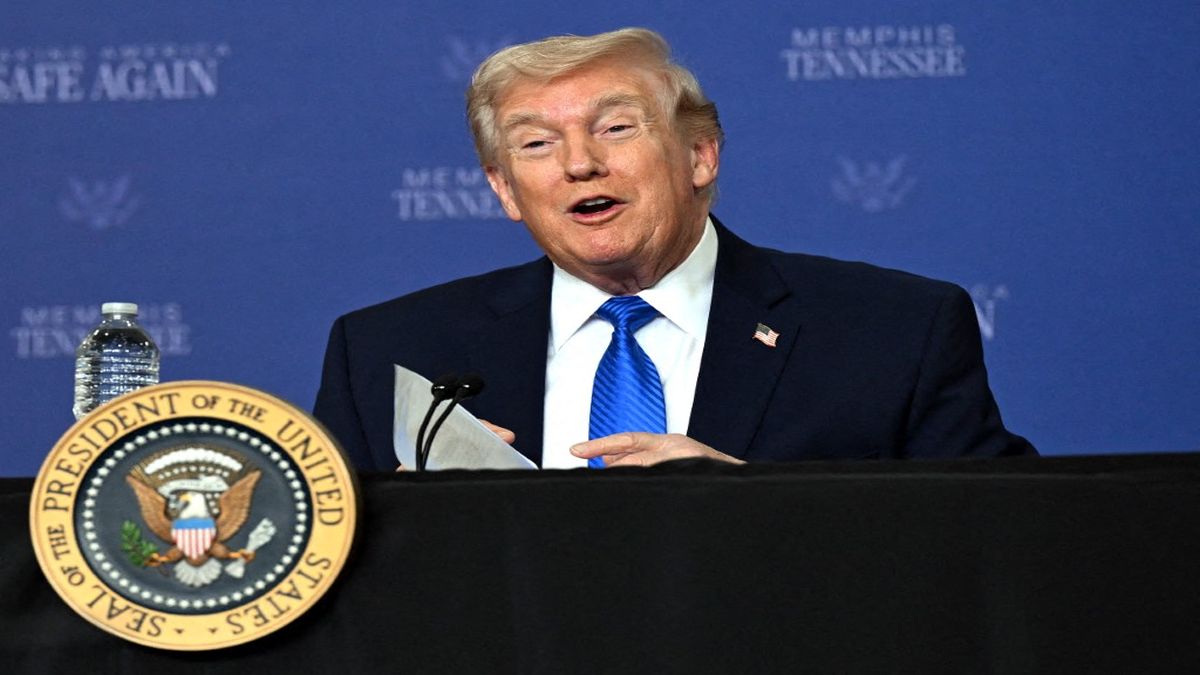
 "US President Donald Trump announced a five-day pause on US attacks on Iranian energy infrastructure amid the war. AFP")
US President Donald Trump has said he would “prefer to take the oil in Iran” and suggested that Washington could consider seizing Kharg Island — Tehran’s main oil export hub — as the United States expands its military footprint in the Middle East.
In an interview with the Financial Times on Sunday, Trump said his “preference would be to take the oil”, drawing parallels with US control of Venezuela’s oil sector, which he claimed Washington intends to hold “indefinitely” following the removal of President Nicolás Maduro earlier this year.
His remarks come amid a deepening US-Israel conflict with Iran that has intensified regional tensions and triggered a sharp spike in global oil prices.
“To be honest with you, my favourite thing is to take the oil in Iran,” Trump said.
He added that Kharg Island could be a potential target, though he acknowledged that such an operation would likely require a sustained US presence.
“Maybe we take Kharg Island, maybe we don’t. We have a lot of options,” he said. “It would also mean we had to be there for a while.”
Trump further claimed that Iran’s defences on the island are limited.
“I don’t think they have any defence. We could take it very easily,” he said.
Comparing it to Venezuela, Trump said Washington had sought to maintain control over its oil sector “indefinitely” following Maduro’s removal.
Quick Reads
View AllUS weighs ground options in Iran
Earlier reports suggested that the United States is drawing up contingency plans for possible ground operations in Iran, including targeted raids near the Strait of Hormuz and potential moves against Kharg Island.
These options are understood to fall short of a full-scale invasion but could involve special forces or limited infantry deployments aimed at disrupting Iran’s energy leverage over global shipping routes.
Why Kharg Island matters
Iran holds one of the world’s largest crude reserves, estimated at around 208–209 billion barrels. It produces about 3.2 million barrels per day.
Kharg Island is central to this system, handling nearly 90 per cent of Iran’s crude exports and serving as the country’s primary offshore oil terminal. Its location near the Strait of Hormuz — through which a significant share of global oil trade flows — makes it a critical chokepoint in global energy security.