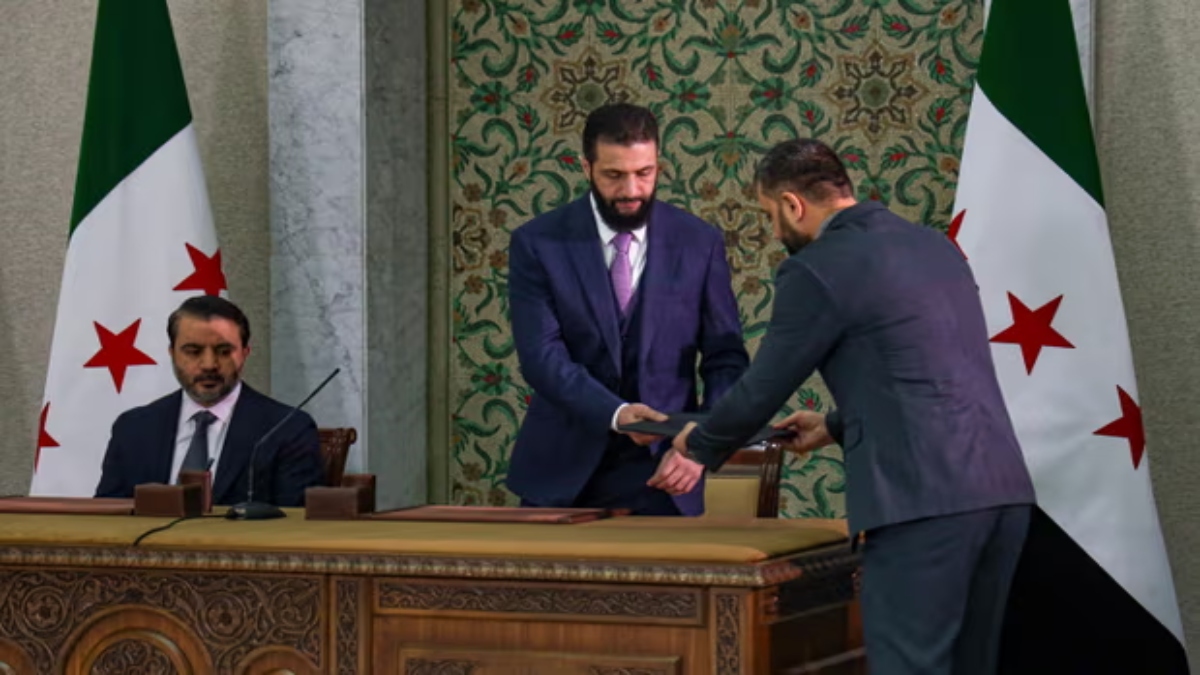
 "Syria’s interim president, Ahmad al-Sharaa, receives Syria’s temporary constitution at a signing ceremony. AP")
Syria’s Interim President, Ahmed al-Sharaa , signed a constitutional declaration that leaves the country under Islamist rule for the next five years during a transitional phase. The temporary constitution came into the picture just three months after his Islamist group led the rebel offensive that overthrew Syrian President Bashar al-Assad .
The new constitution says Islam is the religion of the country’s president, the same as the previous constitution. The document also believes Islamic jurisprudence is “the main source of legislation” rather than “a main source”, according to the drafting committee.
It also calls for the separation of powers and judicial independence. The temporary constitution guarantees women’s rights and safeguards freedom of expression and media freedom, BBC reported. “We hope it will be a new history for Syria, where we replace oppression with justice,” Sharaa said after signing the document.
UN welcomes the constitution
UN special envoy Geir Pedersen welcomed the “move towards restoring the rule of law” and noted that “this development potentially fills an important legal vacuum”. However, the Kurdish-led administration in north-eastern Syria condemned the constitutional declaration, noting that it “contradicts the reality of Syria and its diversity”.
In January this year, commanders of rebel military groups agreed to make Sharaa the interim president of Syria for the transitional period. Soon after coming to power, Sharaa cancelled the Assad-era 2012 constitution and dissolved the former regime’s parliament, army and security agencies. Ten days before signing the declaration, Sharaa announced the formation of seven-member committee to draft the constitutional declaration, which he said would serve as “the legal framework regulating the transitional phase”.
Also Watch:
One member of the constitutional committee, Abdul Hamid al-Awak, a constitutional law expert who teaches at a Turkish university, told a news conference on Thursday that the declaration aimed to “create a balance between a security society and rights and freedoms”. He said that the document stipulates “absolute separation of powers”, highlighting how Assad used to “encroach on other branches of government during his rule.
Impact Shorts
More ShortsThe Constitution amid chaos
The new document states that the president would have executive authority during the transitional period but would have only one “exceptional power” – the ability to declare a state of emergency. Apart from this, a new People’s Assembly will be formed, which will be responsible for the full legislation process.
Two-thirds of its members will be appointed by a committee selected by the president, and one-third will be chosen by the president himself. A committee will be formed to draft a new permanent constitution. Meanwhile, Sharaa has pledged to ensure an inclusive government that will run the country until a new permanent constitution is finalised and elections are held in Syria.
Sharaa signed the temporary document at a time when he facing significant challenges following the overthrow of the Assad regime. Last week, gunmen supporting Sharaa’s Sunni Islamist-led government were accused of carrying out revenge killings against members of Assad’s minority Alawite sect in the western coastal region following a deadly ambush on a security patrol by gunmen loyal to the former president. Syria War Monitor has claimed that almost 1,500 civilians were killed in these clashes .
Amidst the chaos, Sharaa vowed to hold the perpetrators to account and ordered the formation of a committee aimed at preserving civil peace. However, many Alawites and members of other religious and ethnic minorities often claim that they are being discriminated against.
Meanwhile, UN Secretary-General António Guterres said on Thursday that nothing could justify the killing of civilians and warned that Syria’s “much-deserved brighter future hangs in the balance”. “The caretaker authorities have repeatedly committed to building a new Syria based on inclusive and credible foundations for all Syrians. Now is the time for action,” he furthered.
With inputs from agencies.