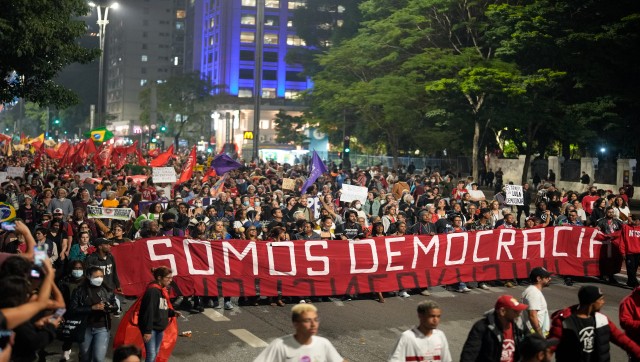
In an attempt to undermine his message of togetherness, President Luiz Inacio Lula da Silva will gather prominent members of Brazil’s political class on Monday to commemorate the first anniversary of the far-right riots that shook the nation’s capital. Tens of thousands of supporters of far-right former president Jair Bolsonaro, Lula’s defeated opponent in the election, stormed the presidential palace, Congress, and Supreme Court on 8 January 2023, trashing the buildings and demanding that the military remove Lula from office. The veteran leftist had only been back in office for a week. The riots in Brasilia exposed the violent differences ripping apart Brazil following Lula’s close victory against Bolsonaro in October of last year. The disturbances immediately drew analogies to the Capitol takeover in Washington two years prior by supporters of Donald Trump. Those differences become less pronounced now: The reaction to the riots and the election authorities’ decision in June of last year to prevent Bolsonaro from seeking office for eight years due to his criticism of the election system’s legitimacy have left the far-right in disarray. But analysts say deep-running fissures remain. The riots “strengthened belief in democracy” in Brazil, whose young constitution only dates to the end of the 1964-1985 military dictatorship, said political scientist Geraldo Monteiro, of Rio de Janeiro State University. “But people are still polarized,” he told AFP. Of the 2,170 arrested over the riots, 30 have been convicted so far, on charges including armed criminal conspiracy, violent uprising against the rule of law and an attempted coup, with sentences of up to 17 years. Bolsonaro, who was in the United States at the time, is under investigation for allegedly instigating the unrest. He denies responsibility. ‘Democracy Unbowed’ Lula, 78, will mark the anniversary addressing a ceremony at the Congress building, with attendees including the leaders of both houses, state governors, military commanders, foreign ambassadors and other honchos. The event, dubbed “Democracy Unbowed,” will feature the presentation of a restored tapestry by iconic Brazilian artist and landscape designer Roberto Burle Marx, which was ripped from a wall in the Senate and torn during the riots. A replica of the constitution taken from the Supreme Court will also be symbolically returned. Lula, who previously served two terms as president in the 2000s, has said January 8 “left deep scars,” but that “democracy emerged victorious.” He will try to use the occasion to transmit a message of unity, said political scientist Andre Cesar, of consulting firm Hold. But there will be notable absences on the right, such as Sao Paulo Governor Tarcisio Freitas, a former Bolsonaro minister touted as a possible presidential contender. Opposition figures “don’t want to reinforce Lula’s image as the great builder… of national unity,” Cesar said. ‘Patriot’s Day’ Hardline Bolsonaro backers meanwhile stand staunchly by the January 8 protesters. The charges against them are “pure political persecution,” influential Evangelical pastor Silas Malafaia, a close Bolsonaro ally, told AFP. “Have you ever seen a coup without weapons? Have you seen a terrorist attack without bombs?” In the buildup to the anniversary, calls circulated on social media to celebrate January 8 as “Patriot’s Day” and take to the streets to “paralyze” the country. However, authorities say they do not expect mass protests. Analysts say January 8 has become the latest litmus test in Brazil’s culture wars, which have split the South American giant on issues such as gun control, LGBTQ+ rights and abortion. “It’s moved beyond politics to become a question of identity,” says Cesar. Today, Brasilia, the ultra-modernist capital inaugurated in 1960, bears few signs of last year’s chaos. The invaded trio of glassy concrete buildings, designed by legendary modernist architect Oscar Niemeyer, have been repaired. Authorities have refrained from walling them off, maintaining the capital’s founding ideal of a “transparent city,” albeit “with fragile barriers,” said urban planner Jorge Francisconi.
Still divided, Brazil marks anniversary of Jan 8 riots
FP Staff
• January 6, 2024, 08:24:22 IST
The riots in Brasilia exposed the violent differences ripping apart Brazil following Lula’s close victory against Bolsonaro in October of last year. The disturbances immediately drew analogies to the Capitol takeover in Washington two years prior by supporters of Donald Trump
Advertisement
 "Still divided, Brazil marks anniversary of Jan 8 riots")
End of Article