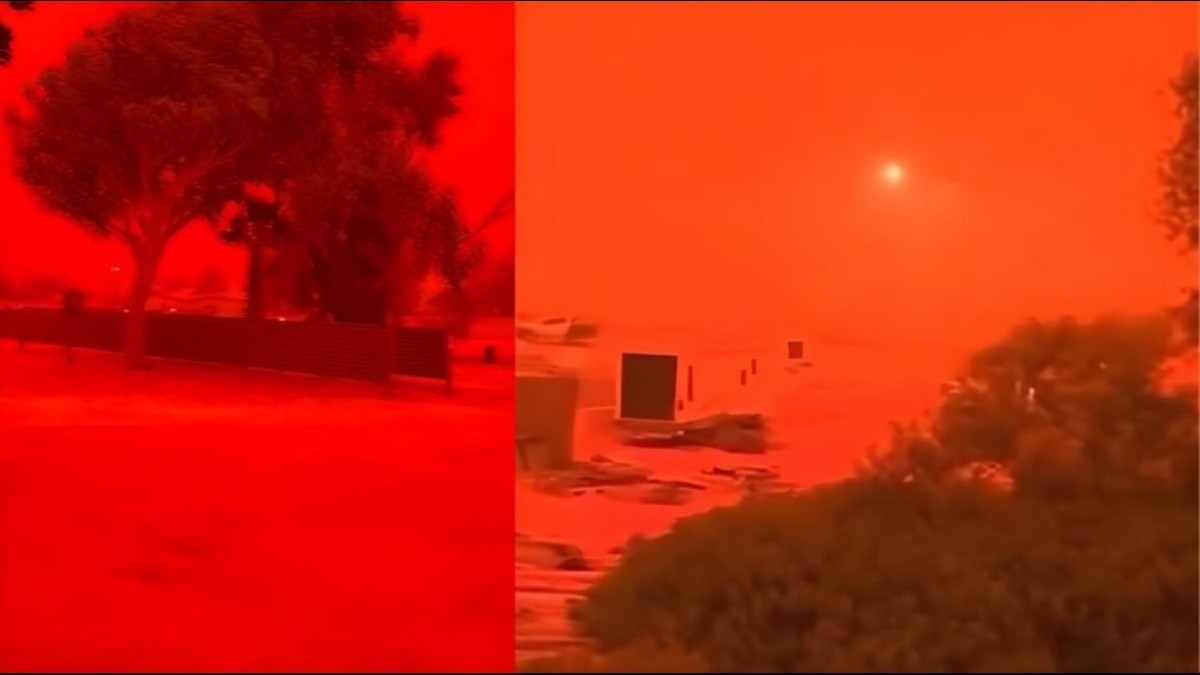
 "Skies in Australia turn blood-red as Cyclone Narelle lifts iron-rich dust | Watch")
The skies over Western Australia recently turned into a surreal, almost otherworldly spectacle, with vast stretches glowing a deep blood-red—leaving residents stunned and social media abuzz.
On March 27, 2026, areas including Shark Bay and the Pilbara witnessed the dramatic shift in colour. The phenomenon was not the result of editing or visual effects, but a powerful atmospheric event linked to Tropical Cyclone Narelle.
As the cyclone moved toward the coast, its strong winds lifted vast amounts of iron-rich dust from the Australian Outback into the atmosphere. This dust remained suspended in the air, casting an intense red hue across the sky.
The striking colour can be explained by light scattering. Under normal conditions, the sky appears blue due to Rayleigh scattering, where shorter wavelengths like blue light are scattered more by tiny air molecules. However, when larger particles such as dust are present, Mie scattering takes over.
In this case, the dust—rich in iron oxide (hematite)—filtered out shorter blue and green wavelengths while allowing longer red wavelengths to dominate, creating the vivid crimson effect, similar to the skies seen on Mars.
Quick Reads
View AllMeteorologists say Tropical Cyclone Narelle is unusual due to its rare path. It is only the third recorded storm to cross three different Australian coastlines, moving from Queensland through the Northern Territory before strengthening again off the coast of Western Australia. At its peak, it reached Category 3–4 intensity, bringing winds exceeding 125 kilometres per hour and heavy rainfall.
While the visuals were striking, experts warn such dust storms can have serious consequences. High concentrations of airborne particles can degrade air quality, reduce visibility, and pose health risks, particularly for those with respiratory conditions.