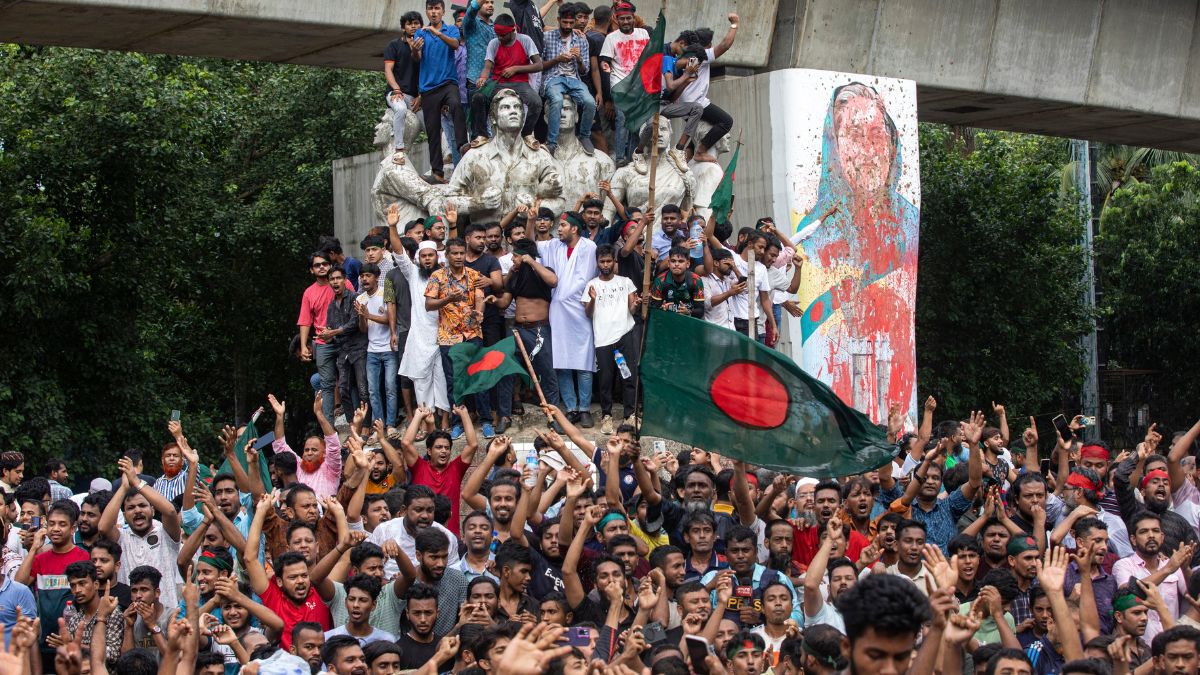
 "Protesters climb a public monument as they celebrate after getting the news of Prime Minister Sheikh Hasina's resignation, in Dhaka, Bangladesh, Monday, Aug. 5, 2024. File Image: AP")
In a sombre ceremony in Bangabhaban on Friday evening, Bangladesh’s Nobel laureate Dr Muhammad Yunus sworn in as the country’s chief adviser to the interim government. The oath was administered by Bangladesh’s President Mohammed Shahabuddin and came after the country’s Prime Minister Sheikh Hasina resigned from her post and fled Dhaka.
The resignation which marked the end of the 15-year-long reign of Hasina came amid nationwide anti-government protests that took Bangladesh by storm. Before assuming the office Yunus said that there is “a lot of work to be done” as he arrived in the country. The decision to name Yunus as the head of the interim government was followed by a meeting between President Mohammed Shahabuddin, military leaders and student leaders.
However, this is not the first time Bangladesh witnessed the establishment of an interim government and saw the chief adviser taking oath as the leader of the country. In fact, it was a common practice in the past which came to an abrupt halt in 2011. It is pertinent to note that the nation which became independent after the 1971 war against Pakistan, had six interim governments over the years.
Here’s a look at the circumstances that led to the formation of interim governments in the past and who all were at the helm of things at that time.
1) 1990 - The first time Bangladesh saw an interim government
It was the year 1990 when the country first witnessed the formation of an interim or as it was said at that time, a caretaker government. Interestingly, the demand for its formation was made by three-party alliances which included the BNP, Awami League and 5 other Left parties.
Under the rule of Bangladesh’s then-President General Hussain m Ershad, political parties and even the people of Bangladesh stopped trusting the electoral process. In the 1990 Joint Declaration of the Three (political) Party Alliances, opposition parties came together and made it clear that they would participate in polls only when they were overseen by a neutral non-partisan caretaker government.
Impact Shorts
More ShortsAmid the growing anti-government public outburst, General Ershad had to agree to the demand and handed over state power to the nominee of the combined opposition Justice Shahabuddin Ahmed, the Chief Justice of Bangladesh. Shahabuddin who was appointed by Ershad as the vice president, became Bangladesh’s first chief adviser.
Upon Ershad’s departure, Shahabuddin assumed the office of the president and formed the first advisory government of the country which comprised 17 members. Shahabuddin was at the helm of things when the concept of caretaker government was not part of the constitution.
Hence, all measures taken by the caretaker government were thus subsequently ratified in 1991 by the popularly elected Fifth Jatiya Sangsad.
1996 - Disagreement among parties led to a chaos
Given the success of the 1990 interim government, there was a proposal from the left parties to conduct the subsequent three elections under a caretaker government. However, the proposal was not supported by the two major parties, the Awami League and the Bangladesh Nationalist Party (BNP).
The lead-up to the 1996 elections was rife with political chaos mostly stemming from three parties disagreeing with how the head of the caretaker government would be selected. The calls for an interim government became more significant after the competing parties once against started distrusting the elections.
Agitations and hartals followed, with the BNP legalising the caretaker government after the Sixth Sangsad was constituted. This time Bangladesh’s chief justice in 1995, Justice Habibur Rahman, became the chief adviser of the interim government.
Interestingly, Muhammad Yunus was also part of the advisory board formulated by Justice Rahman. The caretaker government successfully discharged its duty of holding the free and fair seventh constitutional parliamentary election on 12 June 1996 and continued in office till 23 June 1996. It was Sheikh Hasina’s Awami League which won the elections and formed the government that year.
2001 - Keeping up with the tradition
Since the powers and measures of the interim government were enshrined in Bangladesh’s constitution by the 13th Amendment, the third caretaker government was formed on 15 July 2001 with the responsibility of conducting the country’s eighth parliamentary election on 1 October 2001. Once again, Bangladesh’s then-Chief Justice Latifur Rahman, took over charge as the Chief Adviser. The interim government paved the way for the BNP to come to power under the leadership of former Prime Minister Begum Khaleda Zia.
2006 - A solution amid mayhem
By 2006, the political crisis in Bangladesh reached an all-time high. This time Justice KM Hasan who was the chief justice of the country at that time was supposed to lead the interim government. However, he rejected the post of chief adviser amid opposition from Hasina’s Awami League.
On the advice of the BNP, then-president Iajuddin Ahmed assumed office as chief adviser, while holding on to his role as president. However, the interim government was short-lived and struggled throughout its course.
2007 - An economist takes charge amid complete chaos
During, Ahmed’s time, it was decided that the ninth parliamentary elections would take place on January 22, 2007. However, apprehensions and doubts about the holding of free fair polls continued unabated, and during this time a dialogue on electoral reforms between the two major contending political parties, BNP and Awami League, failed which led to clashes all over the country.
Amid the chaos, Ahmed used his presidential power to declare a state of emergency in Bangladesh on January 1, 2007. This meant that the proposed polls were cancelled.
Ahmed stepped down from the post of chief adviser paving the way for Dr Fakhruddin Ahmed to take charge. The Bangladeshi economist, civil servant, and former governor of the Bangladesh Bank, eventually paved the road map for holding the polls in December 2008. Fakhruddin continued in office till 3 January 2009 when the grand alliance led by Sheikh Hasina assumed the state power and formed the cabinet.
2011 - Bangladesh ended the ritual
In the year 2011, the Bangladeshi parliament overturned the 15-year-old requirement that general elections be overseen by non-partisan caretaker governments. The move came when the country’s ex-Prime Minister Sheikh Hasina was highly critical of the last military-backed caretaker government of 2006-8.
She noted that the interim government of that time stayed longer than it was mandated, delaying polls in the country for two years. As per the Bangladeshi constitution, the interim government had a deadline to conduct polls within three months of coming into power.
“This is a historic moment for democracy,” she told parliament at that time. “We can’t allow unelected people to oversee national elections,” she added. Ironically, the demise of Sheikh Hasina’s government eventually paved the way for a new interim government under the leadership of Muhammad Yunus.