

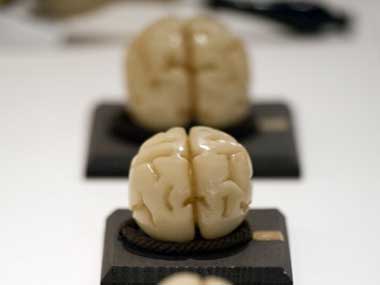
 "Scientists in Austria grow 'mini human brains' from stem cells")
By Kate Kelland/Reuters London: Scientists have grown the first mini human brains in a laboratory and say their success could lead to new levels of understanding about the way brains develop and what goes wrong in disorders like schizophrenia and autism. Researchers based in Austria started with human stem cells and created a culture in the lab that allowed them to grow into so-called “cerebral organoids” - or mini brains - that consisted of several distinct brain regions. It is the first time that scientists have managed to replicate the development of brain tissue in three dimensions. Using the organoids, the scientists were then able to produce a biological model of how a rare brain condition called microcephaly develops - suggesting the same technique could in future be used to model disorders like autism or schizophrenia that affect millions of people around the world. “This study offers the promise of a major new tool for understanding the causes of major developmental disorders of the brain … as well as testing possible treatments,” said Paul Matthews, a professor of clinical neuroscience at Imperial College London, who was not involved in the research but was impressed with its results. [caption id=“attachment_1070717” align=“alignleft” width=“380”] Representational Image. AFP[/caption] Zameel Cader, a consultant neurologist at Britain’s John Radcliffe Hospital in Oxford, described the work as “fascinating and exciting”. He said it extended the possibility of stem cell technologies for understanding brain development and disease mechanisms - and for discovering new drugs. Although it starts as relatively simple tissue, the human brain swiftly develops into the most complex known natural structure, and scientists are largely in the dark about how that happens. This makes it extremely difficult for researchers to gain an understanding of what might be going wrong in - and therefore how to treat - many common disorders of the brain such as depression, schizophrenia and autism. GROWING STEM CELLS To create their brain tissue, Juergen Knoblich and Madeline Lancaster at Austria’s Institute of Molecular Biotechnology and fellow researchers at Britain’s Edinburgh University Human Genetics Unit began with human stem cells and grew them with a special combination of nutrients designed to capitalise on the cells’ innate ability to organise into complex organ structures. They grew tissue called neuroectoderm - the layer of cells in the embryo from which all components of the brain and nervous system develop. Fragments of this tissue were then embedded in a scaffold and put into a spinning bioreactor - a system that circulates oxygen and nutrients to allow them to grow into cerebral organoids. After a month, the fragments had organised themselves into primitive structures that could be recognised as developing brain regions such as retina, choroid plexus and cerebral cortex, the researchers explained in a telephone briefing. At two months, the organoids reached a maximum size of around 4 millimetres (0.16 inches), they said in a report of their study published in the journal Nature. Although they were very small and still a long way from resembling anything like the detailed structure of a fully developed human brain, they did contain firing neurons and distinct types of neural tissue. “This is one of the cases where size doesn’t really matter,” Knoblich told reporters. “Our system is not optimised for generation of an entire brain and that was not at all our goal. Our major goal was to analyse the development of human brain (tissue) and generate a model system we can use to transfer knowledge from animal models to a human setting.” In an early sign of how such mini brains may be useful for studying disease in the future, Knoblich’s team were able to use their organoids to model the development of microcephaly, a rare neurological condition in which patients develop an abnormally small head, and identify what causes it. Both the research team and other experts acknowledged, however, that the work was a very long way from growing a fully-functioning human brain in a laboratory. “The human brain is the most complex thing in the known universe and has a frighteningly elaborate number of connections and interactions, both between its numerous subdivisions and the body in general,” said Dean Burnett, lecturer in psychiatry at Cardiff University. “Saying you can replicate the workings of the brain with some tissue in a dish in the lab is like inventing the first abacus and saying you can use it to run the latest version of Microsoft Windows - there is a connection there, but we’re a long way from that sort of application yet.” Reuters
Scientists have grown the first mini human brains in a laboratory and say their success could lead to new levels of understanding about the way brains develop and what goes wrong in disorders like schizophrenia and autism.
Advertisement
End of Article
Written by FP Archives
see more


 "Russian drones over Poland: Trump’s tepid reaction a wake-up call for Nato?")
 "As Russia pushes east, Ukraine faces mounting pressure to defend its heartland")
 "Why Mossad was not on board with Israel’s strike on Hamas in Qatar")
 "Turkey: Erdogan's police arrest opposition mayor Hasan Mutlu, dozens officials in corruption probe")
 "Russian drones over Poland: Trump’s tepid reaction a wake-up call for Nato?")
 "As Russia pushes east, Ukraine faces mounting pressure to defend its heartland")
 "Why Mossad was not on board with Israel’s strike on Hamas in Qatar")
 "Turkey: Erdogan's police arrest opposition mayor Hasan Mutlu, dozens officials in corruption probe")



