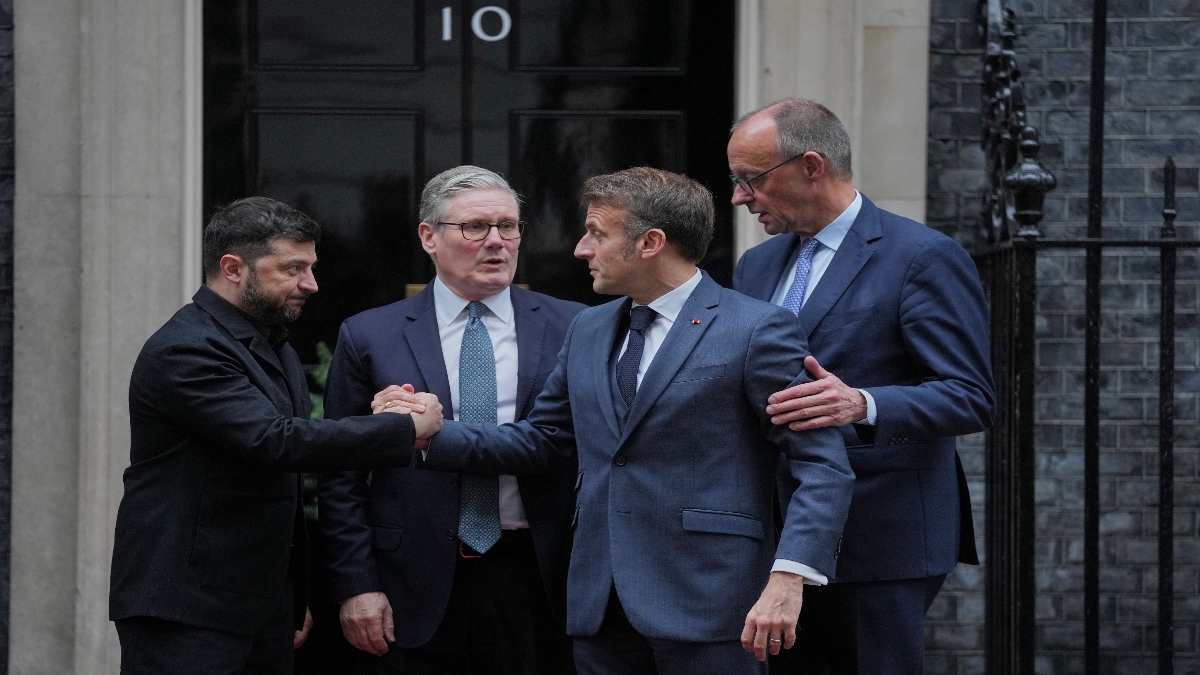
 "Ukrainian President Volodymyr Zelenskyy, left, with Britain's Prime Minister Keir Starmer, French President Emmanuel Macron, and German Chancellor Friedrich Merz pose on the doorstep of 10 Downing Street, London, on Monday, following a meeting of the leaders inside. AP")
Using Russia’s frozen assets to support Ukraine may not be as straightforward as UK Prime Minister Keir Starmer, French President Emmanuel Macron and German Chancellor Friedrich Merz would like.
British Prime Minister Keir Starmer, along with the leaders of France and Germany, discussed the “positive progress” made on plans to use frozen Russian sovereign assets to support Ukraine, Downing Street said on Monday.
A spokesperson for Starmer said the leaders agreed that this is a critical moment, stressing the need to step up support for Ukraine and increase economic pressure on Putin to help bring the war to an end. “While diplomatic efforts continue, Europe must stand with Ukraine … They also discussed positive progress made to use immobilised Russian sovereign assets to support Ukraine’s reconstruction.”
The plan under discussion
The three recently discussed a proposal to give Kyiv access to billions of pounds in frozen Russian assets ahead of the EU leaders’ meeting on 18–19 December, where the plan will be considered. The idea is to channel about £78bn of these assets into a “reparations loan” for Ukraine next year.
The proposal assumes that Moscow will eventually pay reparations to Kyiv. Ukraine would then use those funds to repay the loan to the EU, ensuring the financial institutions holding the frozen Russian assets are reimbursed.
Belgium stands in the way
The plan has met firm resistance from Belgium. Around £160bn of Russian assets are immobilised at Euroclear in Brussels, and the Belgian government fears it could face legal liability or Russian retaliation if the funds are seized. The UK is willing to hand over about £8bn in assets frozen in Britain but wants to do so only as part of a wider European move.
The bottom line is that the plan can proceed only if Belgium agrees to the arrangement and if Russia ultimately pays reparations — two conditions far from assured.
Brussels becomes the key battleground
Ukraine’s Volodymyr Zelensky met on Monday, December 8th with Germany’s Friedrich Merz, France’s Emmanuel Macron and Britain’s Sir Keir Starmer. The three leaders, often referred to as the e3, have become a central force in European decision-making.
But this week, the most decisive choices on Ukraine’s future are being made in Brussels — not as the seat of the EU’s institutions, but as the capital of Belgium.
What might change the mind of Belgium’s prime minister, Bart De Wever, remains unclear. His main concern is that Belgium could be held liable for the €185bn in frozen Russian assets held at Euroclear if Moscow seeks to reclaim them once sanctions are lifted.
Quick Reads
View AllThe EU argues its proposal avoids this problem: banks holding Russian assets would be required to offer an equivalent, interest-free loan to the EU, which would then lend the funds to Ukraine and take responsibility for repaying the banks. Under this structure, the risk would fall on the EU as a whole, not on Belgium alone.