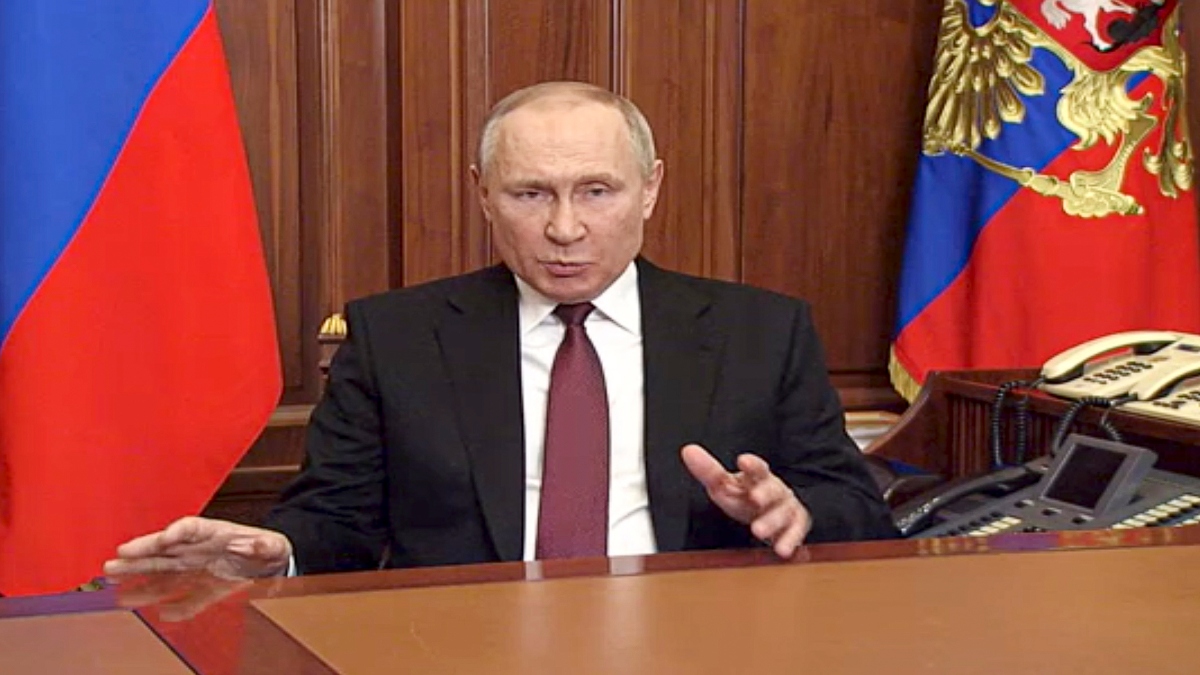
 "In this image made from video released by the Russian Presidential Press Service, Russian President Vladimir Putin addressees the nation in Moscow, Russia, on 24 February, 2022. AP File")
The United States has informed its allies that Russia may deploy either a nuclear weapon or a mock warhead into space as soon as this year, according to a report, citing sources familiar with the situation.
According to a Bloomberg report, citing these sources, Russia is actively working on a space-based capability designed to disable satellites using nuclear weaponry. Such actions would constitute a breach of the 1967 Outer Space Treaty, an agreement to which Russia is a signatory.
This revelation follows a recent warning from the chairman of the House Intelligence Committee regarding a serious, though unspecified, security risk emanating from Russia.
President Joe Biden subsequently acknowledged that the Kremlin is developing anti-satellite technology that, while not directly endangering human lives, poses significant concerns.
White House declined to provide comments on the matter, added the report.
“We have always been categorically against and are now against the deployment of nuclear weapons in space,” Bloomberg report quoted Russian President Vladimir Putin as saying on Tuesday at a televised meeting with Defence Minister Sergei Shoigu.
“We are doing in space only what other countries have, including the United States,” he added.
The alleged ambition of the Kremlin highlights a growing competition among the United States, Russia, and China in developing attack capabilities in space, Bloomberg quoted security experts and officials in Washington as saying. This new space race contrasts with the Cold War era, during which the superpowers negotiated arms control agreements to prevent the militarisation of space.
Impact Shorts
More ShortsWhile there’s an assessment that Russia currently has no intention of detonating orbital weapons, there remains a risk of accidents. A potential nuclear explosion could impact a significant portion of satellites and disrupt communication systems on earth, added the report, citing sources familiar with the matter.
The extent of damage would vary depending on the size of the warhead; it might not necessarily destroy satellites but could cause disruptions requiring corrective measures.
As of last April, there were approximately 7,800 operational satellites orbiting the earth, as reported by the United Nations Office for Outer Space Affairs.
In response to Russia’s nuclear saber-rattling following its invasion of Ukraine two years ago, Putin suspended Russia’s adherence to the New START treaty in 2023, the last agreement limiting nuclear arsenals between the US and Russia.
Efforts are underway by the US and its allies to dissuade Russia from deploying such capabilities, particularly through engagement with China and India, which are perceived to have more influence in Moscow. The New York Times previously covered some of these outreach endeavors.
Politico reported on Thursday that senior intelligence and administration officials had attempted to reach out to Moscow to convince it to stop the project for weeks before it became public.
According to the report, another factor that would determine potential fallout is the altitude at which any explosion occurred. Most commercial satellites are in low-earth orbit, less than 2,000 kilometers (1,200 miles) from the surface.
Experts previously told Bloomberg that the damage from a nuclear weapon exploding in low-earth orbit could fry satellites for hundreds of miles and that the resulting radiation could cause cumulative harm to satellites passing through the affected region for months. The electronics on spacecraft would also risk failure as a result of the blast.
The issue could be discussed by Group of Seven foreign ministers when they meet in Italy in April, added the report, citing people familiar with the matter.
With inputs from agencies