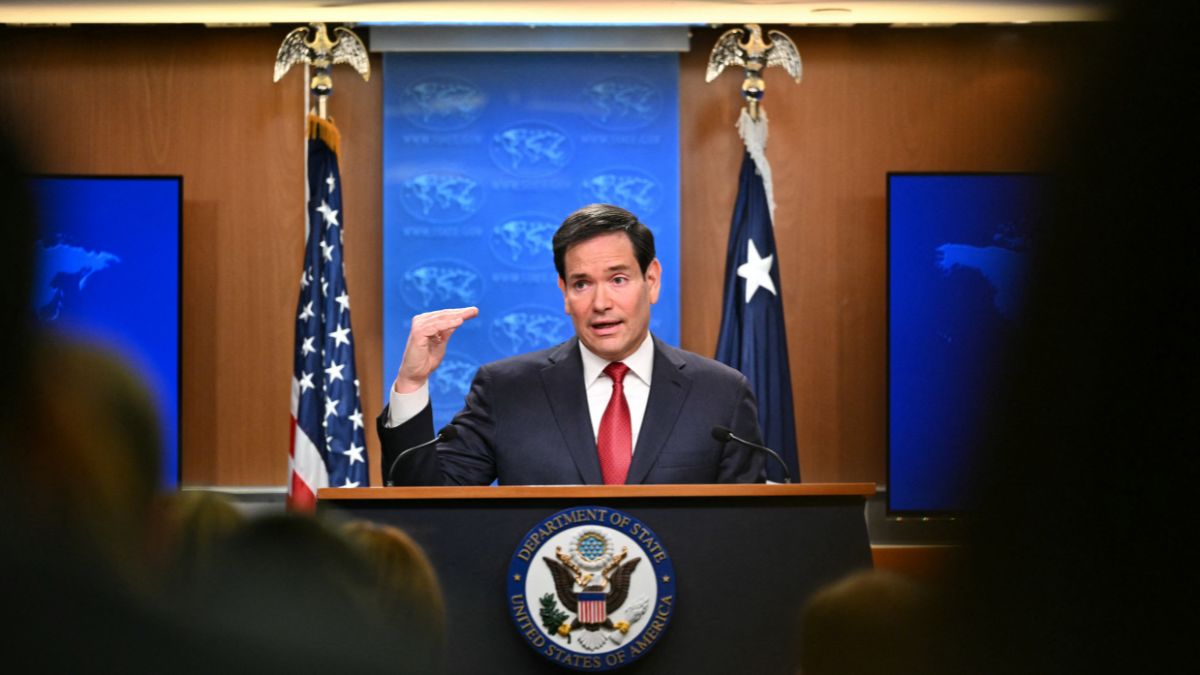
 "File- US Secretary of State Marco Rubio- AFP")
US Secretary of State Marco Rubio has warned lawmakers that the potential fall of Iran’s ruling regime would trigger a succession crisis, admitting that “no one knows” who would fill the resulting power vacuum.
Testifying before the Senate Foreign Relations Committee, Rubio argued that the opaque and deeply entrenched nature of the Iranian government makes any post-Khamenei transition highly unpredictable.
‘No one knows’
He detailed a power structure fractured between the Supreme Leader, the Islamic Revolutionary Guard Corps (IRGC), and various “quasi-elected individuals” who ultimately lack the authority to make major moves without clerical approval.
“That’s an open question," Rubio told the committee. “No one knows what would take over."
The Secretary of State contrasted the situation with other regional shifts, noting that the long-standing nature of the current order in Tehran would necessitate “careful thinking” by American policymakers.
He expressed a cautious hope that the US might eventually find a moderate element within the existing system to facilitate a stable transition, though he admitted such a path is far from guaranteed.
“I don’t think anyone can give you a simple answer to what happens next in Iran if the supreme leader and the regime were to fall, other than the hope that there would be some ability to have somebody within their systems that you could work towards a similar transition,” he stated.
Rubio backs Trump’s military buildup
Amid these uncertainties, Rubio defended the Trump administration’s aggressive military buildup in West Asia, specifically highlighting the recent arrival of the USS Abraham Lincoln carrier strike group.
Quick Reads
View AllHe framed the deployment of thousands of additional personnel and advanced hardware as a “wise and prudent” defensive measure designed to protect the 30,000 US service members currently stationed within reach of Iranian ballistic missiles. Rubio emphasised that while Washington hopes to avoid conflict, the administration maintains the right to act first if American lives are at risk.
“And so I think it’s wise and prudent to have a force posture within the region that could respond and potentially, not necessarily what’s going to happen, but if necessary, preemptively prevent the attack against thousands of American servicemen and other facilities in the region and our allies,” Rubio testified.
Despite characterising the Iranian regime as being “weaker than it has ever been” due to internal unrest and economic decay, Rubio cautioned that Tehran remains a formidable military threat. He noted that the country has continued to amass an arsenal of “thousands and thousands” of long-range missiles despite its financial collapse, leaving the region in a state of high tension as the US waits to see if the current order will hold or fracture.