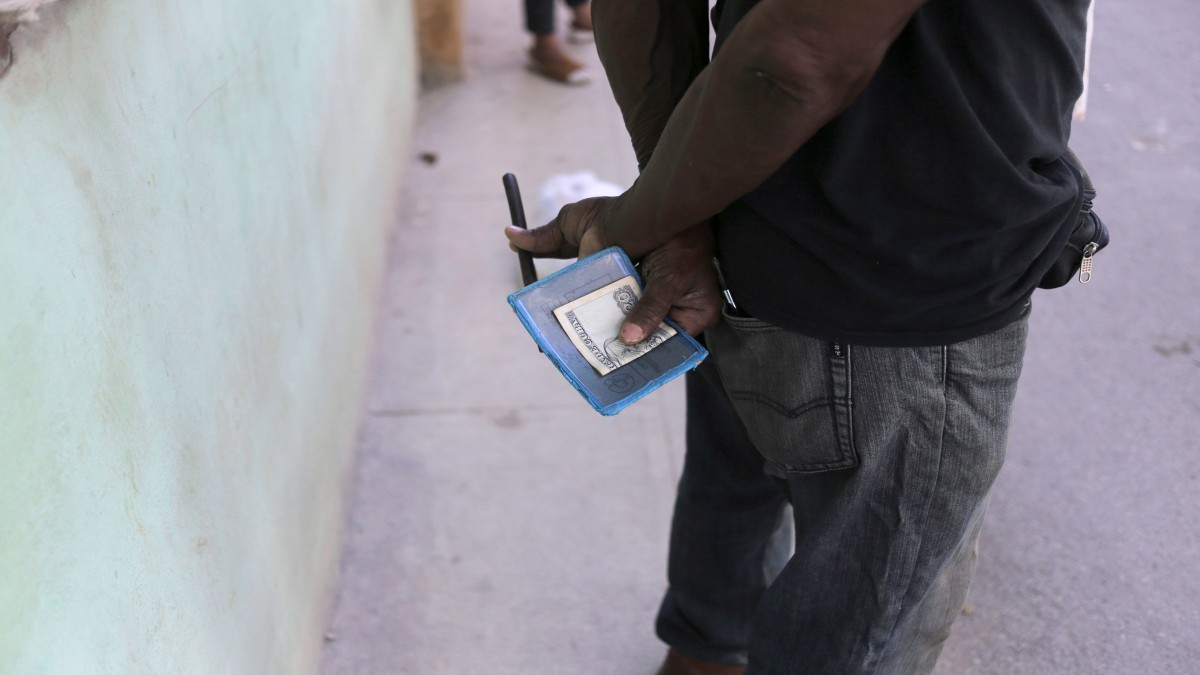
 "A man holds his ration book known as a “libreta,” at a government-run store in Havana, Cuba. AP")
Like millions of other Cubans, María de las Ángeles Pozo remembers with nostalgia the days when her family’s government ration book provided them with everything from chocolate and beer to hamburgers, fish, and milk. Cakes would even be given to people for weddings and birthdays.
Launched in July 1963, the “libreta,” as it is known to the people of Cuba, stood as one of the cornerstones of the island’s socialist system, guiding people through difficult times, such as the reduction in Soviet aid that resulted in the deprivation of the 1990s known as the “Special Period.”
A severe economic crisis in that system has caused about 500,000 Cubans to flee to the United States in the past two years, with many more making their way to Europe. For those that choose to stay, it has also resulted in a sharp decline in the amount of rationed food that is available.
Many Cubans feel unprepared to manage their new, more unequal nation; this feeling has gotten worse as little private markets have opened, charging prices comparable to those of other countries in a nation where non-state commerce has been outlawed for decades and where monthly incomes still hover around $16 to $23.
“Everything comes in small portions and delayed,” said Pozo, 57, a school worker who retired to care for her disabled sister and father in the apartment they share in Old Havana. They earn $10 a month between the three.
Impact Shorts
More ShortsBasic goods like a kilo (2.2 pounds) of powdered milk can cost as much as $8.
“We don’t have the goods that we were used to anymore,” Pozo said. “We’re suffering a lot of deprivation.”
Protesters took to the streets in the eastern city of Santiago this month decrying power outages lasting up to eight hours and shortages of food. State media confirmed the protests in Santiago and videos showing people chanting “electricity and food” were quickly shared by Cubans on and off the island on platforms like X and Facebook. A nongovernmental human rights group that monitors Cuba said there had been at least three arrests.
Pozo pays only $2 at the subsidized state stores at current exchange rates. In February she got a few pounds of rice, beans, some sugar and salt, oil, processed meat and soap for her family of three.
Pozo said that she doesn’t receive money from relatives overseas, a major marker of class differences in 2024 Cuba, and one that about 70 percent of families do get.
While there are no official figures, many experts estimate that Cubans overseas sent $3 billion home in 2019.
Cuba has long struggled with a lack of production.
The lack of hard currency and needed equipment is making the situation even worse without agricultural supplies like insecticides and fertilizers, said Ricardo Torres, an economist at American University in Washington.
Without a functioning market economy, Cuban agriculture has long measured itself by socialist production goals that it has rarely been able to meet.
Camaguey, one of Cuba’s main ranching hubs, only produced 42.8 million liters (11.3 million gallons) of milk last year, out of 81.3 million liters (21.5 million gallons) that producers had agreed to sell.
Producers, for their part, complain that government prices don’t cover expenses.
The Cuban government blames the economic damage wrought by COVID-19, along with U.S. sanctions and macroeconomic changes dating to recent years that have led to severe inflation.
“You can see today private stores that have all the products that you want: milk, bread, sugar — whatever you want — at prices that are not accessible to the majority of the population,” Deputy Foreign Minister Carlos Fernández de Cossío said in a interview with The Associated Press. “The government continues to be committed to provide an equal amount to all.”
Official figures show Cuba’s average annual inflation of nearly 50% a year over the last three years and a 2% contraction in the Gross Domestic Product.
Faced with that scenario, the government has been trying to reduce the number of people who receive subsidized food from an estimated four million libretas.
For most Cubans, the government is failing to take on the most serious issue: low take-home pay as a result of low productivity and inflation.
“Salaries must rise,” said maintenance main Hilmer Pagán, 53.