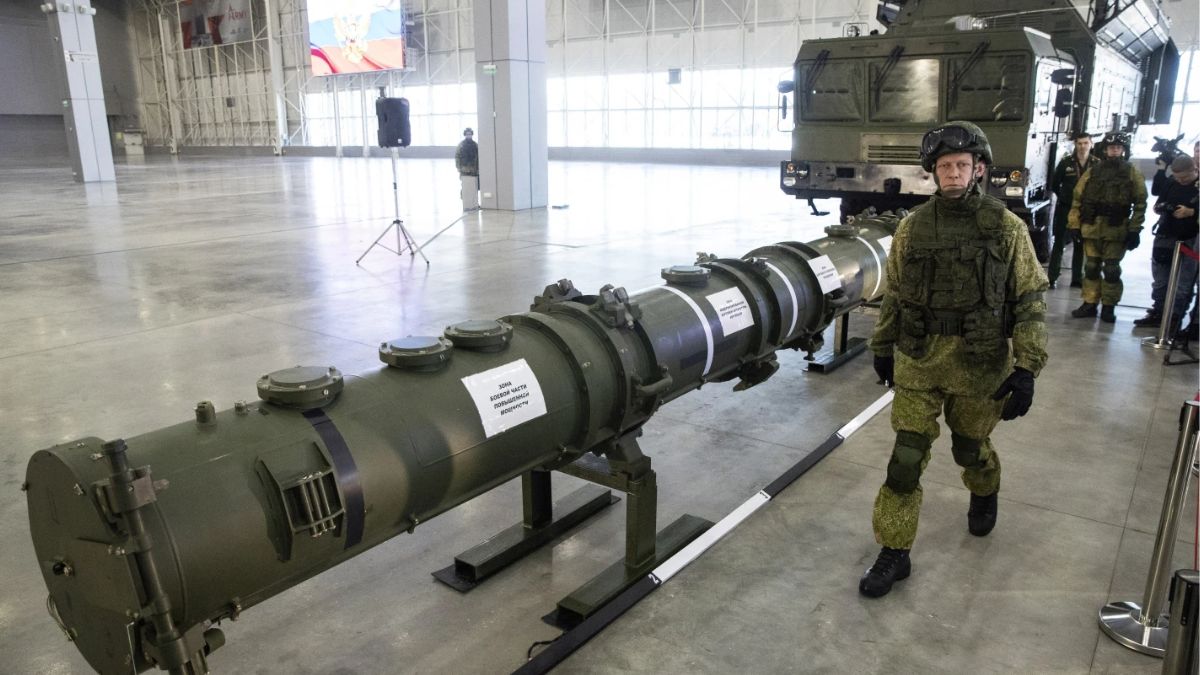
 "A Russian military officer walks past the 9M729 land-based cruise missile on display in Kubinka outside Moscow, Russia, on Jan. 23, 2019. File Photo- AP")
Russia is likely to restart the production of short and intermediate-range missiles, Russian President Vladimir Putin said, adding that the move is a direct response to the deployment of nuclear-capable missiles by the United States in various parts of the world.
The United States formally withdrew from the landmark 1987 Intermediate-range Nuclear Forces (INF) Treaty with Russia in 2019 after saying that Moscow was violating the accord, an accusation the Kremlin denied.
Russia then imposed a moratorium on its own development of missiles previously banned by the INF treaty. ”It is known that the United States not only produces these missile systems, but has already brought them to Europe for exercises in Denmark,” Putin told a meeting of Russia’s Security Council.
”It was recently announced that they are in the Philippines. It is not known whether they took the missiles out of there or not.”
Putin said that Russia was thus forced to respond.
”Apparently, we need to start manufacturing these strike systems and then, based on the actual situation, make decisions about where – if necessary to ensure our safety – to place them,” Putin said.
The last remaining arms-control pact between Washington and Moscow is the New Strategic Arms Reduction Treaty, which limits each country to no more than 1,550 deployed nuclear warheads and 700 deployed missiles and bombers. It’s set to expire in 2026, and the lack of dialogue on anchoring a successor deal has worried arms control advocates.
Impact Shorts
More ShortsWith inputs from agencies.