“The restrictions have certainly not been imposed by the federal government or any regulatory body. Still, media houses are compelled to follow a diktat,”
Dawn wrote two months ago
. “Opinion pieces violating ‘guidelines’ have reportedly been withdrawn by the management of some leading newspapers for fear of being penalised. Indeed, TV channels are much more vulnerable to the threat. And that fear is not unfounded.” The situation has only worsened in Pakistan as the elections come closer. Ahead of the 25 July General Elections in Pakistan, a campaign has emerged to “muzzle independent journalists” who are critical of the military or the judiciary. As described by the Vienna-based
International Press Institute
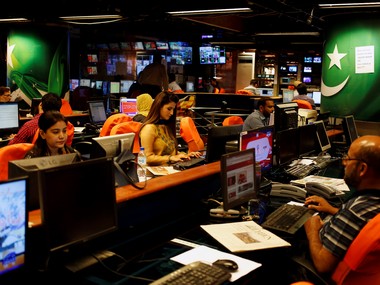
, the situation in Pakistan is “unprecedented” with journalists being intimidated, abducted and threatened and media houses being forced into self-censorship. [caption id=“attachment_4534771” align=“alignleft” width=“380”] The office of television channel Geo News in Karachi. Reuters.[/caption] The polls on 25 July will be the first time Pakistan will hold three consecutive elections without a coup. However, even with a democratically elected government in power, the military is still believed to hold considerable power not-so-covertly. Now, the armed forces have tagged a number of journalists, bloggers and activists as anti-state and anti-military, allegations that could have serious consequences in a country where the military has always directly or indirectly ruled. Journalists and advocacy groups have said that the forces are running a campaign to intimidate media houses to clamp down on criticism or dissent. Over the past few months, journalists and activists have been abducted and allegedly tortured by spy agency Inter-Services Intelligence for writing against the security establishment. Some said they were threatened with blasphemy charges, which can earn them the death penalty in Pakistan. English newspaper Dawn had said authorities had
disrupted its distribution
after it published an
interview with former prime minister
Nawaz Sharif, in which he was critical of the military and also hinted at Pakistan’s role in the 2008 Mumbai attacks. The daily’s top executive had said Dawn was targeted “because it has taken a posture that is pro-democracy”. Quoting human-rights groups, politicians and media personnel,
The Wall Street Journal wrote
that the security establishment “stifling the media” ahead of the General Elections was part of a “larger power grab that seeks to ensure that a pliant government emerges from the polls”. But as can be expected, the spokesperson for the Pakistan military, Major General Asif Ghafoor, has
denied all allegations
of intimidation and press censorship and said the armed forces were a “strong supporter of democracy”. It must be noted that at a press conference on 4 June, Ghafoor had warned the media against reporting against the establishment. In a presentation, he had showcased the social media accounts of several journalists and dubbed them anti-state and anti-military.
The office of television channel Geo News in Karachi. Reuters.[/caption] The polls on 25 July will be the first time Pakistan will hold three consecutive elections without a coup. However, even with a democratically elected government in power, the military is still believed to hold considerable power not-so-covertly. Now, the armed forces have tagged a number of journalists, bloggers and activists as anti-state and anti-military, allegations that could have serious consequences in a country where the military has always directly or indirectly ruled. Journalists and advocacy groups have said that the forces are running a campaign to intimidate media houses to clamp down on criticism or dissent. Over the past few months, journalists and activists have been abducted and allegedly tortured by spy agency Inter-Services Intelligence for writing against the security establishment. Some said they were threatened with blasphemy charges, which can earn them the death penalty in Pakistan. English newspaper Dawn had said authorities had
disrupted its distribution
after it published an
interview with former prime minister
Nawaz Sharif, in which he was critical of the military and also hinted at Pakistan’s role in the 2008 Mumbai attacks. The daily’s top executive had said Dawn was targeted “because it has taken a posture that is pro-democracy”. Quoting human-rights groups, politicians and media personnel,
The Wall Street Journal wrote
that the security establishment “stifling the media” ahead of the General Elections was part of a “larger power grab that seeks to ensure that a pliant government emerges from the polls”. But as can be expected, the spokesperson for the Pakistan military, Major General Asif Ghafoor, has
denied all allegations
of intimidation and press censorship and said the armed forces were a “strong supporter of democracy”. It must be noted that at a press conference on 4 June, Ghafoor had warned the media against reporting against the establishment. In a presentation, he had showcased the social media accounts of several journalists and dubbed them anti-state and anti-military.
Pakistani media gripped by fear of military ahead of General Elections as criticism of establishment could risk abduction, torture
FP Staff
• June 29, 2018, 07:32:00 IST
The Pakistan military has tagged a number of journalists, bloggers and activists as anti-state and anti-military, curbing dissent ahead of the elections.
Advertisement
 "Pakistani media gripped by fear of military ahead of General Elections as criticism of establishment could risk abduction, torture")
Hameed Haroon, CEO of the media group that owns Dawn and president of the All Pakistan Newspapers Society, said the military seeks to “influence the election results, influence the national narrative and liquidate the press”. A recently retired senator, Farhatullah Babar, said Pakistan has seen a “systematic, creeping coup” and “the media has been tamed” even without a single television station being taken over. Former senate chairman Mian Raza Rabbani, too, said on Wednesday that “in the run up to the elections, attempts were being made to
intimidate the print and electronic media
by way of physical intimidation, abduction and torture of dissenting journalists and blocking of news channels”. There is speculation that the military is trying to ensure the loss of Sharif’s Pakistan Muslim League (Nawaz) by working with his biggest rival at the moment, cricketer-turned-politician Imran Khan and his Pakistan Tehreek-e-Insaf. The armed forces and Khan, whose lawsuit against Sharif finally led to his ouster as prime minister, have both denied working with the other. Whatever be the reason, press freedom is under attack in Pakistan. There’s an atmosphere of self-censorship as journalists now fear for their lives. As Aliya Iftikhar, the Asia associate for the Committee to Protect Journalists, rightly says: “Pakistan has long been a dangerous environment for journalists to work in, but this appears to be a
particularly trying time for the press
, as the country prepares for elections. If there is a climate of fear and the media isn’t able to do its job properly, Pakistan cannot ensure that its elections will be free and fair.”
End of Article