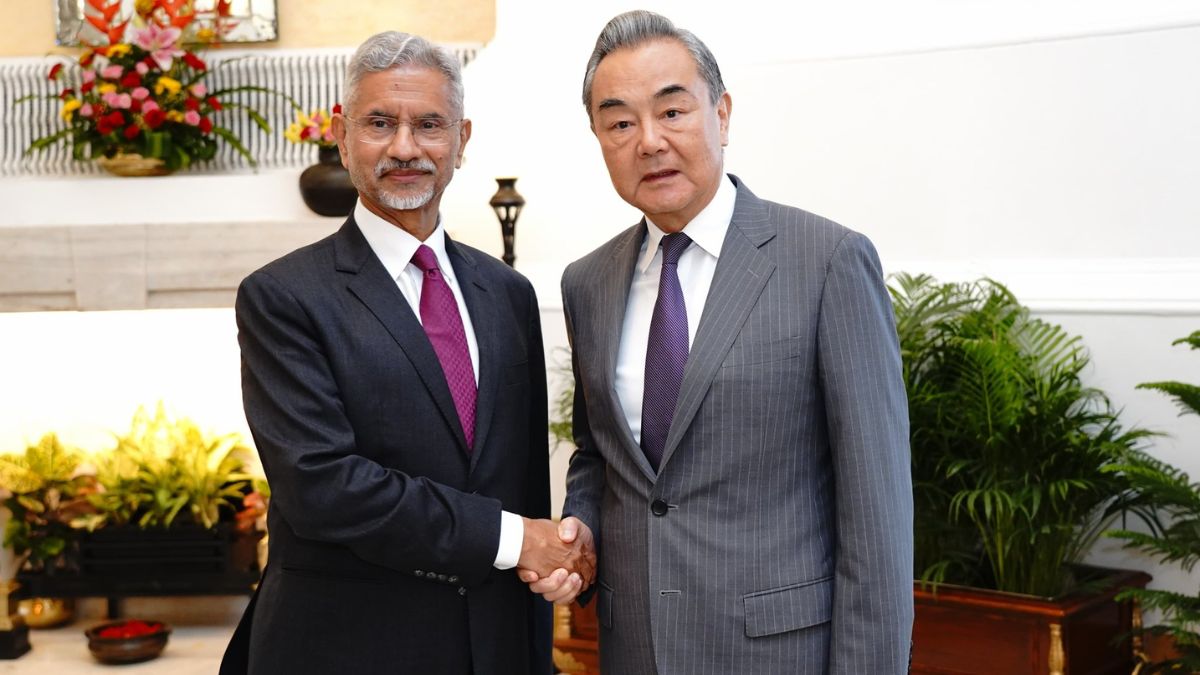
 "External Affairs Minister S Jaishankar shakes hands with Chinese foreign minister Wang Yi on Tuesday, August 19, 2025, in New Delhi. (Photo: X/S Jaishankar)")
Sources in the government on Monday stressed that India’s position on Taiwan has not changed.
The development came after Chinese state media misrepresented External Affairs Minister S Jaishankar’s remarks in the meeting with visiting Chinese foreign minister Wang Yi. A report in state-run Xinhua news agency said that “he [Jaishankar] reaffirmed that Taiwan is a part of China”.
Instead, India made it clear in the meeting that the relations with Taiwan will continue, sources told Firstpost.
“There is no change in our position on Taiwan. We stressed that like the rest of the world, India has a relationship with Taiwan that focuses on economic, technology, and cultural ties. We intend to continue it,” sources said.
China has claimed the self-ruled island of Taiwan to be a breakaway province and is committed to its reunification with the mainland — even with the use of force. The China-Taiwan conflict is rooted in the Chinese Civil War (1945-19) between the Communist Party of China (CPC) and the Kuomintang (KMT, the nationalist party). While the victorious CPC established the People’s Republic of China (PRS) on the mainland, the KMT set up the Republic of China (RoC) in Taiwan.
India on One China Policy
Formally, India and the majority of the world —182 of the 193 United Nations (UN) members— follow the One China Policy that recognise the PRC as the ‘real’ China and do not recognise Taiwan’s nationhood. They, however, engage with Taiwan economically and culturally.
Sources said that India has not referred to the ‘One China’ policy since 2010.
Countries that do not recognise China engage via de facto embassies like the Taipei Economic and Cultural Office” (TECO) or “Taipei Representative Office” in Taiwan or in their own country.
Impact Shorts
More ShortsFormer EAM Sushma Swaraj once said that ‘One China Policy’ had to be reciprocity by a ‘One India Policy’. However, China has never demarcated the border with India or accepted India’s territorial integrity. Instead, China has claimed territories in the Indian Himalayas as its own, such as Ladakh and Arunachal Pradesh.
“For India to agree to a one-China policy, China should reaffirm a one-India policy. When they raised with us the issue of Tibet and Taiwan, we shared their sensitivities. So, we want they should understand and appreciate our sensitivities regarding Arunachal Pradesh,” Swaraj said in 2014.