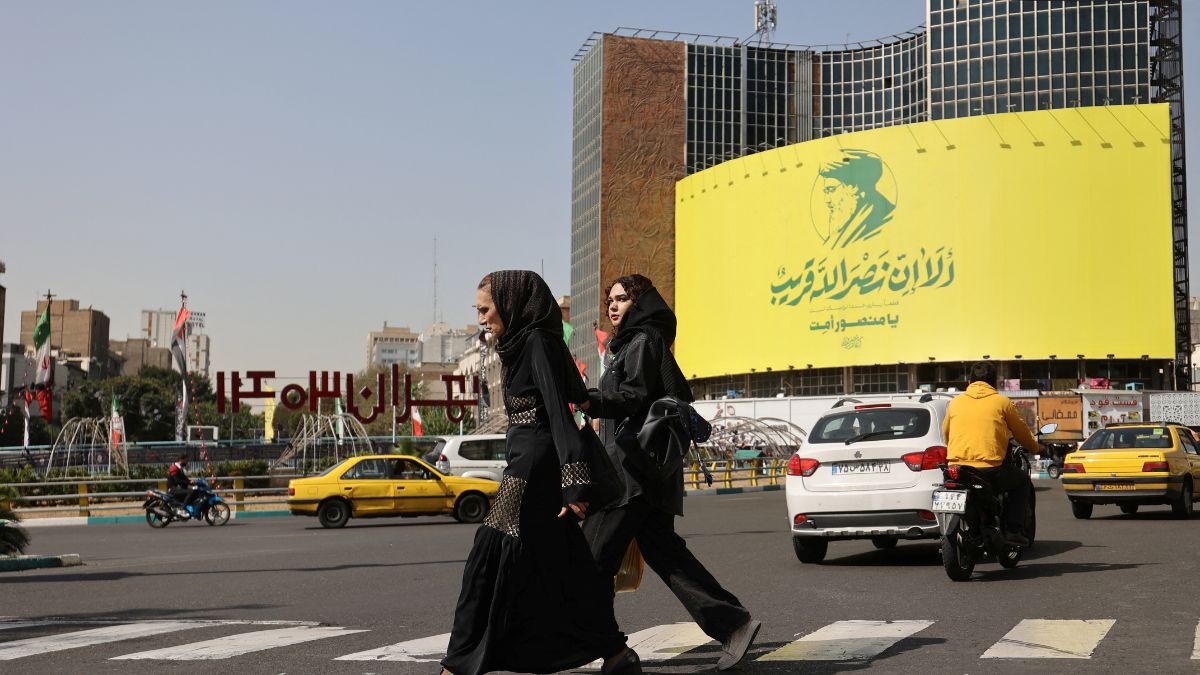
 "People walk past a billboard with a picture of the late Lebanon's Hezbollah leader Hassan Nasrallah, in a street in Tehran, Iran October 2, 2024. Reuters")
Iran launched a slew of missile attacks against Israel earlier this week and possibly drew the battle lines. Now, it’s awaiting a possible and bigger retaliation by Tel Aviv. Israeli leaders have already threatened Tehran with a “wait and watch” kind of message while the US thinks the country might hit Iran’s nuclear facility, and if done so the West Asian conflict is only expected to aggravate.
However, Iranians are not ready for a war with Israel. People have taken to social media and given interviews expressing their anxiety over an imminent war with Israel.
Talking to the New York Times, Iranians have shared how a war with Israel or the US is the last thing they need with all the hardships they are already facing due to a bad economy, sanctions and corruption.
In a telephone interview, Mahdieh, 41, an engineer from Tehran, said, “Nobody I know has prepared for a possible war. We are jarred. Let us have our normal life. We are not willing or want to enter a war era.” She said that she and her husband had packed an emergency bag in case they deemed it dangerous to live in Tehran.
On Friday, Iran’s Supreme Leader Ayatollah Khamenei defended the country’s ballistic missile attack, saying their action was “totally legal and legitimate”, adding that the assault was the “minimum punishment” that came Israel’s way for their crimes. His message gave an impetus to Israel to steadfast its potential plans to strike back.
Quick Reads
View AllHamidreza Jalaeipour, a well-known sociologist affiliated with the reformist faction, stated in a discussion on Clubhouse that “we needed to confront Israel directly; otherwise, it would continue to advance. If a war breaks out, it will be thrust upon us.”
At the same time, many Iranians also voiced their anger at the government’s move to strike Israel in the first place, an action which they think put Iranian lives in danger.
Mahan, a 50-year-old doctor in the northern city of Rasht said, “Most of us are not happy about the interference of the Islamic Republic in the region and its so-called proxies. People do not want their national resources to be spent abroad.”