

 "Labour Day 2020: Why we celebrate International Workers' Day on 1 May, its history and significance")
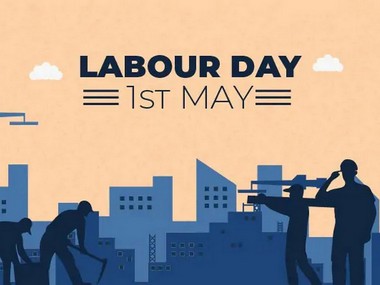
To honour the struggles and gains made by workers and labourers, the first day of May is observed as International Labour Day. The day is also called May Day or International Workers’ Day. [caption id=“attachment_8319711” align=“alignleft” width=“380”]
 Representational image. Firstpost[/caption] History On 1 May, 1886, labour unions in the US decided to go on a strike demanding that workers should not be made to work for more than 8 hours a day. Just three days after the strike began, a blast occurred in Chicago’s Haymarket Square leaving many dead. To honor those who died in the blast, the International Socialist Conference declared 1 May as a day designated for labourers. The commemorative day was
established at a meeting in 1889 and gradually spread to other parts of the world. Labour Day in India In India, the first Labour Day was observed on 1 May, 1923, in present day Chennai. The day was celebrated by Labour Kisan Party of Hindustan. The red flag, which symbolises Labour Day, was used for the first time in India. Prominent communist leader Malayapuram Singaravelu Chettiar raised the flag and arranged meetings to celebrate the occasion. Chettiar passed a resolution stating that the government should announce a national holiday on Labour Day in India and since then the
country has continued to celebrate May Day. According to
an article in Al Jazeera, International Workers’s Day has always been marked by celebrations, protests and strikes across the world. Some of the most well-known events of the day include the US civil disobedience acts against the Vietnam War in 1971.
To honour the struggles and gains made by workers and labourers, the first day of May is observed as International Labour Day.
Advertisement
End of Article


 "Charlie Kirk, shot dead in Utah, once said gun deaths are 'worth it' to save Second Amendment")
 "From governance to tourism, how Gen-Z protests have damaged Nepal")
 "Did Russia deliberately send drones into Poland’s airspace?")
 "Netanyahu ‘killed any hope’ for Israeli hostages: Qatar PM after Doha strike")
 "Charlie Kirk, shot dead in Utah, once said gun deaths are 'worth it' to save Second Amendment")
 "From governance to tourism, how Gen-Z protests have damaged Nepal")
 "Did Russia deliberately send drones into Poland’s airspace?")
 "Netanyahu ‘killed any hope’ for Israeli hostages: Qatar PM after Doha strike")



](https://images.firstpost.com/wp-content/uploads/2020/05/380.jpg)