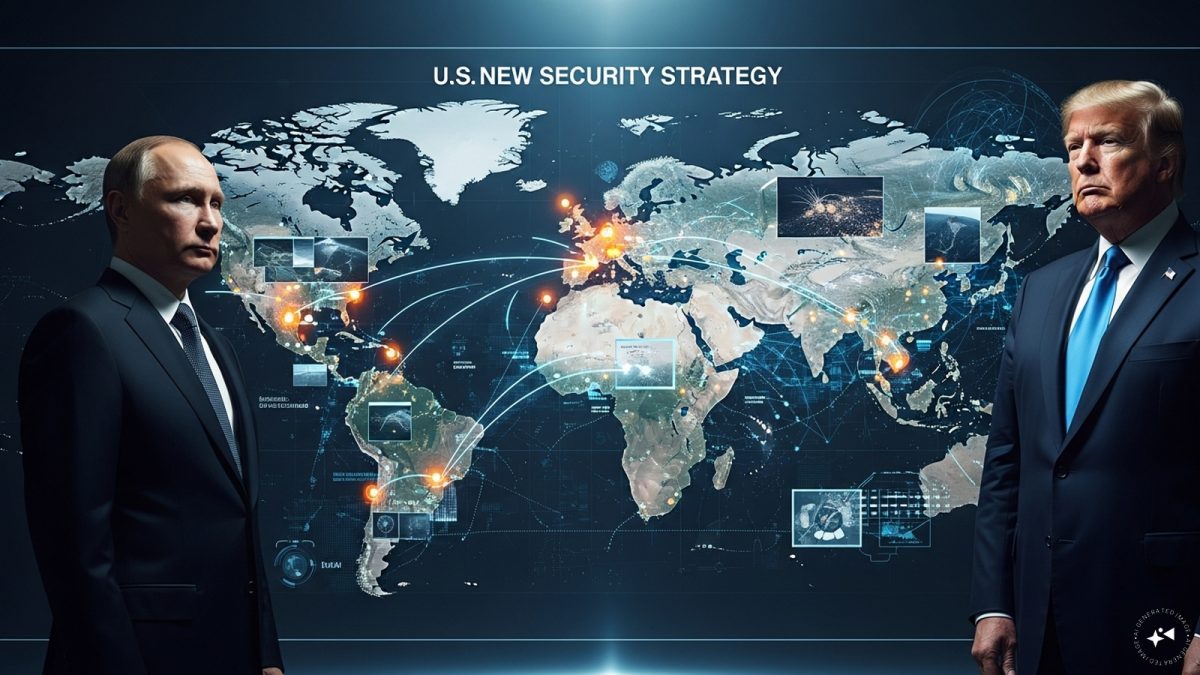
 "Kremlin endorses Trump’s new security strategy, says it mirrors Russia’s worldview")
The Kremlin on Sunday reacted positively to President Donald Trump’s decision to no longer classify Russia as a direct threat, saying the U.S. leader’s newly released national security strategy closely mirrors Moscow’s own worldview—particularly its assessment that Europe’s influence is waning.
The strategy document, signed by Trump and framed around the idea of “flexible realism,” calls for reviving the 19th-century Monroe Doctrine that defined the Western Hemisphere as an American sphere of influence. It also warns that Europe is at risk of “civilizational erasure,” asserts that ending the war in Ukraine is a central U.S. priority, and says Washington aims to rebuild strategic stability with Moscow.
Kremlin spokesperson Dmitry Peskov told state TV journalist Pavel Zarubin that many of the shifts outlined “align with our understanding.”
He welcomed the section pledging to end “the perception, and preventing the reality, of NATO as a perpetually expanding alliance,” calling it a positive sign.
But Peskov also urged caution, arguing that what he termed the American “deep state” holds a fundamentally different outlook from Trump. The former president has long used the phrase to accuse entrenched U.S. officials of seeking to undermine leaders who challenge the status quo, including himself.
Trump’s critics reject that characterisation, saying the “deep state” claim is a baseless conspiracy theory aimed at justifying efforts to consolidate presidential authority.
Since Russia’s 2014 annexation of Crimea and its 2022 invasion of Ukraine, U.S. strategies have designated Moscow as an aggressor or a threat that was trying to destabilise the post-Cold War order by force.
Quick Reads
View AllIn comments to the state-run TASS news agency, Peskov said calling for cooperation with Moscow on strategic stability issues rather than describing Russia as a direct threat was a positive step.
Trump has often made positive and admiring comments about Russian President Vladimir Putin, prompting critics to accuse him of being soft on Moscow even though both his administrations slapped sanctions on Russia.
Senior officials from major European powers have repeatedly expressed worry that the U.S. under Trump could be turning its back on Europe, which depends on Washington for military support.
With inputs from agencies