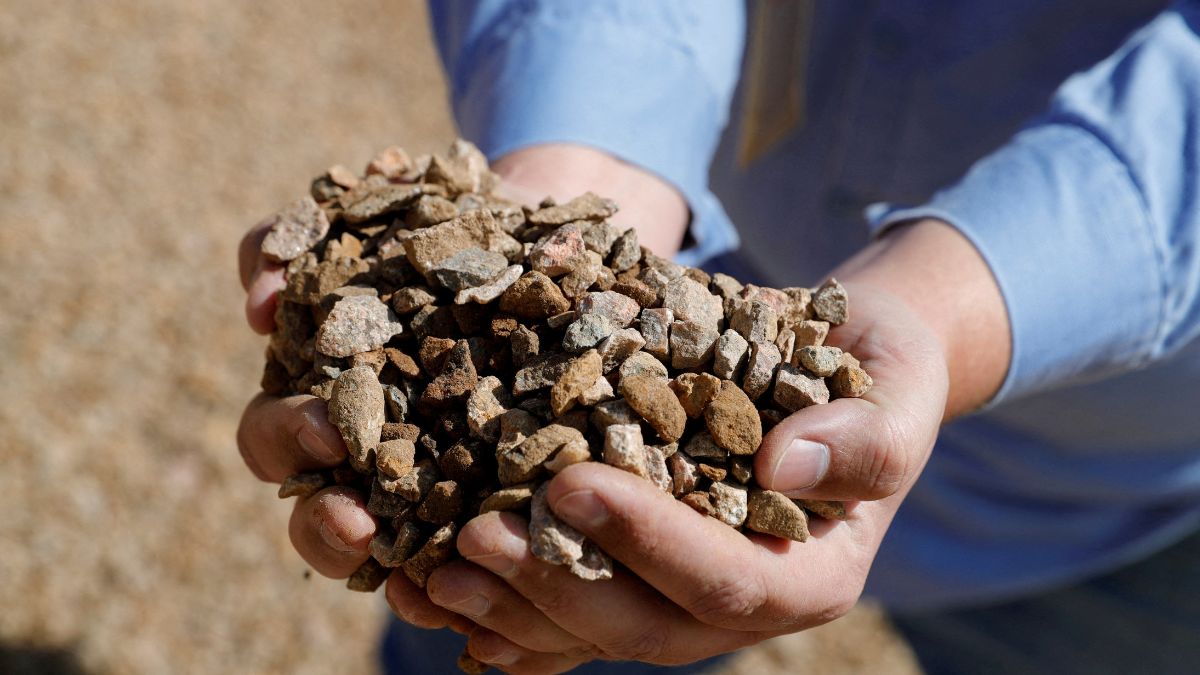
 "Matt Green, mining/crushing supervisor at MP Materials, displays crushed ore before it is sent to the mill at the MP Materials rare earth mine in Mountain Pass, California, US, on January 30, 2020. (Representative Photo, Credit: Steve Marcus/Reuters)")
In a bid to further reduce the dependence on China and ramp up domestic production, Japan has outlined a plan to tap into the deep-sea mud by 2027 to extract and refine rare earth elements, according to Nikkei Asia newspaper.
As per the plan, Japan has planned to look for rare earths in the seabed 6,000 metres below the surface by extracting sea-mud and processing it on the mainland.
Japan is particularly looking for rare earths like dysprosium that are used in the automobile industry. Japan has one of the world’s largest automobile industries with brands like Toyota, Honda, Suzuki, and Nissan a household names in many parts of the world.
After China halted rare earths’ supplies in 2010 over the Senkaku islands’ dispute, Japan began diversifying its rare earths’ supplies. Over the years, it has managed to cut its dependence on China by up to a third.
Globally, China controls around 70 per cent of rare earths’ supplies and 90 per cent refining capabilities. After the 2010 episode, Japan acquired a stake in Australian mining company Lynas and secured long-term supply of rare earths with no exposure to China.
Under the arrangement, Lynas mines for rare earths in Australia and processes the ores at a facility in Malaysia. Until this year, the Malaysia facility was the only large-scale rare-earth separation plant functional outside China, according to The New York Times.
How Japan plans to tap into rare earths on seabed
Japan will build a facility on Minamitorishima, part of the remote Ogasawara Islands, through its Strategic Innovation Promotion Program (SIP), to extract sea-mud, separate the mud from the sea-bed, and then taking it to the mainland for the final refining, according to Nikkei Asia.
The work will start as early as January and February 2026 when the Japan Agency for Marine-Earth Science and Technology will conduct test mining using a deep-sea research ship to recover a small amount of mud with pipes, as per the report.
Quick Reads
View AllThe full-scale demonstration is planned for February 2027.
As per the plan, sea-mud will be taken to a facility on Minamitorishima where seawater —around 80 per cent of the volume— will be separated and the remaining mud will be sent via ship to mainland Japan for refining and production of rare earth metals.
“We will ultimately demonstrate the entire process of extracting rare-earth elements from mud and then assess its economic viability,” Shoichi Ishii, programme director at SIP, told the newspaper.
Japan has allocated 16.4 billion yen ($105 million) for the plan, as per the newspaper.