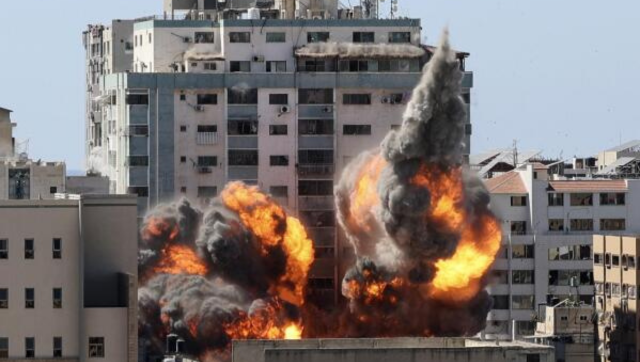
Israel’s military expanded its air and ground attacks on the Palestinian enclave of Gaza on Saturday, raising the possibility that the long-promised ground offensive has started. In response, Hamas vowed to repel Israeli attacks with “full force”. Without providing further details, Israel stated on Saturday morning that its troops, deployed on Friday night, remained in the field. Earlier, during three weeks of bombardment to drive out Hamas fighters, who it said had killed 1,400 Israelis on October 7, the nation had only undertaken fleeting strikes into Gaza. “The forces are still in the field and continuing the war,” Rear Admiral Daniel Hagari told a news briefing on Saturday morning. By Saturday morning, the internet and phone services in Gaza had been shut off for over 12 hours, resulting in an almost total blackout. Israeli bombardment, according to telecom companies and the Palestinian Red Crescent Society, is to blame. The Israel Defence Forces (IDF) have said that they will be intensifying its operations in the Gaza Strip, both air and ground. Rear Adm Daniel Hagari, an IDF spokesman, stated that aerial strikes had been directed on Hamas tunnels and other targets. He cautioned Gaza City’s inhabitants to relocate southward, as there will be “better conditions.” The armed branch of Hamas claimed that it was battling Israeli troops in Burej in the middle of the enclave and Beit Hanoun in northern Gaza, both of which served as IDF entry sites in earlier battles. On the ground, there are “violent engagements,” according to the Al Qassam Brigade. The declaration from the Israeli military was made in the midst of extraordinarily intense bombing and a communications blockade throughout the Gaza Strip. Over Gaza City, the sky was lit up by frequent explosions caused by airstrikes after dusk. Aid organisations including as Unicef, Médecins Sans Frontières, the World Health Organisation, and the Red Crescent reported that they had lost all communication with their employees in Gaza. According to a senior advisor to the Israeli government, Hamas “will feel our wrath tonight.” Mark Regev declared, “We are starting payback tonight.” “Gaza will be very different after this.” According to him, Israel was “beefing up the pressure” on Hamas and would keep up the pressure until its objective was met. The UN general assembly has unanimously urged unrestricted access for humanitarian aid to the beleaguered Gaza Strip and asked for a “immediate, durable and sustainable humanitarian truce” between Israel and Hamas. Though not legally enforceable, the motion sponsored by Jordan has political weight and illustrates how isolated the US and Israel are on the world front as Israel intensifies its ground operations. The Israeli military has charged Hamas with converting Gaza’s hospitals into “hideouts for Hamas terrorists and commanders” and utilising them for military manoeuvres. The specifics of the IDF’s assertions are impossible to confirm, although there is proof that Hamas has previously exploited the cover offered by civilian structures, such as hospitals. According to the health ministry in Gaza, which is under Hamas control, at least 7,326 Palestinians—including 3,038 children—have died as a result of Israeli strikes since October 7. This information was released on Friday. There has been no independent verification of the assertions. The chief of the UN organisation for Palestinian refugees has stated that “many more will die” as a result of Israel’s siege of the Gaza Strip. At a press conference on Friday, Philippe Lazzarini, the head of UNRWA, issued a warning, stating that essential services in Gaza are “crumbling” and that supplies of food, water, and medicine are running low. According to the UN, there appears to be war crimes occurring on both sides of the Israel-Hamas conflict. UN human rights office spokesperson Ravina Shamdasani stated on Friday, “We are concerned about the collective punishment of Gazans in response to the atrocious attacks by Hamas, which also amounted to war crimes.” (With agency inputs)
Israel intensifies airstrikes on Gaza amid ground invasion as Hamas vows retaliation
Ajeyo Basu
• October 28, 2023, 18:24:19 IST
The armed branch of Hamas claimed that it was battling Israeli troops in Burej in the middle of the enclave and Beit Hanoun in northern Gaza, both of which served as IDF entry sites in earlier battles. On the ground, there are “violent engagements,” according to the Al Qassam Brigade
Advertisement
 "Israel intensifies airstrikes on Gaza amid ground invasion as Hamas vows retaliation")
End of Article