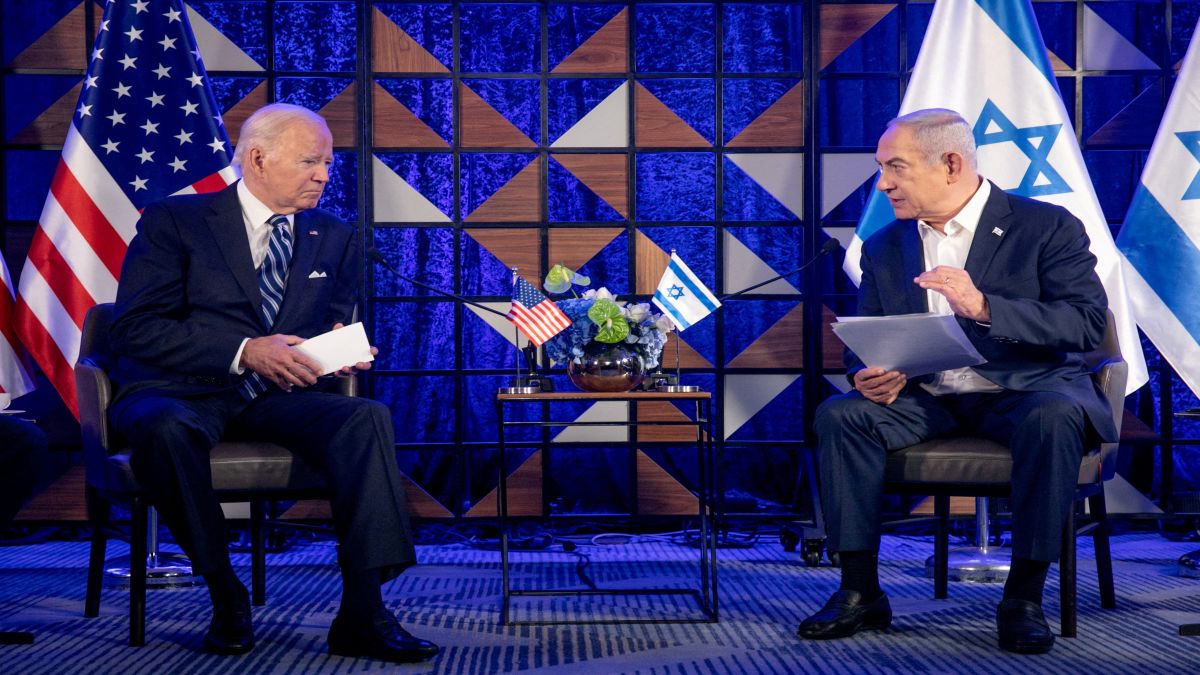
 "US President Joe Biden and Israeli Prime Minister Benjamin Netanyahu. Source: File Photo / Reuters")
Condemnation poured in from Israel after reports started to emerge that the United States is planning to issue sanctions against some of the units of the Israel Defence Force (IDF) over allegations of gross human rights violations amid the ravaging Israel-Hamas war.
Israeli Prime Minister Benjamin Netanyahu made it clear that sanctions must not be imposed on the military unit which played a central role in conducting ground operations in Gaza, home to Hamas terrorists who were responsible for the deadly October 7 massacre.
“Sanctions must not be imposed on the Israel Defense Forces!” he wrote on X, formally known as Twitter.
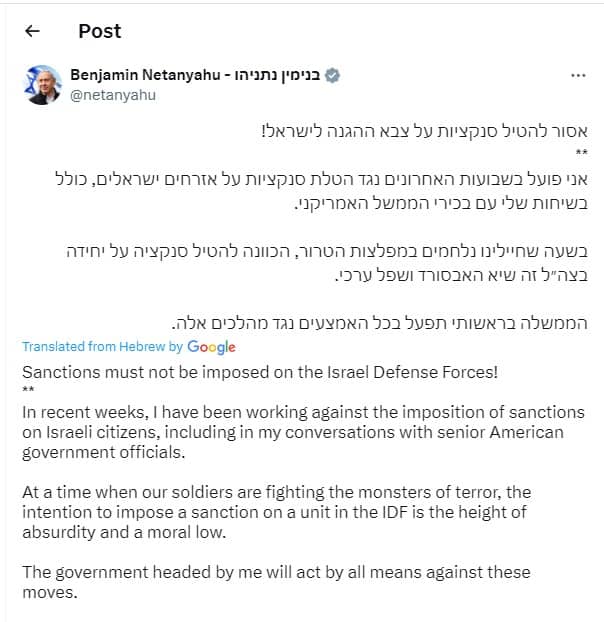
“At a time when our soldiers are fighting the monsters of terror, the intention to impose a sanction on a unit in the IDF is the height of absurdity and a moral low. The government headed by me will act by all means against these moves,” he added.
Why the anger?
The proclamation from the Israeli Prime Minister came after reports emerged that US President Joe Biden’s administration is slated to announce sanctions against the IDF’s Netzah Yehuda battalion for alleged human rights abuses against Palestinians in the West Bank, Axios reported.
The battalion has been at the centre of several controversies in the past and has been accused of propagating right-wing extremism and atrocities against Palestinians.
In 2022, the battalion was responsible for the gruesome death of Omar As’ad, a 78-year-old Palestinian-American who died after being detained, handcuffed, blindfolded, and later abandoned in near-freezing conditions by the soldiers.
Impact Shorts
More ShortsAfter the incident, Israel moved the unit out of West Bank in December 2022. However, the IDF denied that the action was taken because of As’ad’s death.
The battalion now served mostly in the country’s north.
‘Sanctions are the red line’
Netanyahu’s anger was supported by his fellow war cabinet Minister Benny Gantz. The Israeli minister insisted that the infantry unit is “an integral part of the IDF” and was bound by military and international law. He also emphasised that Israel has “strong and independent” courts capable of dealing with alleged violations, The Times of Israel reported.
“We have great respect for our American friends, but imposing sanctions on the unit is a dangerous precedent and sends the wrong message to our shared enemies at a time of war,” Gantz averred.
Meanwhile, Minister of National Security of Israel Ben Gvir maintained that imposing “sanctions on our (Israeli) soldiers is a red line.” He went on to describe these reports as “extremely grave".
The Israeli politician stated that he “expects Defense Minister Yoav Gallant not to submit to American dictates” and that the members of Netzah Yehuda “must be fully supported.”
Blinken’s ‘determination’
Earlier this week, US Secretary of State Antony Blinken said that he has made “determinations” about how to deal with allegations that Israel violated a set of US laws surrounding its military assistance to foreign nations.
Blinken told the reporters that a panel within the department has reviewed the serious charges against multiple Israeli units that frequently receive US aid. He assured that the results of his decision would be made public in the coming days, The Washington Post reported.
“I made determinations. You can expect to see them in the days ahead,” the American secretary of state averred. Blinken’s remarks came in response to an investigative report which was initially published by ProPublica.
What does the law say?
The Leahy Laws is a landmark legislation which was proposed by then-Senator Patrick J. Leahy. The law prohibits providing military assistance to individuals or security force units that violate human rights with impunity.
The legislation has resulted in hundreds of foreign police and military units being blocked from receiving US aid in countries like Colombia, Mexico and Cambodia.
When asked about the recent reports, Blinken made it clear that the Leahy legislation is a “very important law.”
“It’s one that we apply across the board. And when we’re doing these investigations, these inquiries, it’s something that takes time. That has to be done very carefully, both in collecting the facts and analyzing them,” he said.
“And that’s exactly what we’ve done. And I think it’s fair to say that you’ll see results very soon," the veteran diplomat furthered.