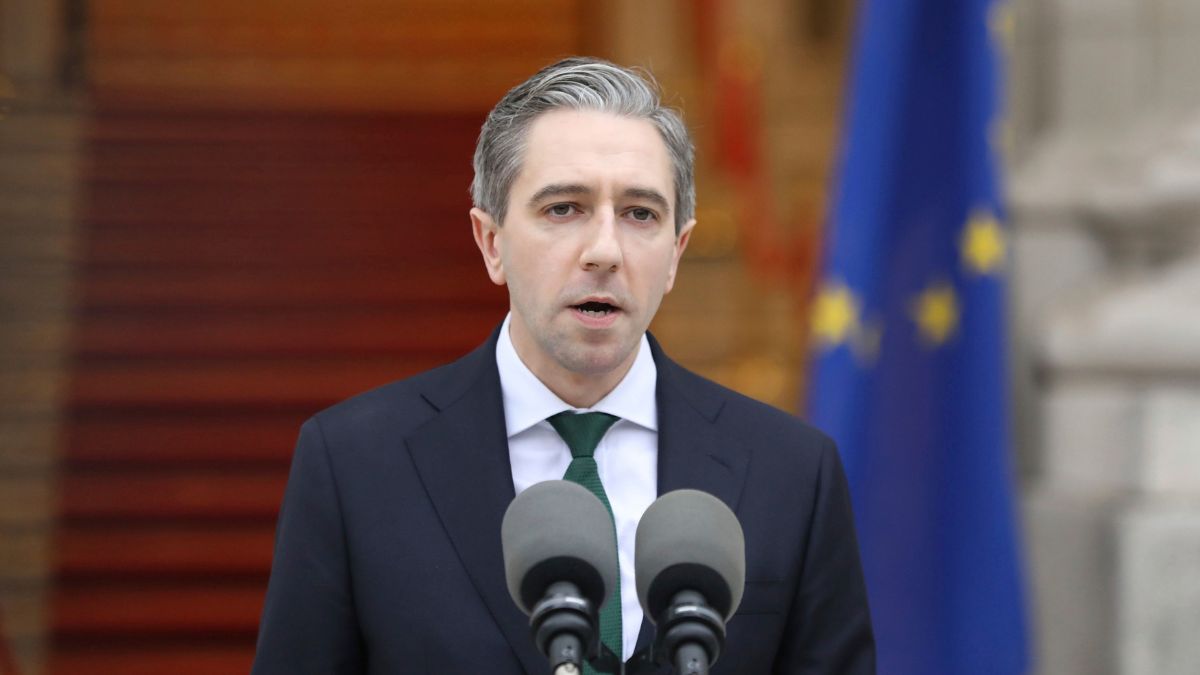
 "Irish Prime Minister Simon Harris makes a statement outside Government Buildings ahead of the Dail being formally dissolved for the General Election scheduled for next Nov. 29, in Dublin Friday Nov. 8, 2024. Image- AP")
Ireland’s President Michael Higgins has dissolved Parliament, paving the way for a crucial general election on November 29. This move comes after Prime Minister Simon Harris announced the election date earlier this week, well ahead of the March deadline.
The upcoming election will determine the fate of the historic coalition government, led by Harris’ center-right Fine Gael party and its center-left counterpart Fianna Fail. Since the closely contested 2020 election, this unlikely alliance has held power. Now, the Irish people will head to the polls to decide who will steer the country forward.
Ireland, with its 5.2 million population, has been grappling with challenges similar to those faced by other nations, including the COVID-19 pandemic, economic fallout from the Ukraine war, and a significant influx of migrants.
“We did not agree on every issue but we did always work hard and together for the good of the Irish people,” Harris said. “The time is now right to ask the Irish people to give a new mandate.”
Fine Gael and Fianna Fail, which arose from opposing sides of Ireland’s 1920s civil war, shared a broadly centrist outlook and had alternated holding power to govern Ireland over the decades. The two set aside their differences in 2020 to work together, bringing the Green Party along as a junior partner.
Fianna Fail leader Micheál Martin served as premier for the first half of the term and was replaced by Fine Gael’s Leo Varadkar in December 2022.
Impact Shorts
More ShortsHarris took over when Varadkar stepped down earlier this year.
The left-wing nationalist Sinn Fein party had won the largest share of votes in the election but was shut out of government because it couldn’t assemble enough support to govern. Sinn Fein has been shunned by centrist parties because of its historic links to the nationalist militants of the Irish Republican Army and decades of violence in Northern Ireland.
Sinn Fein said it was fielding more candidates in its effort to lead the government.
“After a century of Fianna Fail and Fine Gael, it is time to make that change, to give Sinn Fein the chance to lead and the chance to deliver,” said party President Mary-Lou McDonald. “In Sinn Fein you will get a government that will move heaven and earth to make housing affordable, to bring home ownership back into the reach of working people and to restore hope for a generation.”
Martin said the next five years would be challenging for the Irish economy, noting the impact from global conflicts and a potential change in U.S. trade policy change.
“The greatest threat to the Irish economy is external, and we need experience and we need leadership that has already demonstrated its capacity to weather significant events and shocks to lead us through the next challenging five years,” Martin said.
Harris said the coalition had protected people during coronavirus, supported Ukraine in its war and weathered the cost-of-living crisis.
Housing, immigration and childcare are some of the main issues for voters, he said.
He said he was pleased the government had set aside money to weather any future trade shocks.
“We used to be ridiculed for this,” Harris said. “This is exactly why we have the buffer that is there, is a trans-Atlantic shock or indeed any other shock to our economy, my children will never have to experience the austerity that our generation did.”
Ireland in 2010 faced national bankruptcy over the cost of saving its failing banks. It adopted an austerity program as one of the conditions for an international bailout but rebounded strongly after exiting the bailout in 2013.
With inputs from agencies.