 "Iran, Egypt hold urgent talks as West Asia tensions rise; Cairo warns of ‘total chaos’")
 "The who’s who of leadership in Iran as Trump looks to wind down the war")
Israel reportedly removed Iranian Foreign Minister Abbas Araghchi and Parliament Speaker Mohammad Bagher Ghalibaf from its hit list following a request by Pakistan to the United States not to strike them.
Live Blog
Iran Israel War Live Updates: Fresh explosions heard in Tehran; Trump says taking control of Iran’s oil is an option
FP News Desk
• March 27, 2026, 00:56:05 IST
Iran Israel War Live Updates: US President Donald Trump said on Thursday that taking control of Iran’s oil was an “option,” comparing it to the deal Washington made with Venezuela after toppling Nicolas Maduro.
Advertisement
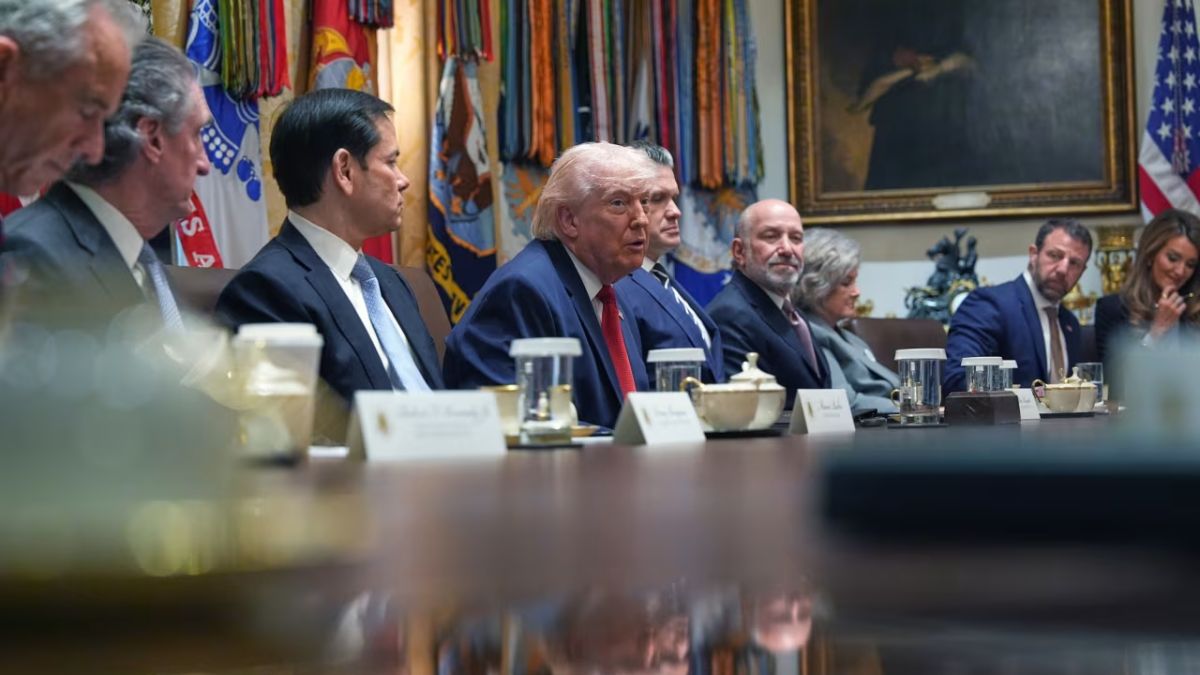)
President Donald Trump speaks during a Cabinet meeting at the White House, Thursday, in Washington, DC- AP
Tensions in West Asia continue to spiral, with the United States warning Iran to accept defeat or risk being “hit harder” than ever before. Tehran, however, has rejected the prospect of talks, vowing to press on with retaliatory strikes.
Meanwhile, US-Israeli attacks on Iran show no signs of easing, even as Iranian missiles continue to target parts of Israel, including central and northern regions. In a parallel escalation, Israeli forces have intensified strikes in Lebanon, with Prime Minister Benjamin Netanyahu saying operations are aimed at expanding a “buffer zone” in the south.
The conflict’s impact is also being felt across the Gulf. In Abu Dhabi, falling debris from intercepted missiles has killed two people and injured three. Air defence systems in Bahrain, Kuwait and Saudi Arabia have also been activated to intercept incoming Iranian missiles and drones.
Amid the escalating hostilities, the United Nations has warned of severe global consequences if the Strait of Hormuz—a critical artery for global oil supplies—remains shut for a prolonged period.
Stay with us for all the LIVE updates
Live Updates
March 27, 2026, 00:56:05 (IST)
Iran Israel War Live Updates: China urges meaningful peace talks to end West Asia war
China on Thursday called on all parties in the West Asia conflict to “create conditions for starting truly meaningful and sincere peace talks.”
Speaking at a regular briefing, foreign ministry spokesperson Lin Jian said the priority is to “actively promote peace talks, seize the opportunity of peace and promote the cessation of the war,” when asked about any ongoing negotiations between the US and Iran.
March 27, 2026, 00:49:38 (IST)
Iran Israel War Live Updates: Indian embassy condoles death of citizen in Abu Dhabi missile debris incident
The Indian Embassy in the UAE expressed condolences Thursday for the death of an Indian national in Abu Dhabi, saying it is providing all possible support and assistance.
In a post on X, the Indian embassy wrote, “Embassy of India expresses its deepest condolences at the tragic demise of an Indian national due to falling debris in Abu Dhabi today. The Embassy is closely coordinating with the UAE authorities to render all possible support and assistance.”
March 27, 2026, 00:43:47 (IST)
Iran Israel War Live Updates: Air strike destroys residential building in Bandar Abbas, three dead
A multi-storey apartment block in the southern Iranian port city of Bandar Abbas was reduced to rubble following a reported air strike, verified footage shows.
The building, located on Daneshgah Street in the city’s eastern residential area, was completely destroyed, while two adjacent blocks sustained partial damage. Local authorities said the strike, carried out by a fighter jet, killed three people.
March 27, 2026, 00:32:37 (IST)
Iran Israel War Live Updates: Spain rolls out €5 billion emergency package to shield consumers from energy price surge
Despite generating more than half of its electricity from renewable sources last year, Spain is moving to protect consumers from rising energy costs caused by West Asia oil and gas shortages.
Parliament approved a package of emergency measures including cutting the sales tax on gas and electricity from 21% to 10%, which the government says will save car owners about 30 cents per litre—or roughly €20 per tank. Truck drivers, farmers, herders, and fishermen can claim a 20-cent per litre diesel refund, which also applies to fertilizers, while prices for butane and propane are being frozen. The €5 billion plan is expected to benefit 20 million of Spain’s 49 million residents.
March 27, 2026, 00:25:19 (IST)
Iran Israel War Live Updates: Trump administration seeks endangered species act exemption for oil, gas projects in Gulf
As the Trump administration wages war on Iran, it’s citing national security to seek an exemption from the Endangered Species Act for expanded oil and gas drilling in the Gulf of Mexico — a move alarming environmental groups who say it could set a dangerous precedent for future fossil fuel projects.
Environmentalists argue the government hasn’t followed proper procedure and they’re seeking to block the move before Interior Secretary Doug Burgum convenes the Endangered Species Committee on Tuesday. The committee, nicknamed the “God Squad” by groups who say it can determine the fate of a species, is comprised of six high-ranking federal officials plus a representative for states involved.
The administration’s exact plans for the Gulf aren’t clear, but experts say the administration must specify the military need that would endanger a specific species to make a case for the national security exemption. The environmental groups worry that a blanket exemption would open the way for the administration to proceed with oil and gas projects without regard for several species including the Rice’s whale, of which only about 50 remain in the Gulf.
“There’s no imaginable justification to sacrifice them,” said Steve Mashuda, Earthjustice managing attorney for oceans. “It’s beyond reckless even to consider greenlighting the extinction of sea turtles, fish, whales, rays, and corals to further pad the oil industry’s pockets at the public’s expense.”
March 27, 2026, 00:25:03 (IST)
Iran Israel War Live Updates: World Bank ready to support emerging markets hit by War
The World Bank said Thursday it is prepared to provide immediate financial assistance to emerging-market countries affected by the economic fallout of the US-Israel war in Iran.
“We are ready to respond at scale—combining immediate financial relief with policy expertise and private sector support for the recovery of jobs and growth,” the World Bank Group said in its first statement on the crisis.
The conflict, which began on February 28, has driven up oil prices as Iran’s near blockade of the Strait of Hormuz disrupts nearly a fifth of global energy supplies. The halt in shipping has also affected key commodities including fertilizer, raising concerns about food security and supply-chain disruptions in the region.
Advertisement
March 27, 2026, 00:09:25 (IST)
Iran Israel War Live Updates: France consults 35 countries on post-war Strait of Hormuz mission
France said on Thursday that its military chief held talks with representatives from around 35 countries to explore proposals for a mission to reopen the Strait of Hormuz after the US-Israeli war in Iran ends.
While Washington’s Western allies have declined to participate in the ongoing conflict, the consultations highlight concerns that Tehran could continue to threaten the strategic waterway, which handles roughly a fifth of global oil shipments.
March 27, 2026, 00:07:42 (IST)
Iran Israel War Live Updates: UAE intercepts 15 ballistic missiles, 11 drones amid Iranian attacks
The United Arab Emirates said on Thursday that its air defences engaged 15 ballistic missiles and 11 drones as part of ongoing Iranian attacks.
The UAE defence ministry posted on X that its systems have so far targeted 372 ballistic missiles, 15 cruise missiles, and 1,826 drones since the assaults began, demonstrating the scale of the aerial threat from Tehran-backed forces.
March 26, 2026, 23:49:08 (IST)
Iran Israel War Live Updates: Iran war to drive US inflation higher, slow global growth: OECD
The Iran war’s disruption of oil exports from the West Asia will substantially boost consumer prices while also slowing growth in the United States and many other developed countries, the Paris-based Organisation for Economic Cooperation and Development said Thursday.
The OECD expects U.S. inflation to jump to an annual average of 4.2% this year, from about 2.6% in 2025. The increase will manly be driven by spiking gas costs, but fertilizer exports have also been interrupted and could raise food prices in coming months, the OECD said.
“In the United States, the impact of higher energy prices on inflation will more than offset the effect from the decline in effective tariff rates on imports,” the OECD’s interim outlook report said.
Growth is expected to slip to 2% this year from 2.1% in 2025, then decline further next year to 1.7%. In 20 of the largest countries, referred to as the Group of 20, which includes Japan, Europe, and large emerging economies such as Brazil, inflation is forecast to rise to 4% from 3.4%.
March 26, 2026, 23:43:56 (IST)
Iran Israel War Live Updates: Rubio heads to G7 as US pressures allies over Iran war
US Secretary of State Marco Rubio departed Thursday for the G7 ministerial meeting in Vaux-de-Cernay, France, as hopes for a diplomatic breakthrough with Iran fade and tensions grow between Washington and its G7 partners.
President Donald Trump has criticised G7 and NATO members for failing to support the US war effort, asking at a Cabinet meeting, “They weren’t there. So what makes you think they’d be there if we needed them for something?” The administration has also pressed the G7 to contribute military assets to reopen the Strait of Hormuz.
French officials said the ministerial will focus on possible negotiation avenues on the Iran conflict, the reopening of maritime and trade routes and curbing Tehran’s nuclear and ballistic missile programs.
March 26, 2026, 23:30:35 (IST)
Iran Israel War Live Updates: The latest developments you need to know
Blasts in Tehran
Warplanes could be heard overhead in northern districts of Tehran, shortly before three loud explosions rang out, an AFP correspondent in the Iranian capital said.
The blasts were heard after dark, during rain, and it was not immediately possible to identify what had been hit.
Iraq condemns targeting Gulf, Jordan
Iraq condemned the targeting of the Gulf states and Jordan, a day after these countries issued a joint statement demanding Baghdad act to prevent attacks from its territory.
An Iraqi foreign ministry statement “affirms the government’s categorical condemnation” of any such aggression, adding that it was prepared to “work jointly to address them (attacks) responsibly and swiftly”.
Taking control of Iran oil an ‘option’
US President Donald Trump said taking control of Iran’s oil was an “option”, comparing it to the deal Washington made with Venezuela after toppling Nicolas Maduro.
“It’s an option,” Trump told reporters at a cabinet meeting, saying that the United States had done “very well” with Venezuela’s reserves.
Trump claims tanker ‘present’
Iran allowed 10 oil tankers to pass through the strategic Strait of Hormuz as a “present” to show it was serious about negotiations to end the war, US President Donald Trump said.
Referring to cryptic comments earlier this week about a “gift” from Tehran, Trump said Iran allowed eight “big boats of oil” to transit the waterway earlier this week, followed by two others later on.
Lebanon UN complaint
Lebanon will file a complaint with the UN Security Council over Israel’s attacks in the country, the prime minister said, as Israel continues to strike as part of a campaign against Hezbollah.
‘Extremely’ ahead of schedule
Trump said US military operations against Iran were “extremely” ahead of schedule, citing an original timeframe of four to six weeks for the war that began nearly a month ago.
“We estimated it would take approximately four to six weeks to achieve our mission. Twenty-six days in we’re extremely, really, a lot ahead of schedule,” Trump told his first cabinet meeting since the start of the conflict.
Witkoff touts ‘strong signs’
US envoy Steve Witkoff said there were “strong signs” Iran could be convinced to make a peace deal, confirming that Washington had passed a 15-point plan to Tehran through mediator Pakistan.
‘Repay loyalty with loyalty’
Abdul Malik al-Houthi, leader of Yemen’s Iran-backed Houthi movement, warned of a “military response” should the Middle East war require it.
“As the people of Yemen, we repay loyalty with loyalty,” the Houthi leader said. The Houthis, a key part of Iran’s so-called “axis of resistance”, have so far refrained from joining the war.
Iran answers US proposal
Iran has responded through unnamed intermediaries to a 15-point US plan to end the war and is now awaiting Washington’s reply, the Tasnim news agency said.
The exact contents of the US plan, conveyed to Iran via Pakistan according to Pakistani officials, are not officially known.
‘Kill Americans’
The EU accused Russia of providing intelligence support to Iran in the Middle East war to “kill Americans”, calling on the United States to increase pressure on Moscow.
“We see that Russia is helping Iran with intelligence to target Americans, to kill Americans, and Russia is also supporting Iran now with the drones so that they can attack neighbouring countries and also US military bases,” the European Union’s top diplomate Kaja Kallas said.
Five killed in Lebanon
Israeli strikes on Lebanon killed at least five people, Lebanese state media said, as Hezbollah militants claimed they had staged a new wave of attacks on Israel.
The Israeli military announced, meanwhile, the killing of a soldier in fighting in south Lebanon, raising to three the total number of troops killed since Hezbollah drew Lebanon into war with Israel.
March 26, 2026, 23:09:05 (IST)
Iran Israel War Live Updates: Trump denies being 'desperate' for Iran deal
US President Donald Trump denied being “desperate” to make a deal with Iran Thursday, as he mixed threats with diplomacy in a push to wrap up his war in the West Asia.
Holding his first cabinet meeting since the start of the joint US-Israeli operation, Trump insisted that Iran was being “beat to shit” and was “begging” for a deal, despite Tehran’s denials.
But Trump rejected reports that he was looking for an exit ramp, as oil prices soar and political pressure mounts to avoid the kind of drawn-out Middle East war he once spurned.
“I read a story today that I’m desperate to make a deal,” Trump told reporters. “I’m the opposite of desperate. I don’t care.”
Advertisement
March 26, 2026, 23:06:50 (IST)
Iran Israel War Live Updates: Hardliners push for nuclear option as Iran faces US-Israeli attacks: Report
The debate among Iranian hardliners over whether Tehran should seek a nuclear bomb in defiance of an escalating US-Israeli attack is getting louder, more public and more insistent, Reuters cited sources in the country s saying.
With the Revolutionary Guards now dominant following the killing of veteran Supreme Leader Ayatollah Ali Khamenei at the start of the war on February 28, hardline views on Iran’s nuclear approach are in the ascendant, two senior Iranian sources said.
While Western countries have long believed that Iran wants the bomb – or at least the ability to make one very quickly – it has always denied that, saying Khamenei had banned nuclear arms as forbidden in Islam and citing its membership of the Nuclear Non-Proliferation Treaty.
There was no plan to change Iran’s nuclear doctrine yet and Iran had not decided to seek a bomb, one of the sources said, but serious voices in the establishment were questioning the existing policy and demanding a change.
The U.S.-Israeli attacks on Iran, which came midway through talks on Tehran’s nuclear programme, may have changed the equation, convincing Iranian strategists that they have little to gain by forswearing a bomb or staying in the NPT.
March 26, 2026, 23:01:23 (IST)
Iran Israel War Live Updates: France pushes for coordinated effort to secure Strait of Hormuz once hostilities ease
France’s ministry of armed forces said it is consulting international partners on an initiative to help restore freedom of navigation in the Strait of Hormuz, once the intensity of hostilities in the region decreases.
Earlier, French military officials held a video conference with representatives from 35 countries, convened by the French chief of the defence staff. The ministry said the meeting allowed countries to share positions on a coordinated, strictly defensive effort aimed at resuming safe maritime navigation in the strategic waterway, independent of ongoing military operations.
March 26, 2026, 22:55:23 (IST)
Iran Israel War Live Updates: Iraq condemns attacks on Gulf states and Jordan
Iraq’s foreign ministry on Thursday issued a strong statement “categorically condemning any aggression or targeting of the Gulf countries and the Kingdom of Jordan,” as regional tensions escalate alongside the Iran war. The ministry said Baghdad was prepared to “work jointly to address these attacks responsibly and swiftly,” a clear rebuke of violence spilling across borders from armed groups tied to Tehran. Some of the recent assaults on neighbouring Gulf states have been attributed to Iran‑backed militias operating within Iraq, complicating Baghdad’s efforts to balance internal security and regional diplomacy.
March 26, 2026, 22:42:01 (IST)
Iran Israel War Live Updates: Trump keeps Cabinet meeting focused on Iran war
Trump’s first Cabinet meeting since the start of the Iran war ran an hour and 40 minutes. But unlike past meetings of this kind, the president kept it largely focused on the war.
Trump usually gives every Cabinet member time to speak, but on Thursday he limited speakers to himself, Vance, Rubio, Hegseth, Bessent, Energy Secretary Chris Wright and Interior Secretary Doug Burgum.
Still, Trump weighed in on a few unrelated topics, such as his choice of writing implements, a construction project at the Federal Reserve that he thinks costs too much, and lawsuits pending to stop him from closing the Kennedy Center performing arts venue for a two-year renovation project.
March 26, 2026, 22:39:04 (IST)
Iran Israel War Live Updates: Philippines declares energy emergency as West Asia war threatens fuel supply
The Philippines became the first country in the world to declare a state of national energy emergency in response to global energy shortages triggered by the war in the West Asia.
President Ferdinand Marcos Jr. announced the emergency on Tuesday, warning of an “imminent danger” to the stability and availability of the country’s energy supply. Measures include enforcing energy conservation, introducing fuel subsidies, and cracking down on hoarding and profiteering, as Foreign Affairs Secretary Maria Theresa Lazaro said the nation has only 40–45 days of petroleum reserves remaining.
March 26, 2026, 22:32:41 (IST)
Iran Israel War Live Updates: Explosions rock Tehran as Israel signals more strikes after naval commander’s death
Warplanes were reported over northern Tehran on Thursday, followed by three loud explosions after dark, according to an AFP correspondent in the Iranian capital. The blasts came during rain, and it was not immediately clear what had been hit.
The incidents follow Israel’s announcement that it killed a senior Iranian naval commander and plans further “wide-scale” strikes against targets inside Iran.
Advertisement
March 26, 2026, 21:59:53 (IST)
Iran Israel War Live Updates: Iran says receptive to any request from Spain, alluding to Hormuz transit
The Iranian embassy in Spain said on Thursday on X that Spain respects international law and therefore Iran would be receptive to any request from Madrid related to the Strait of Hormuz.
“BREAKING NEWS: Iran considers Spain a country committed to international law, so it shows receptiveness to any request coming from Madrid.#StraitofHormuz,” the post on X read.
The post follows a note seen by Reuters on Thursday from Iran’s Ministry of Foreign Affairs stating that “non-hostile vessels” could transit the strait if they coordinate with Iranian authorities.
The Embassy of Iran in Spain was not immediately available to provide further details.
Spain’s government was among the first to condemn US-Israeli attacks on Iran, denouncing the war as reckless and illegal.
March 26, 2026, 21:50:34 (IST)
Iran Israel War Live Updates: Vance says Iran’s conventional military 'effectively destroyed' in war
US Vice President JD Vance said Iran’s “conventional military” has been “effectively destroyed” during the war, arguing that Tehran has lost much of its ability to strike. Speaking at a cabinet meeting, he said Iran no longer has a functioning navy and cannot hit the US as it could weeks ago, adding that this shift “gives us options.”
March 26, 2026, 21:48:54 (IST)
Iran Israel War Live Updates: Trump says taking control of Iran’s oil an 'option'
US President Donald Trump said taking control of Iran’s oil remains an “option” as Washington continues its campaign in the ongoing war. Speaking at a cabinet meeting, he indicated the possibility was under consideration even as the administration weighs both military and diplomatic paths.
March 26, 2026, 21:45:57 (IST)
Iran Israel War Live Updates: Germany urges Nato unity with US on Iran ahead of G7 talks
Germany’s foreign minister Johann Wadephul said it is important for NATO countries to develop a “common position” with the United States on Iran. He said the UK and France share this view ahead of talks with US Secretary of State Marco Rubio at a G7 foreign ministers’ meeting near Paris, according to Reuters.
His remarks come as President Donald Trump continues to criticise NATO allies for not joining the conflict, while also saying the US does not need their involvement.
March 26, 2026, 21:44:00 (IST)
Iran Israel War Live Updates: Tehran military warns Gulf states to reveal US troop locations, vows retaliation
An Iranian military spokesperson warned Gulf countries to reveal the locations of US forces in the region, saying Tehran is “pursuing” American soldiers and threatening retaliation if its conditions are not met.
The spokesperson called on regional states to “show us hiding places” of US troops, adding that Iran would take revenge and would not “let Americans off the hook” even if the war ends without its demands being fulfilled. The remarks underscore escalating rhetoric as tensions continue between Iran, the US and regional allies.
March 26, 2026, 21:41:51 (IST)
Iran Israel War Live Updates: Finland's Stubb says Ukraine talks at the 'end of the road'
Finnish President Alexander Stubb, who is close to the US and Ukrainian presidents, said he feared Washington-led Ukraine peace talks may be over, before backtracking to say they had stalled.
“It may be due to the war in Iran, which is drawing a lot of attention away from the war in Ukraine. But it may also be that the negotiations have come to a halt because they’ve reached the end of the road,” Stubb said in the interview with Norwegian daily VG which was published Thursday.
“I believe the American negotiators have done everything they could, and that most of it now hinges on one issue: Donetsk and territories,” he said referring to the frontline eastern Ukrainian region.
Advertisement
March 26, 2026, 21:40:48 (IST)
Iran Israel War Live Updates: Trump says Iran allowed passage of 10 oil tankers as a 'present'
Iran allowed 10 oil tankers to pass through the strategic Strait of Hormuz as a “present” to show it was serious about negotiations to end the war, US President Donald Trump said Thursday.
Referring to cryptic comments earlier this week about a “gift” from Tehran, Trump said Iran allowed eight “big boats of oil” to transit the waterway earlier this week, followed by two others later on.
March 26, 2026, 21:36:48 (IST)
Iran Israel War Live Updates: G7 meets in France hoping to heal transatlantic Iran rift
European and allied nations on Thursday looked for ways to narrow differences with the United States on the Middle East war as a two-day meeting of G7 foreign ministers got underway outside Paris.
While President Donald Trump says Washington is pursuing diplomacy with Iran while threatening even more intense military action, American allies are hoping that the United States will set out its position clearly.
The start of the two-day meeting of seven leading industrialised democracies at the Vaux-de-Cernay Abbey outside Paris on Thursday was marked by the absence of US Secretary of State Marco Rubio.
He will join fellow top diplomats from Canada, Germany, Italy, France, Japan and the United Kingdom — but only on Friday.
March 26, 2026, 21:08:57 (IST)
Iran Israel War Live Updates: US defence chief says pressure on Iran to continue, open to diplomacy
US Defence Secretary Pete Hegseth said Washington would continue military pressure on Iran while remaining open to a diplomatic deal. Speaking at a cabinet meeting, he said the US would keep up its campaign as part of “Operation Epic Fury” unless an agreement is reached, while stressing that the administration still supports negotiations.
March 26, 2026, 21:08:18 (IST)
Iran Israel War Live Updates: Trump says oil, markets less impacted than expected by Iran war
US President Donald Trump said oil prices and stock markets have been less affected by the war in Iran than he had anticipated. Speaking at a cabinet meeting, he said the impact “hasn’t been nearly as severe” as expected, though he cautioned that energy prices could still rise before stabilising.
March 26, 2026, 21:03:37 (IST)
Iran Israel War Live Updates: Trump mocks UK offer, says Hormuz could reopen with 'right deal'
US President Donald Trump renewed criticism of UK Prime Minister Keir Starmer, saying Britain’s offer to send aircraft came after the “war was already over” and was not needed. Speaking at a cabinet meeting, he also said UK aircraft “aren’t the best,” and suggested the Strait of Hormuz could reopen if the US and Iran reach “the right deal.”
March 26, 2026, 21:02:59 (IST)
Iran Israel War Live Updates: US confirms sending Iran 15-point peace framework via Pakistan
US special envoy Steve Witkoff confirmed that Washington has sent Iran a “15-point action list” forming the framework for a peace deal, marking the first official acknowledgment by the White House. Speaking at a cabinet meeting, he said the proposal was conveyed through Pakistan and that details would remain confidential, adding there are “strong signs” Iran could be persuaded toward an agreement.
Advertisement
March 26, 2026, 21:00:35 (IST)
Iran Israel War Live Updates: US envoy confirms Pakistan mediating Iran talks, shares 15-point plan
US special envoy Steve Witkoff said Pakistan is acting as an intermediary between the United States and Iran, confirming that a 15-point framework for a peace deal has been conveyed through Islamabad. Speaking at a cabinet meeting, he said the proposal was shared with Tehran via Pakistan as part of ongoing diplomatic efforts.
March 26, 2026, 20:59:29 (IST)
Iran Israel War Live Updates: Zelensky arrives in Saudi Arabia for unannounced visit amid regional tensions
Ukrainian President Volodymyr Zelensky arrived in Saudi Arabia on Thursday for an unannounced visit at a time when the war in Iran has spurred interest among Gulf countries in Ukrainian military technology.
“Arrived in Saudi Arabia. Important meetings are scheduled. We appreciate the support and support those who are ready to work with us to ensure security,” Zelensky wrote on social media.
March 26, 2026, 20:58:14 (IST)
Iran Israel War Live Updates: Iran calls US proposal 'one-sided,' says path possible if 'realism' prevails
Iran’s initial response to the US proposal to end the war, which was conveyed to Pakistan, was that it was “one-sided and unfair”, a senior Iranian official told Reuters on Thursday, adding that a path forward might still be found if realism prevailed in Washington. The official said the proposal “was reviewed in detail on Wednesday night by senior Iranian officials and the representative of Iran’s Supreme Leader”.
March 26, 2026, 20:54:01 (IST)
Iran Israel War Live Updates: US envoy confirms Iran talks via Pakistan, cites 'positive' signals
US special envoy Steve Witkoff confirmed that Washington has been negotiating with Iran through diplomatic channels mediated by Pakistan, presenting a 15-point framework for a potential peace deal. Speaking at a cabinet meeting, he said the proposal has generated “strong and positive messaging and talks,” while Pakistan’s Foreign Minister Ishaq Dar also said the plan is under consideration by Tehran.
The remarks come as US officials, including Vice President JD Vance, work to arrange a meeting in Pakistan to discuss a possible off-ramp to the war with the framework reportedly covering issues such as Iran’s nuclear and missile programmes.
March 26, 2026, 20:53:10 (IST)
Iran Israel War Live Updates: Vance calls Iran war a 'success,' says it opens new options for US
US Vice President JD Vance said the war in Iran has been a “resounding success,” arguing it has reduced Tehran’s ability to strike and created new options for Washington. Speaking at a cabinet meeting, he said those options include both further military action and a potential diplomatic path to end the conflict.
March 26, 2026, 20:49:40 (IST)
Iran Israel War Live Updates: Iran doubts US intent on talks, says response to proposal sent: Report
Iran has “complete doubt” about Washington’s willingness to negotiate, the semi-official Tasnim news agency reported, citing a source familiar with the matter. The source said Tehran has formally delivered its response to a 15-point US proposal and is now awaiting a reply, while reiterating demands including a halt to “aggression and assassinations” and recognition of its sovereignty over the Strait of Hormuz.
The report also said Iranian officials view the US push for talks as a “deception,” alleging it is aimed at managing oil prices and buying time for potential further military action, even as US President Donald Trump has cast doubt on the prospects of a deal.
Advertisement
March 26, 2026, 20:47:37 (IST)
Iran Israel War Live Updates: Trump says Iran 'defeated,' claims it cannot make a comeback
US President Donald Trump said Iran is ‘defeated’ and claimed it ‘can’t make a comeback’ amid the ongoing conflict. His remarks follow repeated assertions that US and Israeli military operations have significantly weakened Iran’s capabilities and put pressure on Tehran in the war.
March 26, 2026, 20:44:38 (IST)
Iran Israel War Live Updates: 'Strong signs' Iran can be convinced to make deal: US envoy Witkoff
US envoy Steve Witkoff said Thursday there were “strong signs” Iran could be convinced to make a peace deal, confirming that Washington had passed a 15-point plan to Tehran through mediator Pakistan.
“We will see where things lead, and if we can convince Iran that this is the inflection point with no good alternatives for them, other than more death and destruction. We have strong signs that this is a possibility,” Witkoff told a cabinet meeting.
March 26, 2026, 20:38:35 (IST)
Iran Israel War Live Updates: CENTCOM confirms killing of IRGC naval commander Tangsiri
The United States Central Command (CENTCOM) confirmed the killing of IRGC naval commander Alireza Tangsiri in a post on X, following earlier Israeli claims.
The confirmation comes after Israel said it had carried out a strike targeting senior Iranian naval leadership, with Tangsiri among those killed. Iran has not publicly commented on the claim.
March 26, 2026, 20:36:25 (IST)
Iran Israel War Live Updates: Trump says US, Gulf 'shocked' by Iran attacks, calls Tehran 'sick'
US President Donald Trump said Washington and Gulf countries were “shocked” by Iran’s retaliatory attacks across the West Asia, claiming the strikes on nations such as Qatar, Saudi Arabia and the UAE were unexpected. He described Iran as “sick” and accused it of having ambitions to “take over the West Asia.”
Trump has previously said he was surprised that Iran targeted US allies in the Gulf during the conflict, calling it one of the biggest surprises of the war.
End of Liveblog