 "In Photos: Artemis II rolls out on path to the Moon’s far side")
Standing as an industrial titan of the Florida Space Coast, the Vehicle Assembly Building is brilliantly illuminated against the night sky. The heavy-lift Space Launch System (SLS) begins its meticulous exit from the high bay, marking the start of a journey years in the making. Floodlights cast long shadows across the tarmac as the ground crew prepares for the slow trek to the historic Launch Complex 39B.
Under the harsh glare of portable industrial lamps, ground teams and engineers keep a watchful eye on the massive crawler-transporter. The rollout requires constant monitoring to ensure the multi-billion pound stack remains perfectly vertical during its transit across the gravel. Silhouetted against the bright beams, these specialists represent the thousands of people working behind the scenes to return humanity to deep space.
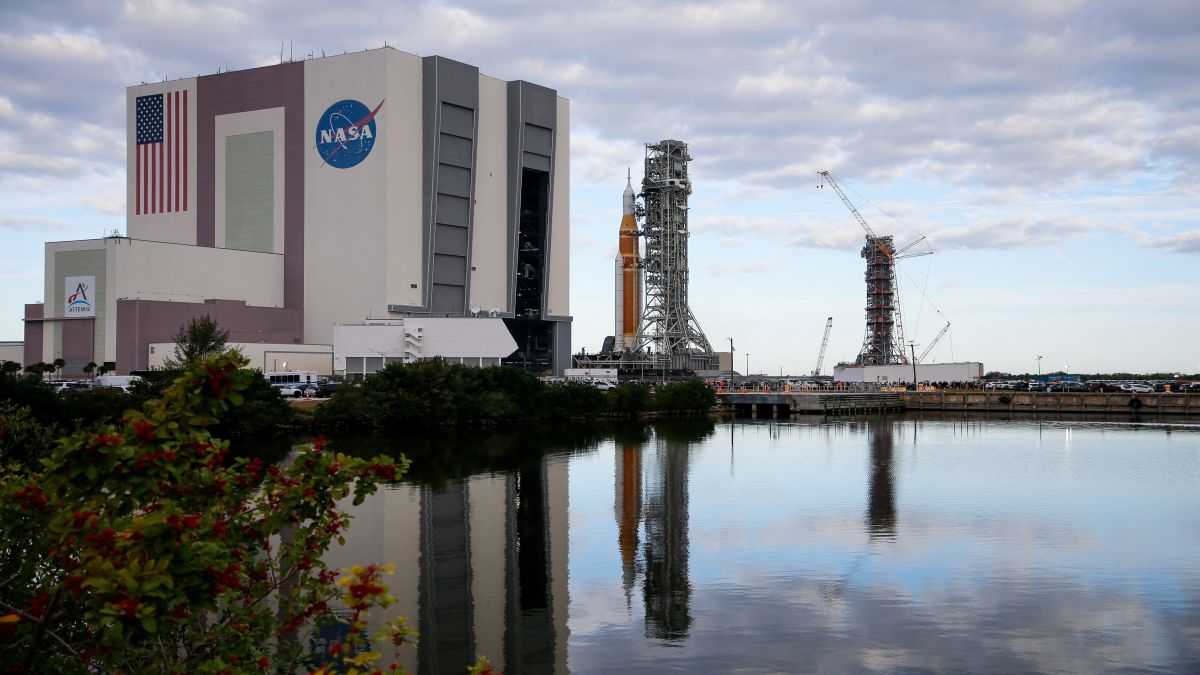
The immense scale of the Artemis mission is laid bare as the rocket clears the shadow of the world’s largest single-storey building. Flanked by the American flag and the iconic Nasa
“meatball” logo, the SLS rocket appears small next to the structure where it was painstakingly assembled. This wide perspective captures the quiet tension of a rollout, a process that moves at a pace of less than one mile per hour.
The mobile launcher platform, a steel behemoth in its own right, carries the orange core stage and twin boosters out into the humid Florida night. Every inch of movement is tracked by sensors to protect the delicate Orion spacecraft perched nearly 322 feet above the ground. This departure from the assembly bay signifies the transition from the construction phase to active launch preparations for the crewed lunar flyby.
Detailed markings on the solid rocket boosters and the white Orion stage highlight the complex engineering required to survive the rigours of spaceflight. The orange foam of the core stage, designed to insulate the super-cooled liquid hydrogen and oxygen, glows under the artificial lights. Soon, this hardware will be the vessel for four astronauts as they become the first humans to visit the Moon’s vicinity in over half a century.
Quick Reads
View AllSearchlights pierce the darkness, framing the Artemis II stack as it navigates the specialised crawlerway made of river rock. The path is specifically designed to support the 18-million-pound combined weight of the rocket and its transport vehicle without shifting. In the distance, the launch pad awaits, serving as the final destination before the engines ignite for the mission to the lunar far side.
Leaving the safety of the assembly hall behind, the SLS heads toward the horizon where the Atlantic Ocean meets the Cape Canaveral coastline. The Artemis logo is projected onto the side of the VAB, serving as a beacon for a new era of lunar exploration and international cooperation. With the rollout complete, the countdown to the most anticipated crewed mission of the decade truly begins.


 "Iran Israel War Live News: White House seeks $1.5 trillion defence budget amid ongoing Iran war")
 "India commissions INS Aridhaman. Which other nations are in the nuclear sub club?")
 "Trump says US can 'easily' open Hormuz, take oil and 'make a fortune,' but needs more time")
 "US pilot captured in Iran after US F-35 downed: Report")
 "Iran Israel War Live News: White House seeks $1.5 trillion defence budget amid ongoing Iran war")
 "India commissions INS Aridhaman. Which other nations are in the nuclear sub club?")
 "Trump says US can 'easily' open Hormuz, take oil and 'make a fortune,' but needs more time")
 "US pilot captured in Iran after US F-35 downed: Report")