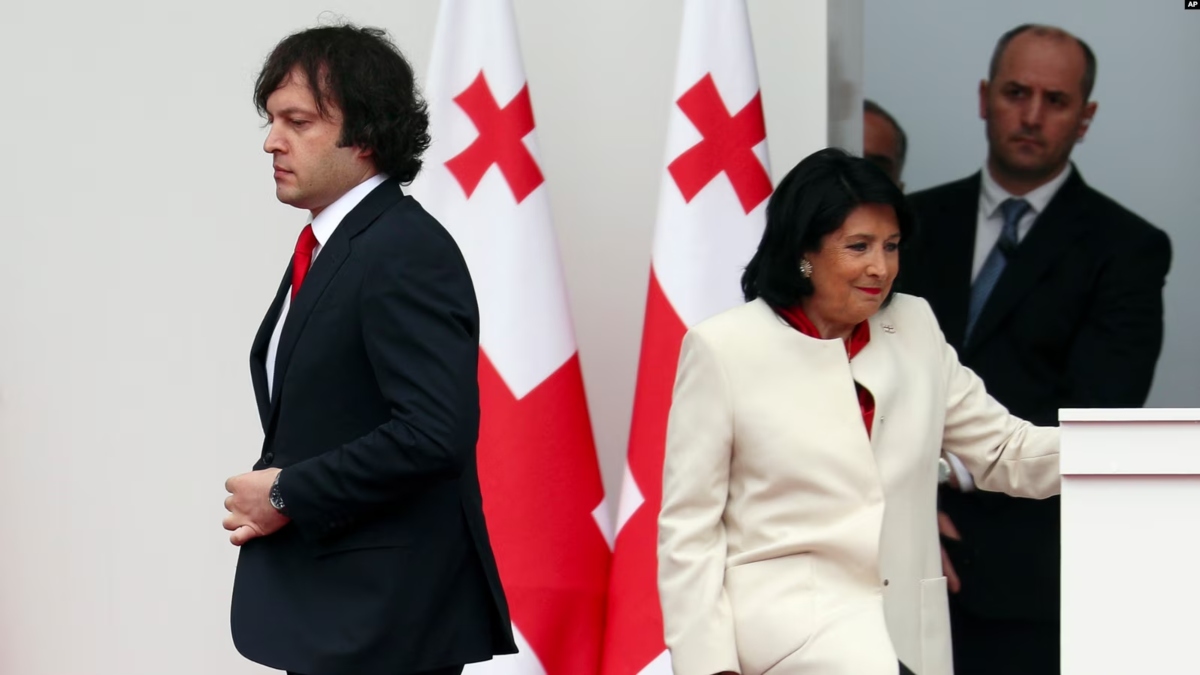
 "Georgian President Salome Zourabichvili, right, and Prime Minister Irakli Kobakhidze, left, leave a podium after marking Independence Day in Tbilisi, Georgia, May 26, 2024. File Image / AP")
An intense political tussle is brewing between the president and the newly-elected prime minister of Georgia, which has triggered nationwide protests that have been intensifying for the past four days. At the heart of this tussle is the question of whether the erstwhile Soviet Union nation should be part of the European Union or not.
While Georgia’s President Salome Zourabichvili has called the country’s newly formed government “illegitimate,” the country’s Prime Minister Irakli Kobakhidze insisted that she should step down even though he is facing calls for resignation. The tussle between the two sides intensified after the newly elected government took a dramatic decision to halt EU accession talks.
Things went downhill after the Georgian Dream Party (GD) announced that it had won the intense national election with 54 per cent of the vote. While the country’s Election Commission supported the Georgian premier, Brussels and Washington have expressed concern about the legitimacy of the result because of reports of intimidation, ballot-stuffing and fraud at polling stations.
The Russia & Trump influence
Following the election, the European Parliament passed a resolution that called for a rerun of the polls and introduced sanctions against Georgian politicians, including oligarch and GD founder Bidzina Ivanishvili. It is pertinent to note that GD has been in power in the country since 2012.
However, the party has gradually, expanded its influence over almost all of the country’s institutions, including the office of the president. Over the years, Geogia’s political landscape has undergone significant changes, transforming from presidential to semi-presidential form, with the prime minister replacing the president as the head of the government, with the latter becoming only a ceremonial post after the 2013 constitutional amendment.
Hence, the current government has become stronger than the previous government due to several institutional changes.
- Russian influence
What makes matters concerning for Georgia is the fact that GD has been notorious for leaning towards the Russian orbit.
Georgia has been divided over the Russia question ever since it gained independence in 1991, with the fall of the USSR. Both countries were embroiled in a major war in 2008, with Russia annexing some of its territories. While diplomatic ties between Georgia and Russia remain suspended, many in the country accused GD of getting help from Russia to manipulate the elections.
Impact Shorts
More Shorts“Russia wants to capture us — this is what is happening,” said Eka Gigauri, head of Transparency International Georgia, another NGO.
- Trump’s influence
Meanwhile, amid protests, the Georgian Prime Minister clarified that they are halting the EU accession talks “temporarily,” since they are waiting for US President-elect Donald Trump to assume the Oval Office. “Whatever Trump says, that’s what will happen. So for us, the most important thing is the relationship with Donald Trump,” Kobakhidze said.
GD has been already in indirect contact with Trump and his team after the Republican firebrand won the November 5 polls. However, the current US President Joe Biden’s administration is not happy with the Georgian government halting its talks.
“By suspending Georgia’s EU accession process, Georgian Dream has rejected the opportunity for closer ties with Europe and made Georgia more vulnerable to the Kremlin,” Washington said in a statement. While Trump often expressed love for Putin, it is unclear what his stance is on the matter.
The president goes head-to-head against the PM
While the protests across the country intensified, Zourabichvili issued a televised address, calling the government illegitimate. Zourabichvili insisted that she won’t leave the office, despite the fact that her term is scheduled to end on December 16.
“There is no legitimate parliament and, therefore, an illegitimate parliament cannot elect a new president. Thus, no inauguration can take place, and my mandate continues until a legitimately elected parliament is formed," the pro-EU president said in a statement on Saturday.
Earlier this month, the president also refused to sign the controversial “foreign agents” law passed by the GD-led Georgian parliament, which the critics argued was inspired by a similar law in place in Russia. The controversial bills require NGOs and media that receive foreign funding to register with the government or face fines.
PM rejects calls for resignation but asks President to step down.
Meanwhile, Kobakhidze said that he would not step down from the office of the Prime Minister and rejected calls for re-election across the country. However, he has been asking the country’s president to bow out. He emphasised that Zourabichvili would have to leave the Orbeliani Palace residence in the capital Tbilisi and “hand over this building” to a new president after one was chosen by an electoral college that includes members of parliament.
The process of electing the new president is slated for December 14. “Zourabichvili had fought for the radical opposition’s victory” in last month’s general elections, thinking that this would “guarantee her a chance to remain in office, but she lost,” the premier added.
While the PM office has more power than the president’s office in Georgia, a president refusing to step down is an unprecedented situation the country is facing. Hence, it will remain unclear how Kobakhidze plans to take down Zourabichvili.
EU keeps its doors open
Amid the escalating protests, which has entered its fourth day, European Commission President Ursula von der Leyen said that the door for the EU will remain open for Georgia. “We regret the Georgian leadership’s shift away from the EU and its values,” she said in a statement on X, voicing concern over Georgia’s recent political direction.
The EU leader reassured that the regional body’s invitation remains intact, adding “the door to the EU remains open.” However, she noted that the ball was in Georgia’s court. “The return of Georgia on the EU path is in the hands of the Georgian leadership,” she said.
Interestingly, it was Brussels that first halted Georgia’s accession talks this summer because of a controversial “foreign agents” law. The country has been seeing protests since multiple organisations claimed that Over 80 per cent of Georgia’s 3.8mn population support EU membership. With hundreds of protests and numerous deaths the fate of Georgia remains unclear.
With inputs from agencies.