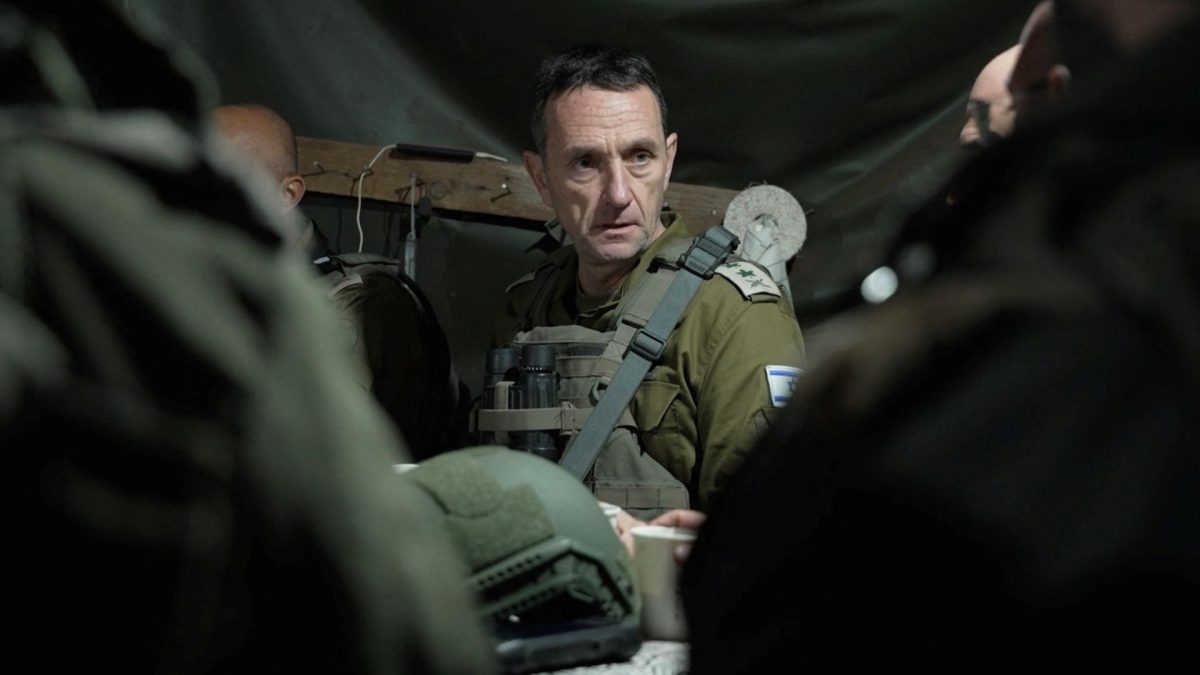
 "Israeli military Chief of General Staff Herzi Halevi. FILE/REUTERS")
The IDF has warned Iran of consequences of its missile and drone attack on Israel over the weekend and said the Israeli military “will choose its response accordingly”.
In a video statement, the Israel Defense Forces (IDF) Chief of the General Staff Lieutenant General Herzi Halevi said his country has no choice but to respond to Iran’s attack on Saturday.
The statement by Halevi came even when the United Nations has been urging Israel to show restraint in its response to Iran’s attack and European and the US officials boosted their calls for Tel Aviv to avoid a tit-for-tat escalation that could lead to a wider war.
Is Israeli considering ‘response’ attack on Iran?
In a video message, recorded during his visit to the Nevatim air base in southern Israel which was targeted on the night of April 13, Halevi said: “Iran will face the consequences for its actions. We will choose our response accordingly. The IDF remains ready to counter any threat from Iran and its proxies as we continue our mission to defend the state of Israel.”
‘IDF at highest level of readiness’
“Iran’s attack has created new opportunities for cooperation in the Middle East. We are closely assessing the situation. We remain at our highest level of readiness,” Halevi said.
Halevi also said Iran’s attack on Israel had created new opportunities for cooperation in West Asia.
“Over the weekend, Iran launched a large scale attack on Israel. Over 350 ballistic missiles, cruise missiles, drones and rockets were fired from Iranian soil as well as Iraq, Yemen and Lebanon towards the state of Israel. Across the skies of the Middle East, a coalition was activated to counter this attack, marking the start of the IDF’s operation: ‘Iron Shield’,” he said.
“The Israel Defense Forces, together with the United States Central Command, the British and the French armed forces and other partners, operated together in real-time in the air, on the ground and at sea,” Halevi further said.
Impact Shorts
More Shorts“Defence systems were activated, the threats were intercepted, and Iran’s attack on Israel failed. Operation Iron Shield proved the strength of our iron clad cooperation. I want to thank all our international partners who stood up to Iran’s aggression,” the IDF chief said.
UN, world leaders call for ‘de-escalation’
Halevi’s statement came moments after UN Secretary-General Antonio Guterres said the region couldn’t afford another war and it was time to “defuse” and “de-escalate”.
“We have a shared responsibility” to de-escalate tensions and work for peace, Guterres said while opening the emergency session of the Security Council on Sunday.
The White House national security spokesman John Kirby on Sunday said US President Joe Biden does not want an escalation in the regional conflict or a “wider war” with Iran and is “working on the diplomatic side of this personally."
“The president has been very clear. We don’t seek a war with Iran. We are not looking for escalation here. We will continue to help Israel defend itself,” Kirby said.
British Foreign Secretary David Cameron said the UK does not support a retaliatory strike by Israel.
French President Emmanuel Macron said Paris will try to “convince Israel that we must not respond by escalating.”
With inputs from agencies