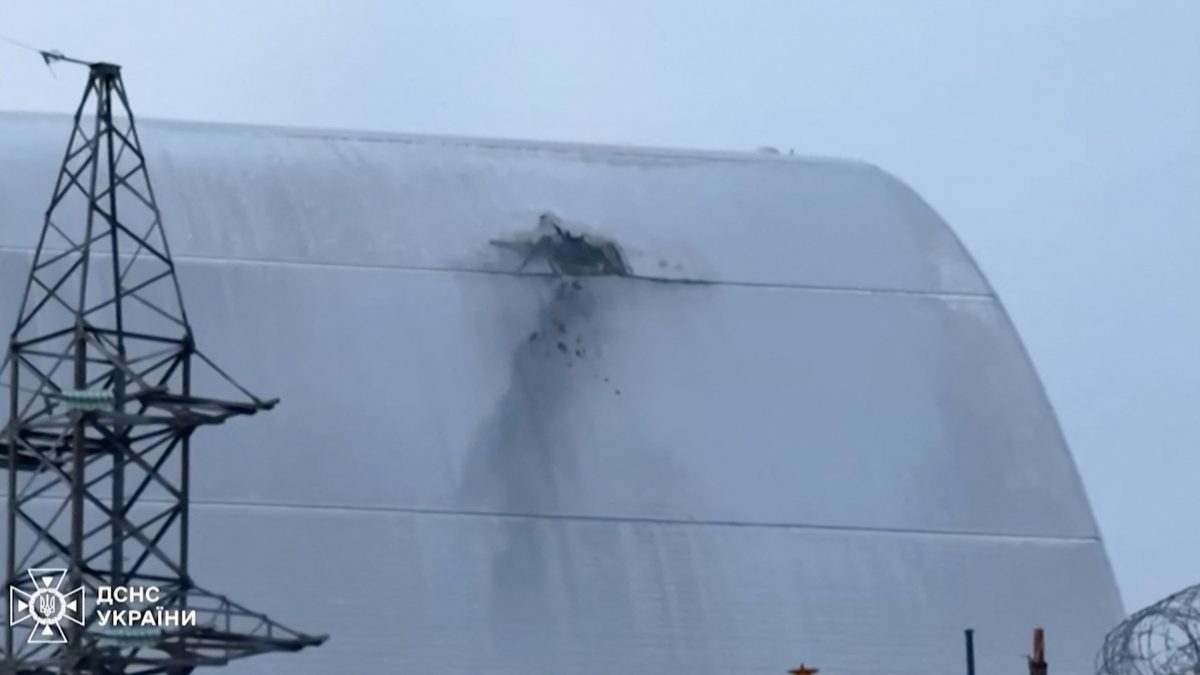
 "This handout photograph taken and released by Ukrainian Emergency Service on February 14, 2025 shows the New Safe Confinement (NSC), which protects the remains of reactor 4 of the former Chernobyl Nuclear Power Plant following a drone attack on its cover built to contain radiation. (AFP)")
A fresh Russian strike on the defunct Chernobyl nuclear power plant could cause the collapse of its internal radiation shelter, the site’s director told AFP.
Ukraine has repeatedly accused Russia of targeting the facility since Moscow launched its full-scale invasion in February 2022. The plant, north of Kyiv, was the site of the catastrophic 1986 disaster that remains the worst nuclear accident in history.
Damage already done
Earlier this year, a Russian strike punched a hole in the outer radiation shell protecting the ruined reactor. The International Atomic Energy Agency (IAEA) had warned that the structure had “lost its primary safety functions.”
In an interview with AFP, Chernobyl plant director Sergiy Tarakanov said the damage has left the site dangerously exposed and that repairing it will be a long process.
Tarakanov warned that another strike—even one landing nearby—could have serious consequences for the inner shelter that contains radioactive material.
“If a missile or drone hits it directly, or even falls somewhere nearby, for example, an Iskander, God forbid, it will cause a mini-earthquake in the area,” Tarakanov told AFP.
The Iskander is Russia’s short-range ballistic missile system and can be equipped with bunker-busting warheads.
“No one can guarantee that the shelter facility will remain standing after that. That is the main threat,” he added.
How the shelter works
The destroyed reactor is currently sealed by two layers of protection. The inner structure, known as the Sarcophagus, was built hastily after the 1986 disaster using steel and concrete. Over it sits the New Safe Confinement (NSC), a modern, high-tech steel shell designed to prevent radiation leaks.
Quick Reads
View AllThe NSC suffered extensive damage in a Russian drone strike in February, which sparked a major fire and tore through its roof.
“Our NSC has lost several of its main functions. And we understand that it will take us at least three or four years to restore these functions,” Tarakanov said.
The IAEA confirmed this month that the shelter had “lost its primary safety functions, including the confinement capability,” though it said load-bearing structures and monitoring systems were not permanently damaged.
Tarakanov said radiation levels at the site remain “stable and within normal limits.” While the main hole caused by the drone strike has been sealed with a protective screen, around 300 smaller holes—drilled by firefighters battling the blaze—still need repairs.
Russian forces briefly seized Chernoby l at the start of the invasion before withdrawing weeks later.