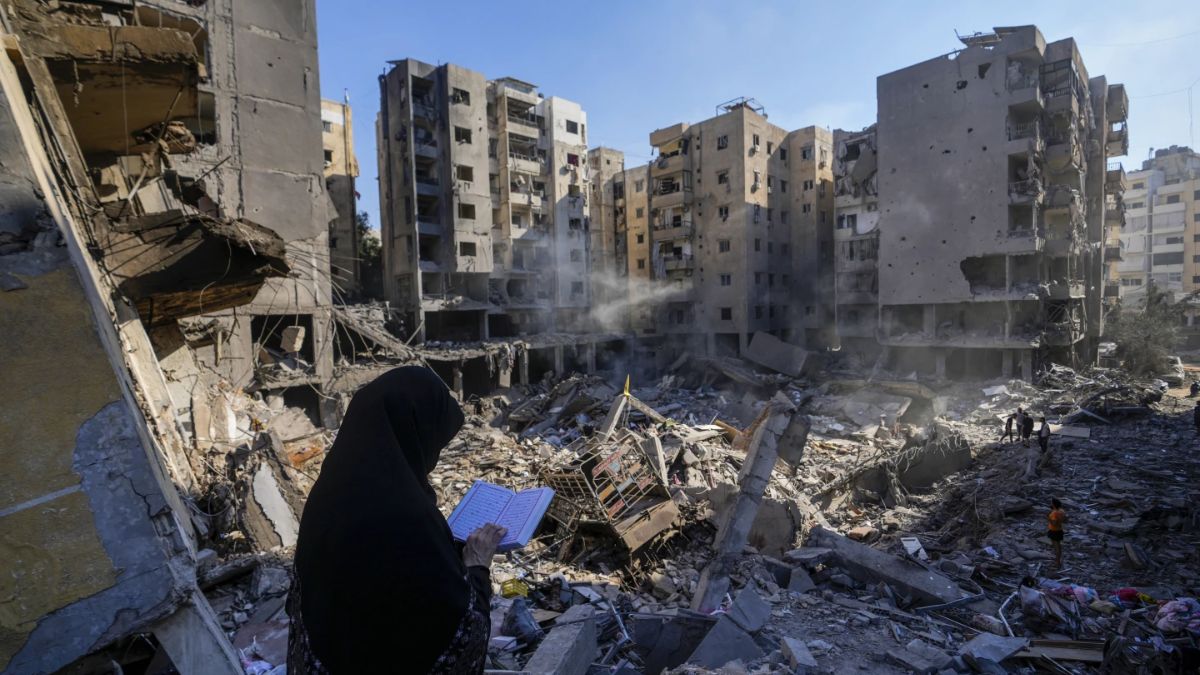
 "A woman reads the Quran at the site of the assassination of Hezbollah chief Hassan Nasrallah. AP")
July 27, when a Hezbollah rocket attack killed 12 Druze children in the Israeli town of Majdal Shams, marked a shift in the Israel-Hezbollah conflict. Israel responded by targeting Hezbollah’s second-in-command, Fuad Shukr, in a residential building in Beirut using precision weapons to minimise collateral damage. Then in late August, Israel pre-emptively struck Hezbollah missile launchers set to attack military sites in Israel.
As the geographic scope of attacks on both sides has moved deeper into Lebanon and Israel, Israeli operations are aimed at senior Hezbollah commanders.
Thereafter, Israeli Defence Forces (IDF) strikes and targeted assassinations have been occurring at a pace and on a scale that indicate a higher risk tolerance and a readiness to enter a new phase of the conflict with Hezbollah. Back-to-back operations on September 17 and 18, in which Hezbollah pagers and walkie-talkies exploded, set a new record for Hezbollah casualties, with at least thirty dead and thousands injured. Although the operation was designed to limit civilian casualties since only Hezbollah operatives would have been utilising it, the group’s integration into the fabric of Lebanese society meant that many of the explosions occurred in civilian areas.
On September 20, Israel executed another targeted assassination strike on a group of elite Hezbollah forces meeting in a residential building in a Beirut suburb. This time, an estimated 30 civilians were killed. Thereafter there were reports that Ibrahim Aqil, an elite unit chief, and Muhammad Qabisi, the commander of Hezbollah’s Missiles and Rockets Force, were killed in separate Israeli strikes, and now the latest news coming out of Lebanon and confirmed by Israel, Iran, and the Hezbollah is that Hassan Nasrallah was killed in a devastating wave of air raids in Dahiyeh in Beirut when Israel targeted the Headquarters of Hezbollah on September 27.
The pace of attack had grown exponentially. Shortly before the strike, Israeli Prime Minister Benjamin Netanyahu, during a speech at UN general assembly promised to continue “degrading” Hezbollah, crushing hopes that Israel would agree to a 21-day truce proposed by the US and France.
Quick Reads
View AllThe Israelis have tried to kill Nasrallah before. That they have been successful now is attributed to their vastly improved intelligence collection effort inside Lebanon. They must have had precise real-time intelligence on Nasrallah and established that he was due to attend a meeting at the command complex and killed him in an operation reportedly codenamed “New Order.”
Israeli Defence Minister Yoav Gallant said that the Hezbollah Chief “was the murderer of thousands of Israelis and foreign citizens. He was an immediate threat to the lives of thousands of Israelis and other citizens”. “To the people of Lebanon, I say: Our war is not with you. It’s time for change.”
Who Was Hasan Nasrallah?
Nasrallah, who was married and has four surviving children, was born on August 31, 1960, in the northern Beirut suburb of Burj Hammud. He was one of nine children of a grocer hailing from the southern village of Bazuriyeh. Said to have been pious from an early age, Nasrallah himself has described how he would spend his free time as a child staring at a portrait of the Shia scholar Musa al-Sadr. In 1974, Sadr founded the Movement of the Disinherited to press for better economic and social conditions for the Shia’s in Lebanon**.** Which had an armed wing called Amal, or ‘hope’.
After the outbreak of civil war between Lebanon‘s Christian Maronites and Muslims, Nasrallah joined Amal’s movement and fought with its militia. But as the conflict progressed, Amal adopted an unsympathetic stance towards the presence of Palestinian militias in Lebanon. Due to this difference, Nasrallah split from Amal in 1982, shortly after Israel’s invasion of Lebanon, and formed a new group with Iranian support that would later become Hezbollah and stated that Ayatollah Khomeini of Iran was its one true leader.
By the 1990s, after numerous bloody clashes with Amal and with the civil war over, Hezbollah was the dominant group among Lebanon‘s Shia supporters. Nasrallah became its Secretary General in 1992, after his predecessor, Abbas al-Musawi, was killed by Israeli missiles.
Nasrallah’s elegies on the history of oppression in the Middle East made him an influential figure. For more than 30 years, Nasrallah has often been described as the most powerful figure in Lebanon, despite never personally holding public office. His political muscle came from the weapons Hezbollah held and that he has used against domestic opponents, including the assassination of the former Lebanese Prime Minister Rafik Hariri.
He enjoyed cult status among his supporters, had a formidable arsenal far bigger and more modern than Lebanon’s national army, and dominated Lebanese institutions. Standing up to Israel is what defined him and his Iranian-backed group, Hezbollah, for years.
Though considered the most heavily armed non state actor in the world. Within Lebanon, Hezbollah operates as a legal political party and as a security force; the group effectively governs much of the country, particularly in the south and east.
After October 7, 2023, Hezbollah opened up a front against Israel to help relieve pressure on its ally Hamas in Gaza. The group suffered losses after months of cross-border fighting and Israeli attacks that targeted significant figures in the movement. But Nasrallah remained defiant, and his death is unlikely to remove the group from power in Lebanon.
What Happens Next?
The expected scenario involves Iran using its proxies, the Hezbollah and the Houthis, to launch an extensive missile and drone attack on Israel**.** In an even more extreme scenario, Iran itself could join the conflict directly with strikes from its territory, although this is considered unlikely. Iran’s Ayatollah Ali Khamenei said, “The fate of this region will be determined by the forces of resistance, with Hezbollah at the forefront.”
The strikes represent a direct challenge to Iran, as Nasrallah was considered its most important strategic regional ally, whose tens of thousands of Iranian-supplied missiles aimed at Israel have long been seen as a key strategic foil preventing an Israeli attack on Iran itself.
The most important question is whether Iran can accept the strike against Nasrallah, or whether it too could be drawn into a widening conflict, or whether the strike is intended by Israel as setting the conditions for a strike against Iran.
The US Defence Secretary, Lloyd Austin, said the US was determined to prevent Iran or Iran-backed groups from expanding the conflict and was committed to the defence of Israel. While Russia condemned the killing of Nasrallah as “political murder” and called on Israel to stop hostilities in Lebanon.
Iran faces a difficult dilemma between a sharp reaction to Israel, which risks a regional war, and no reaction, which will deeply harm its Axis of Resistance armed proxy network. At the same time, there is the question of Iran’s nuclear deterrence, given the fact that Hezbollah is presently considered a deterrence tool of Iran against Israel. While Iran will seek to stabilise Hezbollah and rebuild its force.
No doubt this is a transformative moment for Hezbollah, as it has lost not only Hassan Nasarallah but also many leaders in its command structure. The central question is whether Hezbollah’s leadership will stick to its hardline stance against Israel, continuing to tie the organisation’s fate to the ongoing conflict in Gaza, or whether it will reconsider its strategy for the present in view of the loss of their leadership at various levels. A statement from the group said Nasrallah “has joined his fellow martyrs", and it vowed to “continue the holy war against the enemy and in support of Palestine”.
For Lebanon’s elected government, this turn of events opens up possibilities of it reclaiming greater control over parts of southern Lebanon where the writ of the Hezbollah ran. There is no doubt that Lebanon is a multiethnic and religiously divided country, and its ‘confessional system’ of democracy only adds to that. Ever since experiencing a near-total collapse of its economy in 2019, ordinary Lebanese have faced immense challenges.
Hezbollah, though powerful, is blamed for many of its present ills, including the storage of a large amount of ammonium nitrate at the Port of Beirut, which exploded on August 4, 2020, causing 218 deaths, 7,000 injuries, and rendering an estimated 300,000 people homeless. Hezbollah is deeply embedded in Lebanon, and its foreign policy is largely dictated by the group, particularly when it comes to Israel. A recent Arab Barometer survey indicated that 55 per cent of Lebanese have “no trust at all” in Hezbollah.
The Israeli Question
The other question is: will Israel now open up yet another front by launching a ground offensive into southern Lebanon in order to eliminate the threat from Hezbollah? An Israeli campaign that intends to degrade Hezbollah and dislodge it from its entrenched positions would lead to large-scale collateral damage as Hezbollah shielded its weapons by embedding them in urban and civilian areas.
Hezbollah is likely to retaliate by launching rockets and missiles at Israel. The first task of Israel will be to disrupt or intercept these launches.
Since the October 7 Hamas attack, Israel has been engaged on numerous fronts. Hezbollah has been engaging Israel from Lebanon, and this has resulted in displacing 60,000 Israelis. Shortly thereafter, the Houthis in Yemen also joined in, launching attacks on international shipping in the Red Sea and launching missiles and drones at Israel, including one that exploded in central Tel Aviv.
Meanwhile, militias in Iraq and Syria have also targeted Israel with drones and rockets. In mid-April, after Israel carried out an airstrike near an Iranian diplomatic complex in Damascus, Iran retaliated by launching more than 350 ballistic missiles, cruise missiles, and drones at Israel, creating a new precedent for direct and open combat between the two countries. At the same time, Iran has been flooding the West Bank with funds and weapons to encourage terrorist attacks.
But, so far, this multifront war has been of limited intensity. Will this change now? If the war becomes wider as well as longer, existing security assumptions will be even further challenged. In an all-out regional war, Israel would be fighting not only proxies sponsored by Iran but also Iran.
Conclusion
Israel has been working deliberately on targeting Hezbollah commanders in different areas to dismantle the command chain of the group. The two sides were locked in an upward military spiral with a violent choreography of incremental escalation and calculated strikes.
While Hezbollah has suffered a severe setback, it is unlikely to crumble under the weight of Nasrallah’s death, even though the group has lost a leader whose influence extended far beyond Lebanon. Hashem Safieddine, who could have succeeded Nasrallah, was reportedly also targeted in Friday’s airstrike.
The death of Hassan Nasrallah can be termed ‘a seismic event’ in the Middle East. While the group will now need to select a new leader, who in turn will need to decide what direction to take Hezbollah in. The question uppermost in everyone’s mind is: What comes next?
The risk of a broader conflict is at its highest, but there are also opportunities for a comprehensive settlement while everything now hinges on Israel and Iran. But this is the time for the international community, led by the US, to exert its full leverage on Israel to demand a complete and immediate ceasefire in Lebanon. This would make any reaction by Iran and its proxies more difficult and provide the opportunity of a larger settlement.
But there is no doubt that the killing marks a major escalation in the crisis and threatens to reshape the course of events in a region where Nasrallah was a significant presence, and we have stepped into uncertain territory.
The author is a retired Major General of the Indian Army. Views expressed in the above piece are personal and solely those of the author. They do not necessarily reflect Firstpost’s views.