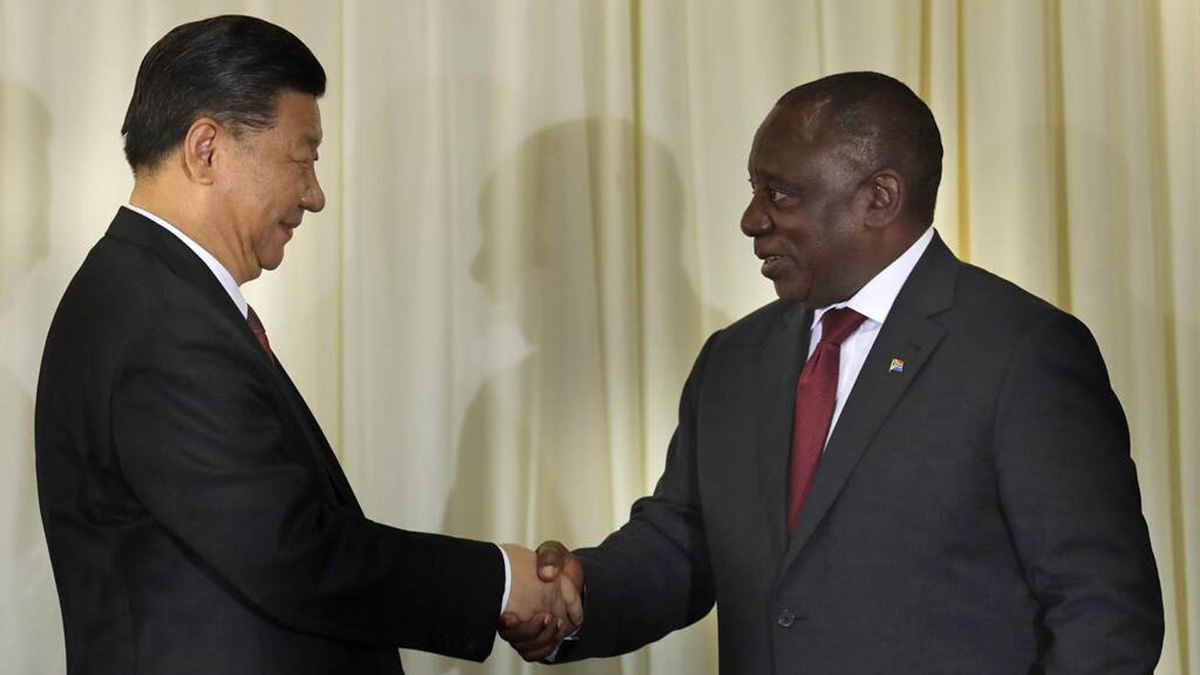
 "(File) South African President Cyril Ramaphosa, right, shakes hand with Chinese President Xi Jinping. AP")
As President Cyril Ramaphosa embarks on his State Visit to China and participates in the Forum on China-Africa Cooperation (FOCAC) Summit, the spotlight shines brightly on the evolving relationship between China and South Africa. This visit, scheduled from September 2 to 5, 2024, marks a significant moment in a partnership that has continually grown in both scope and significance. From their historic ties dating back to South Africa’s struggle against apartheid to their current role as leading players in the Global South, the bilateral relationship between these two nations is redefining the landscape of international cooperation. With China as South Africa’s largest trading partner and South Africa being China’s foremost partner in Africa, their collaboration is set to influence development strategies and global policies. As they sign new agreements and co-chair key discussions at FOCAC, their strengthened alliance promises to set new benchmarks for economic and strategic partnerships worldwide.
Economic ties: Backbone of the relationship
Economic cooperation forms the bedrock of China-South Africa relations, with both nations benefitting from a robust trade partnership. China is South Africa’s largest trading partner globally, while South Africa holds the position of China’s number one trading partner in Africa. Bilateral trade has seen impressive growth, rising from R614 billion in 2022 to R692 billion in 2023. This trade relationship is marked by mutual benefit and win-win results, with South African products such as wine, rooibos tea and aloe vera gels gaining popularity in China while Chinese automobiles and home appliances are increasingly common in South African households.
The partnership extends beyond trade with significant Chinese investments in South Africa contributing to local economic development. Over 200 Chinese companies operate in South Africa creating more than 400,000 jobs. These investments, valued at approximately $10 billion, have positioned South Africa as one of the leading African nations in terms of Chinese investment. On the flip side, South African companies are also exploring opportunities in the Chinese market, eager to tap into its vast consumer base and growing demand for diverse products.
Strategic cooperation in development and modernisation
The China-South Africa partnership is not limited to economic ties but extends into areas critical for national development and modernisation. The bilateral cooperation is underpinned by a Ten-Year Strategic Programme of Cooperation (2020–2029), which aims to strengthen collaboration in sectors such as infrastructure, logistics, manufacturing, agriculture and science and technology. This strategic framework aligns with both China’s Belt and Road Initiative (BRI) and South Africa’s Economic Reconstruction and Recovery Plan, creating synergies that drive forward the development agendas of both countries.
Impact Shorts
More ShortsDuring President Ramaphosa’s visit beginning on 2 September, several key agreements are expected to be signed, particularly in human settlements, agriculture and science and technology. These agreements are designed to enhance technical cooperation, support South Africa’s efforts in modernisation and build the foundation for sustained economic growth. The visit to Shenzhen, China’s economic technology hub, highlights South Africa’s commitment to embracing technological advancements and integrating them into its development strategies.
China-South Africa cooperation in a global context
The bilateral relationship between China and South Africa also plays a critical role in the broader context of global governance and South-South cooperation. Both nations have consistently advocated for a more equitable international order and have championed the interests of developing countries in global forums. This shared commitment was evident during the recent BRICS Summit, where both countries emphasised the importance of multilateralism, the need for greater representation of Global South countries in international organizations, and the pursuit of sustainable development goals.
President Xi Jinping has repeatedly stressed the importance of China and South Africa being global partners that uphold justice and work together to address common challenges. The two nations have collaborated on initiatives such as the Global Development Initiative, the Global Security Initiative and the Global Civilisation Initiative, all of which aim to promote peace, security and sustainable development on a global scale. China’s support for South Africa’s role in international and regional affairs is a testament to the deep mutual respect and strategic alignment between the two countries.
FOCAC and the future of China-Africa relations
The Forum on China-Africa Cooperation (FOCAC) serves as a crucial platform for enhancing the relationship between China and the entire African continent. The 2024 FOCAC Summit, held under the theme Joining Hands to Advance Modernisation and Build a High-Level China-Africa Community with a Shared Future, reflects the commitment of both China and Africa to work together towards modernisation and sustainable development.
South Africa, as a key participant in FOCAC, plays a significant role in shaping the agenda and ensuring that the outcomes align with Africa’s development priorities as outlined in the African Union’s Agenda 2063. The Declaration and Action Plan (2025–2027) that will be issued at the conclusion of the summit is expected to focus on areas such as industrialisation, agricultural modernisation, green development and technological innovation. These initiatives are designed to propel Africa towards a more prosperous and sustainable future, with China serving as a critical partner in this journey.
A relationship poised for greater heights
As President Ramaphosa’s State Visit to China unfolds, it is clear that the China-South Africa relationship is entering a new phase of strategic cooperation and mutual benefit. The strong economic ties, coupled with shared commitments to development and global governance, position both nations as key players in shaping the future of the Global South. The outcomes of the FOCAC Summit which begins on 4 September and the bilateral agreements signed during this visit will likely further strengthen this partnership, setting the stage for even deeper cooperation in the years to come. As the world faces increasing challenges and uncertainties, the China-South Africa relationship stands as a testament to the power of collaboration, solidarity and shared vision in achieving sustainable development and global stability.