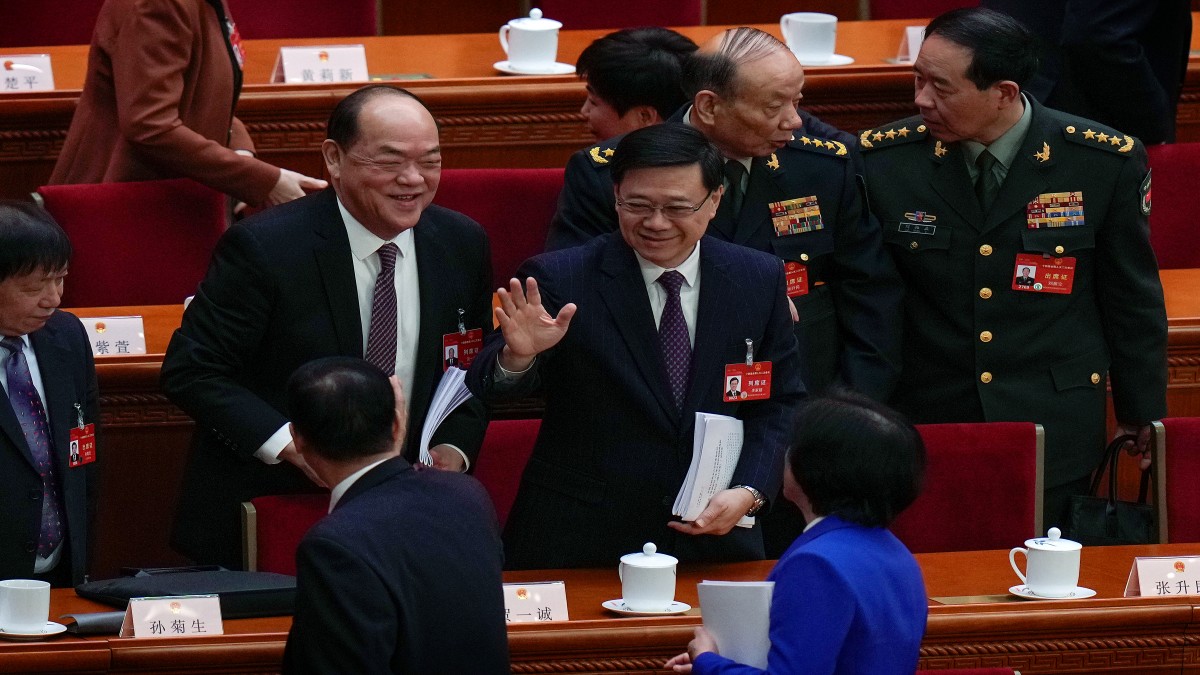
 "Hong Kong Chief Executive John Lee, center, waves to delegates after the opening session of the National People's Congress (NPC) at the Great Hall of the People in Beijing. AP")
Following Beijing’s implementation of a similar legislation four years ago that essentially eliminated opposition, Hong Kong published a new national security bill on Friday that calls for up to life imprisonment for crimes including treason and rebellion. This development intensifies concerns about future erosion of the city’s liberties.
The proposed law would target espionage, outside intervention, and the safeguarding of state secrets, among other things, and increase the government’s ability to crush any future threats to its authority. Sedition was also urged to have harsher punishments.
Hong Kong leader John Lee has urged lawmakers to complete the legislative procedure “at full speed,” and they are scheduled to begin their discussion on Friday in a meeting particularly convened to hasten it. The law is anticipated to pass quickly, maybe in weeks, in a legislature stacked with Beijing supporters following an election change.
Critics have warned that the law will make Hong Kong’s legal structure more comparable to that of mainland China, contributing to a decrease in human rights that were pledged to be protected for 50 years when the former British colony reverted to Chinese sovereignty in 1997.
However, the administration used the major anti-government rallies that erupted in the city in 2019 to justify its necessity, claiming that it would only affect “an extremely small minority” of disloyal citizens.
Under the new legislation, inciting a foreign country to attack China with force may result in a maximum sentence of life imprisonment for treason. Committing violence while recklessly endangering the city’s public safety as a whole may be deemed rebellion.
Impact Shorts
More ShortsThe government also suggested harsher penalties when residents collude with foreign forces to commit certain offenses, as opposed to doing them independently.
If they damage public infrastructure, including the airport and other public means of transport, with the intent of endangering national security, they face maximum penalty is imprisonment for 20 years. But if they collude with an external force in doing so, they could be sentenced for life.
Similarly, those who commit a sedition offense face a jail term of seven years but colluding with an external force to carry out such acts increase that penalty to 10 years.
Its expansive definition of external forces include foreign governments and political parties, international organizations, and companies when their directors are obligated to act in accordance with the wishes of a foreign government.
Hong Kong’s mini-constitution, the Basic Law, requires the city to enact a homegrown national security law. But a previous attempt to pass a version of the law sparked a massive street protest that drew half a million people, and the legislation was shelved.
Huge protests against the current bill are unlikely to be repeated due to the chilling effect of the 2020 law. After it was enacted to quell the 2019 protests, many of the city’s leading pro-democracy activists have been arrested and others fled abroad. Dozens of civil society groups have been disbanded, and outspoken media outlets like Apple Daily and Stand News have been shut down.
During a one-month public comment period that ended last week, 98.6% of the views received by officials showed support, and only 0.72% opposed the proposals, the government said. The rest purely contain questions or opinions that cannot reflect the authors’ stance, it added.
But business people and journalists have expressed fear that a broadly framed law could criminalize their day-to-day work.