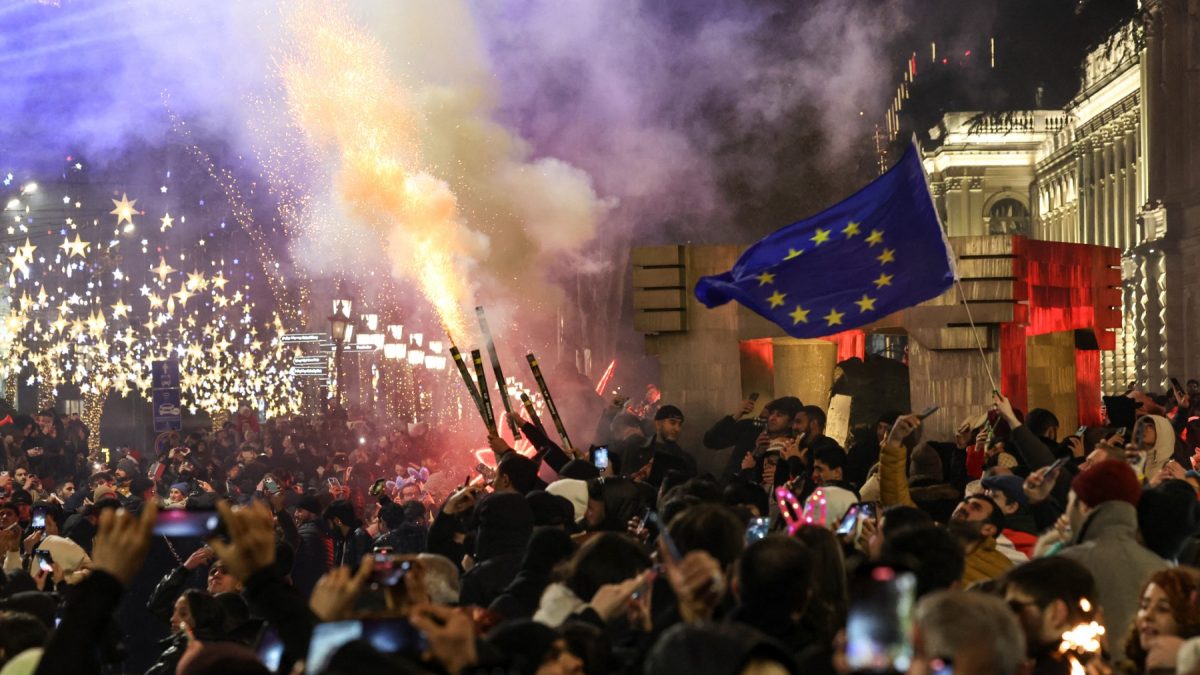
 "Anti-government demonstrators protest against the Georgian government's postponement of European Union accession talks until 2028, outside the parliament in central Tbilisi on December 31, 2024, the New Year's Eve. (AFP)")
Georgian authorities are facing explosive allegations that they deployed a dangerous, obsolete chemical weapon, a compound known as “camite” used in World War One, to suppress massive anti-government protests in late 2024.
Evidence gathered by a BBC World Service investigation points to the use of the persistent agent in water cannons against demonstrators protesting the government’s suspension of its European Union accession bid.
Protester testimony collected by the BBC paints a vivid picture of extreme pain and long-lasting effects. One protester, Gela Khasaia, described the sensation of being sprayed by water cannons, stating, “You could feel [the water] burning,” a sensation that could not be easily washed away. Other demonstrators reported severe long-term symptoms, including shortness of breath, persistent coughing, and vomiting that lasted for weeks.
Dr Konstantine Chakhunashvili, a pediatrician who was sprayed and later ran a study on victims, confirmed the severity, noting his own skin felt like it was burning for days. His peer-reviewed study, which found nearly half of surveyed protesters suffered side-effects for more than 30 days, showed effects inconsistent with conventional riot control agents like CS gas.
The BBC’s findings, gathered from experts, doctors, and police whistleblowers, suggest the chemical is bromobenzyl cyanide, also known as camite. Professor Christopher Holstege, a leading toxicology and chemical weapons expert, assessed the evidence—including victim accounts and police inventory records—concluding the symptoms “are consistent with bromobenzyl cyanide.” He emphasised the persistence of the clinical effects is “not consistent with the typical agents used for crowd dispersal.”
Adding weight to the claim, former high-level riot police official Lasha Shergelashvili confirmed testing a similar chemical in 2009 that was unlike regular tear gas, noting it could not be easily washed off and remained potent for days. He told the BBC he immediately suspected the same chemical was deployed during the 2024 protests.
Quick Reads
View AllDespite the mounting evidence, the Georgian authorities staunchly rejected the investigation’s findings, describing them as “absurd” and “deeply frivolous.” They maintained that police had acted legally and “within the bounds of the law and constitution” in response to the “illegal actions of brutal criminals.”
The potential use of such an obsolete and potent agent has drawn condemnation from international bodies. UN Special Rapporteur on Torture, Alice Edwards, stressed that under international law, populations should “never be subjected to experiments,” suggesting the described symptoms warrant investigation under the rubric of “torture or other ill-treatment.”