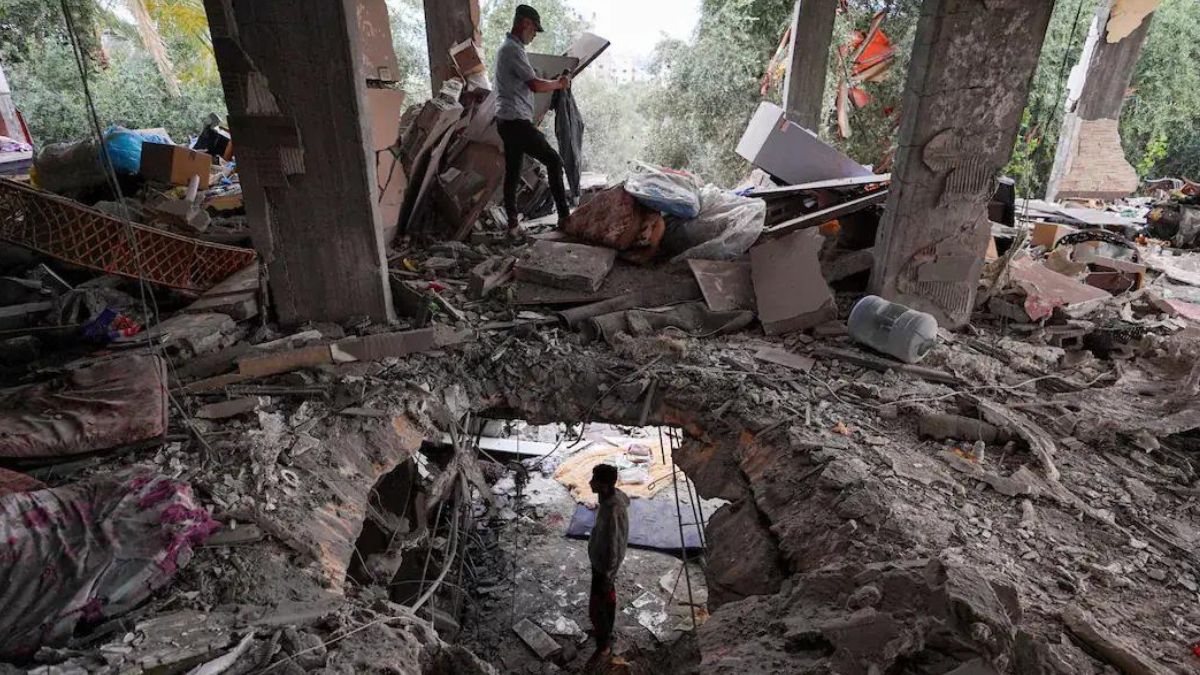
 "According to Biden, Israel's three-stage offer would begin with a six-week phase that would see Israeli forces withdraw from all populated areas of Gaza and an initial hostage-prisoner exchange Image Courtesy AFP")
Heavy violence erupted for the third day since US President Joe Biden’s White House statement on Monday, casting doubt on a proposal for a Gaza truce and hostage release arrangement.
On Friday, Biden unveiled what he called an Israeli three-phase plan that would free all captives, put an end to the horrific conflict, and allow the destroyed Palestinian region to be rebuilt without Hamas holding power.
But, Netanyahu’s office emphasized on Saturday that Israel would continue the battle it began on October 7 when Palestinian terrorists attacked southern Israel, calling for the elimination of Hamas’s military and political capacities, until all of its “goals are achieved”.
The degree of coordination between Biden’s speech and Netanyahu’s staff on key issues, such as the duration of any truce and the timing of detainee release, has been called into question by Israeli media.
Afterwards, the three mediators—the US, Qatar, and Egypt—expressed their desire for “finalization of the agreement embodying the principles outlined by President Joe Biden, on both Hamas and Israel.”
According to John Kirby, a spokesman for the White House National Security Council, “we have every expectation that if Hamas agrees to the proposal… that Israel would say yes” on Sunday.
In a phone conversation with war cabinet member Benny Gantz and defense minister Yoav Gallant, US Secretary of State Antony Blinken “commended” Israel on the proposal, according to the State Department.
Impact Shorts
More ShortsHowever, as the Gaza conflict, which is about to enter its ninth month and has destroyed the 2.4 million-person Palestinian coastal region, continues, the bombardments and fighting show no signs of stopping.
The Israeli military declared on Monday that it had hit “over 50 targets in the Gaza Strip” on the previous day.
At least 19 individuals were reportedly slain in nighttime attacks, according to Gaza hospitals on Monday.
Based on Israeli official data, an AFP tally shows that 1,190 people, largely civilians, were killed in Hamas’s October 7 attack, which set off the Gaza conflict.
Around 250 hostages were also taken by combatants; 120 of them are still in Gaza, including 37 that the army claims are dead.
At least 36,439 individuals have died in Gaza as a result of Israel’s retaliatory bombings and military assault, the majority of whom were civilians, according to the health ministry of the Hamas-run enclave on Sunday.
UN agencies report that most civilians have once again been forced to flee their homes as a result of the intense fighting, which has been concentrated in Gaza’s far-southern Rafah sector near the Egyptian border.
News agency AFP qouted witnesses as saying that artillery fire and airstrikes were heard in Gaza City and Rafah, primarily in the Tal al-Sultan neighborhood.
“Troops are continuing intelligence-based targeted operations in the Rafah area,” the army said.
“Over the past day, the troops conducted scans and located terror infrastructure and large quantities of weapons.”
Gaza’s European hospital said 10 people were killed and several wounded in an Israeli air strike on a house near the main southern city of Khan Yunis.
And six people were reported killed in a strike on a family home in the central Bureij refugee camp, according to Al-Aqsa Martyrs hospital.
Netanyahu – a hawkish veteran leading a fragile coalition government often described as the most right-wing in Israel’s history – is under intense domestic pressure from two sides.
Relatives and supporters of hostages have staged mass protests demanding that he strike a truce deal – but the premier’s far-right coalition allies are threatening to bring down the government if he does.
According to Biden, Israel’s three-stage offer would begin with a six-week phase that would see Israeli forces withdraw from all populated areas of Gaza and an initial hostage-prisoner exchange.
Both sides would then negotiate for a lasting ceasefire, with the truce to continue as long as talks are ongoing, Biden said, adding it was “time for this war to end”.
Netanyahu took issue with Biden’s presentation, insisting that according to the “exact outline proposed by Israel” the transition from one stage to the next was “conditional” and crafted to allow it to maintain its war aims.
Finance Minister Bezalel Smotrich and National Security Minister Itamar Ben Gvir, leaders of extreme-right parties, warned they would leave the government if it endorsed the truce proposal.
But opposition leader Yair Lapid, a centrist former premier, said the government “cannot ignore Biden’s important speech” and vowed to back Netanyahu if his far-right coalition partners quit.
Gallant, who has criticised Netanyahu over the lack of a post-war plan for Gaza, said Sunday that Israel was “assessing a governing alternative” to Hamas to rule the territory after the war ends.
UN and other aid agencies have warned for months of the looming risk of famine in the besieged territory.
At a hospital in Deir al-Balah, 33-year-old Amira al-Taweel told AFP that her frail son, suffering from malnutrition, “needs treatment and milk, but there’s none available in Gaza”.
Israel’s seizure last month of the Rafah crossing has further slowed sporadic aid deliveries for Gaza’s people and effectively closed its main exit point on the Egyptian border.
Cairo refuses to coordinate with Israel humanitarian deliveries through Rafah, but has agreed to send some aid via Israel’s Kerem Shalom crossing.