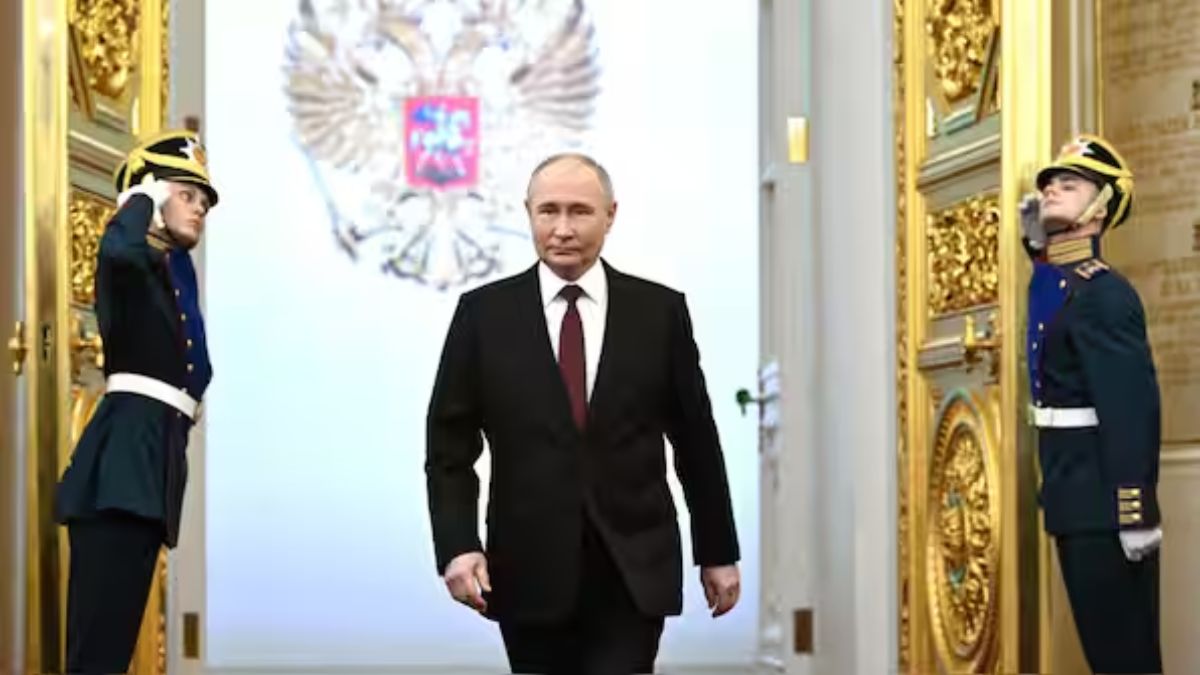
 "President-elect Vladimir Putin arrives for his inauguration ceremony at the Kremlin in Moscow, Russia, on May 7, 2024. (Photo: Kremlin)")
When Vladimir Putin took over as Acting President of Russia on New Year’s Eve in 1999, he was not a household name at home and barely known abroad. Now, more than 25 years later, the world recognises him as one of the most powerful rulers in modern history.
In this 25-year rule, Putin has turned a nation struggling after the Soviet collapse into a global power. He rose on the promise of stability and security.
After 15 years in the Soviet spy agency KGB, Putin entered politics in the early 1990s in his hometown of St Petersburg. Within a few years, he moved to Moscow, steadily climbing the ranks to become Russia’s Prime Minister in August 1999.
The moment that shaped Putin
Putin was inspired to join the KGB in 1975 after watching the film ‘The Sword and the Shield ’ (1968). But the moment that cemented his worldview —and would shape Russia decades later— came in 1989 with the fall of the Berlin Wall.
Putin was stationed in Dresden, East Germany, when the Wall fell. That moment marked the lowest point for the Soviet Union in its great power rivalry with the West.
According to widely reported accounts, Putin watched from the local KGB headquarters as crowds stormed the Stasi offices, East Germany’s secret police, in Dresden. He is said to have single-handedly warned off the mob as it approached the KGB facility though this account is disputed by some. Later, when he reportedly requested a tank squad for help, he was told there would be no intervention without Moscow’s authorisation — which never came.
Historians and biographers note that the fall of the Berlin Wall and Moscow’s failure to respond deeply shaped Putin’s worldview and later policies. Already proud of Russia, the Dresden experience pushed him to commit to restoring Russian greatness, which he saw as being in decline. He also became a firm believer in centralised power and a securitised state.
Quick Reads
View AllBoth beliefs —lessons drawn from the Soviet collapse— became cornerstones of his rule.
From an unknown to a world leader
Few knew Putin when he became Acting President on New Year’s Eve in 1999, but he had already begun to make his mark.
Earlier in 1999, as confidence in the Russian state hit rock bottom, a series of bombings killed hundreds. Amid public anger, newly appointed Prime Minister Putin rose to the occasion. He launched a counter-terrorism campaign that led to the Second Chechen War. He declared: “Should we catch them in the toilet, we will whack them in the outhouse after all. That’s it. The subject is closed for good.”
With that statement, Putin signalled to Russians that they finally had a no-nonsense leader who would not tolerate violence and terrorism.
Putin’s political rise was meteoric. After leaving the KGB, he returned to Russia and joined Anatoly Sobchak, his former university teacher and then Mayor of St Petersburg, as an adviser. He became Deputy Mayor in 1994. Two years later, Putin moved to Moscow and joined the presidential administration as deputy to Pavel Borodin, the Kremlin’s chief administrator. His rise in Moscow was rapid—far quicker than in St Petersburg.
In 1998, President Boris Yeltsin appointed him head of the FSB, the successor to the KGB, and soon promoted him to Secretary of the Security Council. In August 1999, Yeltsin named him Prime Minister.
From an unknown figure, Putin consolidated power and centralised governance — drawing on lessons from the Soviet collapse. He reined in the oligarchs who had flourished under Yeltsin and ousted those who might challenge his authority. He nationalised several companies privatised during the 1990s’ “shock therapy” and ensured his loyalists controlled them. He also placed trusted allies in key government positions and shaped Russian politics around himself.
The result was that Putin acquired powers comparable to the tsars of imperial Russia. Critics accused him of expansionism, but Putin argued his actions were a response to NATO’s eastward expansion. He said this forced him to intervene in Ukraine first in 2014 and later in 2022. Earlier, he intervened in Georgia, claiming ethnic Russians were being harassed there.
While critics called these moves expansionist, they undeniably reshaped Europe’s post-World War II geopolitics and re-established Russia as a great power — the same greatness Putin saw slipping away in Dresden. Putin now stands as one of the most powerful rulers in the world in defiance of Western sanctions and rhetoric.