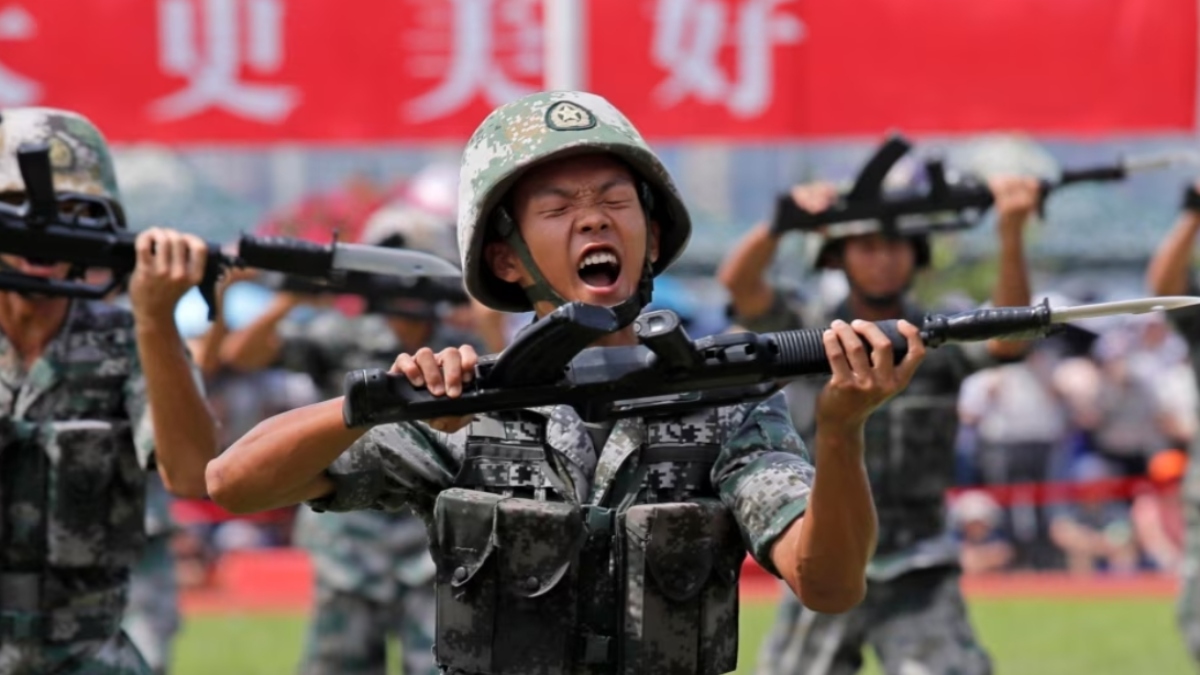
 "In this June 30, 2019, file photo, soldiers of Chinese People's Liberation Army demonstrate their skill during an open day of Stonecutter Island naval base, in Hong Kong. China is revising its National Defense Education Law to expand military training. AP File")
As part of its efforts to raise awareness among young people about national security, schools in China are conducting national defence education classes to prepare students to counter what China perceives as foreign ideological influences.
According to a South China Morning Post report, these classes are one of many similar programmes being held around the country to sow “seeds of patriotism” among its youth.
They come as patriotic fervour is on the rise – driven by Beijing – in response to geopolitical rivalries, notably with countries like the US, and as analysts express concerns about declining military recruitment levels due to factors such as falling birth rates, added the report.
Following former US House Speaker Nancy Pelosi’s visit to Taiwan in August 2022, which Beijing interpreted as part of US efforts to contain its rise, schools across China have intensified their military education programs.
China is also making changes to a law in a bid to boost national defence education, including exploring ways to enhance the combat skills of teenagers to prepare for potential risks in a “complex and ever-changing security and development environment”.
According to the report, citing experts, the trends underline growing concerns in Beijing over what are seen as geopolitical risks, and challenges to attract young people to join the military, all while experts attempt to extract military lessons from key battlegrounds like Ukraine.
“The world is not peaceful, the education on patriotism and national defence should be cultivated from an early age,” South China Morning Post report quoted Chinese military analyst Fu Qianshao as saying.
Impact Shorts
More Shorts“In the future, when war breaks out, all citizens must be mobilised, which can be seen in the Ukraine war,” Fu added.
The ramp-up in military education extends beyond classroom lectures. Recent years have seen Chinese universities incorporating drones and rocket launchers into combat training, while even kindergarten-age children visit military camps to foster what military commanders term as the “seeds” of a “strong military.”
Catching them young
For decades, alongside its predominantly voluntary conscription system, China has implemented a public military education system that mandates training in high schools and universities. This approach, while not widely adopted globally, shares similarities with practices observed in Russia and North Korea.
Russia reintroduced compulsory military training for high school students in 2023, a year after its invasion of Ukraine, marking a return to a practice abandoned after the Soviet Union’s collapse.
Many countries offer some form of national defence education through optional courses, specialised military academies, or organisations focusing on values and skills development for young people.
In Chinese high schools, military training echoes the ethos of organisations like the Boy Scouts of America, founded in 1910, which integrate patriotic themes into various activities and educational programs. Notably, the Chinese version of such training is mandatory.
Amid escalating geopolitical challenges, Beijing has underscored the need to bolster support among China’s youth for its military efforts.
Recent amendments to China’s National Defense Education Law, the first since 2018, emphasise enhancing military education for teenagers.
Under the proposed changes, primary school students as young as six would be required to receive compulsory military “awareness” classes, as outlined in a draft presented in April to the Standing Committee of the 14th National People’s Congress (NPC).
Additionally, junior high schools may soon initiate military training programs for students aged 12-15, complementing existing mandatory programs in universities and high schools.
These amendments, currently under review for potential second or third readings, form part of a broader set of policy initiatives rolled out in recent years. In 2022, directives from the Central Committee of the Chinese Communist Party mandated the integration of national defense education into school curricula and examinations, with primary schools urged to conduct week-long combat training sessions.
By January this year, 2,431 primary and secondary schools had been selected for pilot programs aimed at enhancing military awareness and skills among children, according to a South China Morning Post report.
Lu Li-shih, a former instructor at the Taiwanese naval academy in Kaohsiung, told South China Morning Post that patriotism stands as a cornerstone of national defence education.
“If you receive national defence education as early as possible, whether it is physical fitness, national identity, or the construction of patriotic thinking, you will have a correct view on how to protect the country,” South China Morning Post quoted Lu as saying.
“Now that the US is joining forces with allies to launch all-round containment on China, including in science and technology, strengthening defence education is very important for uniting national consciousness,” he added.
Drones and combat training
In the 1980s, China’s short-term military training for students mainly consisted of marching, drills, and physical exercises. Today, these programs have evolved significantly, incorporating advanced elements like drone operations and simulated battlefield scenarios.
According to South China Morning Post, citing The Beijing News, students at Guilin University of Electronic Technology in Guangxi Zhuang Autonomous Region engaged in combat training with rocket launchers and simulated drone attacks. Similarly, Peking University students conducted gun target practice, while Shanghai Jiao Tong University organised night marches to simulate air attack scenarios.
Unlike countries with conscription requiring longer service periods, China’s military education spans various school levels, integrating courses, lectures, and visits to military sites and camps. Even kindergarten children have observed frontline soldier training, fostering early patriotism and military awareness.
Recruitment challenges
Amid recruitment challenges and geopolitical tensions, Beijing is intensifying military indoctrination efforts.
President Xi Jinping’s emphasis on Taiwan’s reunification and the necessity of legislative amendments underscore the strategic importance of bolstering China’s military readiness and national defence capabilities.
Many of China’s challenges in attracting people to enlist in military service can be traced to demographics, as the country’s population ages and the proportion of young people declines.
However, a “weak sense"of national defence is also a factor, added the report, citing a paper published in Contemporary Youth Research in 2014.
Because they have grown up in an extended era of peacetime, younger generations are increasingly influenced by “hedonistic” trends in social media that steer them away from military service, said the report, citing a proposal by a Chinese local advisory body.
With inputs from agencies