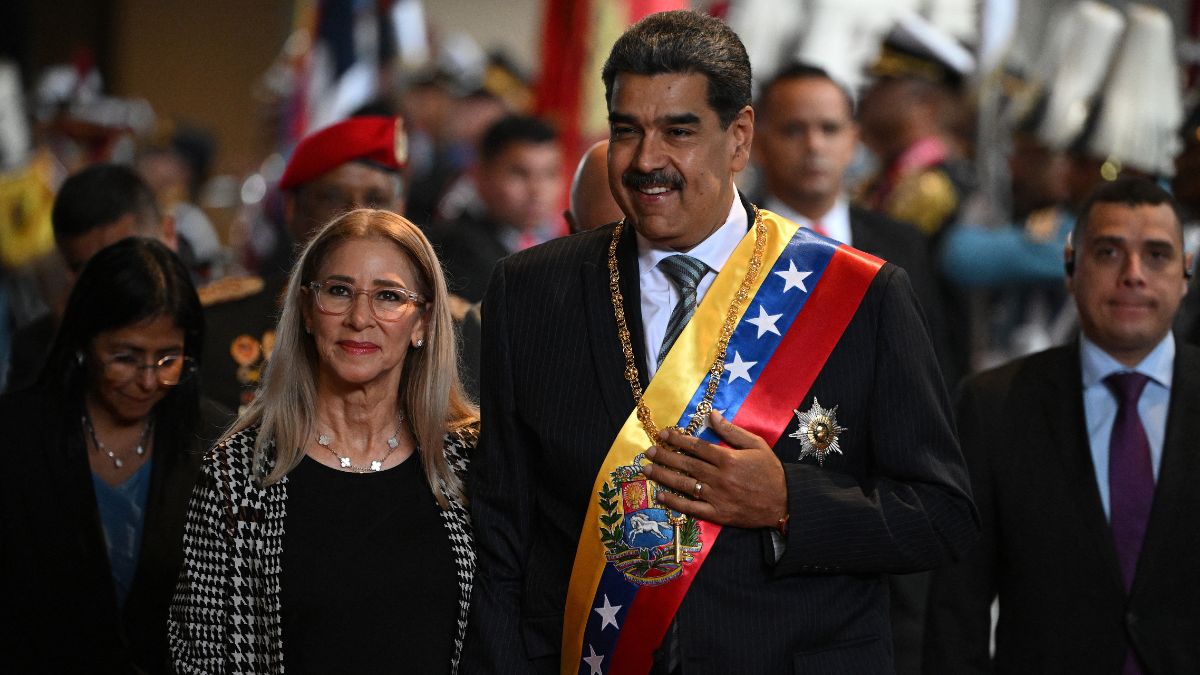
 "Maduro’s 12-year rule in Venezuela finally ended by Trump")
Nicolas Maduro’s unceremonious removal from power brings a dramatic close to one of Latin America’s most polarising political chapters. For more than 12 years, the Venezuelan leader ruled with an increasingly authoritarian grip, weathering economic collapse, mass protests, international isolation and repeated challenges to his legitimacy.
That era ended abruptly on Saturday when US President Donald Trump announced that American forces had captured Maduro and flown him out of the country, following what Washington described as a large-scale military operation.
The development capped months of intensifying US pressure on Caracas, combining sanctions, maritime interdictions and intelligence operations. It also marked the most decisive foreign intervention in Venezuela’s long-running political crisis, raising new questions about the country’s future and the regional fallout of Maduro’s fall.
A rule defined by repression and economic collapse
Maduro, a 63-year-old socialist and the handpicked successor to revolutionary leader Hugo Chavez, took office in 2013 after narrowly winning an election following Chavez’s death. Unlike his charismatic predecessor, Maduro struggled to consolidate popular support even in his early years, governing an oil-dependent economy already showing structural weaknesses.
Those problems soon spiralled into a prolonged economic meltdown. Inflation surged, food and medicine shortages became widespread and the once relatively affluent nation descended into a humanitarian crisis.
An estimated 7.7 million Venezuelans fled the country during Maduro’s presidency, one of the largest migration waves in modern history. According to United Nations data, nearly 82 per cent of the population lives in poverty, with more than half in extreme poverty.
Politically, Maduro entrenched his power through contested elections and harsh crackdowns on dissent. His re-elections in 2018 and 2024 were widely rejected by the opposition, the United States and several Western governments, which cited irregularities, voter suppression and the jailing of rivals. After his swearing-in for a third term in January 2025, security forces detained thousands of protesters who challenged the results.
Quick Reads
View AllInternational scrutiny of his government’s record grew steadily. A UN fact-finding mission last year concluded that Venezuela’s security forces committed serious human rights violations and crimes against humanity, including torture, arbitrary arrests and killings targeting political opponents.
Defiance of Washington and growing isolation
Maduro styled himself as a bulwark against US influence in Latin America, frequently accusing Washington of plotting to overthrow his government and seize Venezuela’s oil wealth. He dismissed sanctions as an “economic war” and portrayed his rule as part of a broader anti-imperialist struggle, earning vocal support from allies such as Cuba and Iran.
That defiance intensified under Trump’s renewed presidency. After Washington authorised covert intelligence operations in Venezuela last October, Maduro warned of “demonic powers” seeking to destabilise the country.
His rhetoric did little to stem mounting pressure. In August, the US doubled a reward for his arrest to $50 million, citing allegations of drug trafficking and links to criminal organisations, charges Maduro consistently denied.
By the end of 2025, Trump had dramatically expanded America’s military footprint in the southern Caribbean and Pacific, alongside dozens of strikes on vessels allegedly linked to narcotics trafficking. Saturday’s announcement of Maduro’s capture followed this sustained escalation, signalling Washington’s determination to decisively dismantle his rule.
From working-class roots to contested power
Maduro’s rise to power was once a key pillar of his political narrative. Born in 1962 into a working-class family, he worked as a bus driver and trade union activist before becoming involved in Chavez’s socialist movement after the latter’s failed coup attempt in 1992. Maduro campaigned for Chavez’s release from prison and later emerged as a loyal lieutenant in the Bolivarian revolution.
Following Chavez’s election in 1998, Maduro climbed steadily through the ranks, serving as a lawmaker, president of the National Assembly and foreign minister. In the latter role, he built alliances across the developing world, leveraging oil revenues to expand Venezuela’s influence.
Yet critics often portrayed him as a weaker echo of Chavez, lacking both ideological depth and mass appeal. As oil prices fell and subsidies became unsustainable, his government resorted to price controls, shop seizures and heavy-handed interventions that further distorted the economy. Over time, repression replaced populism as the regime’s main tool for survival.
His political life was closely intertwined with that of his wife, Cilia Flores, a powerful insider who held senior posts including attorney general and parliamentary leader. Trump said she was also captured during the operation, a move that dismantles the ruling family’s grip on power.
An uncertain future for Venezuela
Maduro’s sudden fall leaves Venezuela at a crossroads. Supporters view him as a leader who resisted foreign dominance, while opponents see his removal as long overdue accountability for years of economic ruin and rights abuses.
What comes next will depend on whether Venezuela can transition towards political stability without further violence, and whether international actors can agree on a path forward that avoids deeper division.
For now, the end of Maduro’s rule has reshaped Venezuela’s political reality, closing the chapter on a leader who rose from the driver’s seat of a bus to the presidency and whose reign ended not at the ballot box, but through foreign intervention led by Washington.
With inputs from agencies

 "Trump announces 25% tariff on Iran’s trading partners. How India may be affected")
 "India, US to resume BTA talks after 5 months as Gor pushes for trade deal with 'real friends'")
 "ICC sources rubbish Bangladesh sports adviser’s sensational claim of BCB being asked to drop Mustafizur")
 "Jerome Powell: The 'Fed chair with a spine' taking on Trump")
 "Trump announces 25% tariff on Iran’s trading partners. How India may be affected")
 "India, US to resume BTA talks after 5 months as Gor pushes for trade deal with 'real friends'")
 "ICC sources rubbish Bangladesh sports adviser’s sensational claim of BCB being asked to drop Mustafizur")
 "Jerome Powell: The 'Fed chair with a spine' taking on Trump")