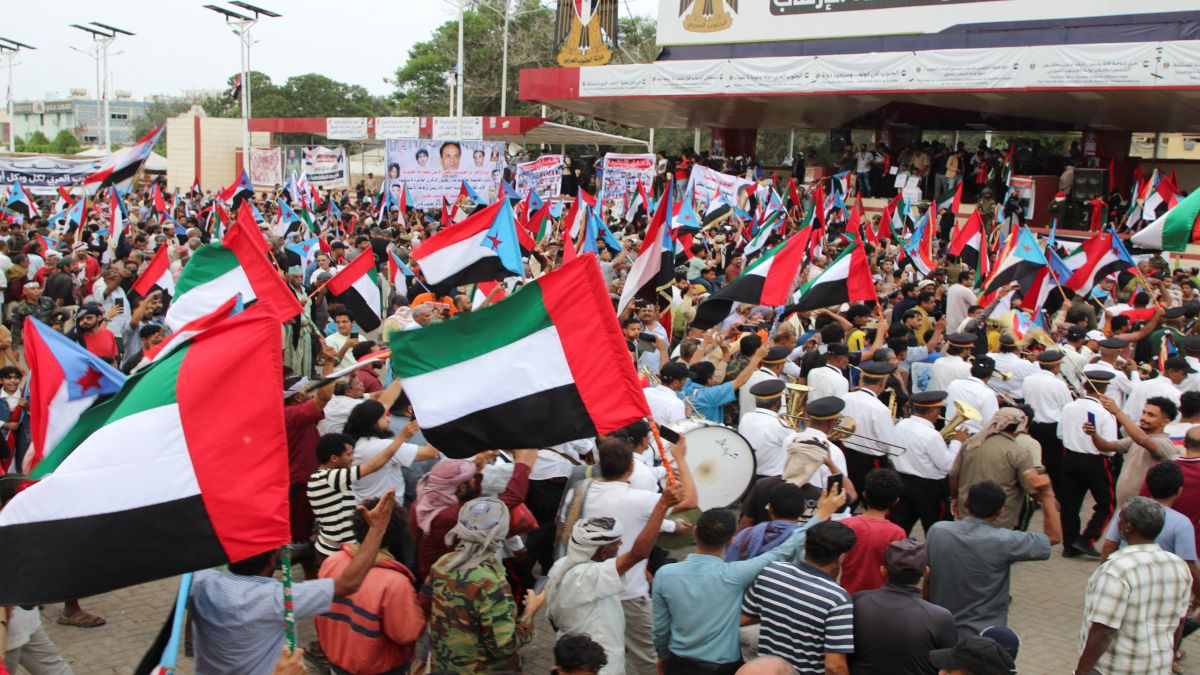
 "Supporters of the UAE-backed separatist Southern Transitional Council (STC) wave flags of the United Arab Emirates and of the STC, during a rally in Aden, Yemen. Reuters")
A Saudi airstrike on what it said was a UAE-linked weapons shipment in Yemen on Tuesday marked the most significant escalation between Riyadh and Abu Dhabi to date. Once the twin pillars of regional security, the two Gulf heavyweights have seen their interests diverge on everything from oil quotas to geopolitical influence.
Here is a timeline of how the relationship has evolved:
2011: As the Arab Spring spreads, the two form a unified front against Islamist movements, deploying joint forces to Bahrain to quell an uprising and coordinating support for Egypt’s 2013 military overthrow of the Muslim Brotherhood government.
March, 2015: They launch a military intervention in Yemen to restore the government ousted by the Iran-aligned Houthis. UAE troops lead ground operations, while Saudi air power controls the skies.
June, 2017: The allies lead a boycott of Qatar, accusing Doha of supporting terrorism, charges it denies. The move cements the alignment between Crown Prince Mohammed bin Salman (MBS) and UAE leader Sheikh Mohammed bin Zayed (MBZ).
2019: The UAE draws down troops in Yemen, shifting strategy but retaining influence through the separatist Southern Transitional Council (STC), leaving Riyadh to shoulder the war against the Houthis.
September, 2020: The UAE normalizes ties with Israel under the U.S.-brokered Abraham Accords. Saudi Arabia, the custodian of Islam’s two holiest sites, declines to follow suit, insisting on Palestinian statehood first, giving Abu Dhabi a unique diplomatic channel to Washington.
Quick Reads
View AllJanuary, 2021: Saudi Arabia leads the Al-Ula summit to end the Qatar dispute. The UAE signs reluctantly, maintaining a cooler stance toward Doha.
February, 2021: Riyadh challenges Dubai’s commercial dominance, telling foreign firms to move regional HQs to the kingdom by 2024 or lose state contracts.
July, 2021: Economic rivalry spikes. Riyadh removes tariff concessions for goods from free zones, undercutting the UAE’s trade model. Simultaneously, a rare dispute erupts at OPEC as the UAE blocks a Saudi-led deal, demanding a higher crude oil production baseline.
April, 2023: In Sudan’s war, Riyadh hosts ceasefire talks supporting the army, while UN experts accuse the UAE of arming the rival Rapid Support Forces, which Abu Dhabi denies.
December 8, 2025: Tensions peak in Yemen as the UAE-backed STC seizes oilfields in Hadramout, crossing a Saudi “red line."
December 30, 2025: Saudi jets strike a vessel in Mukalla. The coalition says the ship was delivering heavy weapons to separatists, marking the first direct engagement between the partners’ interests.
(Except the headline, this story has not been edited by Firstpost staff)