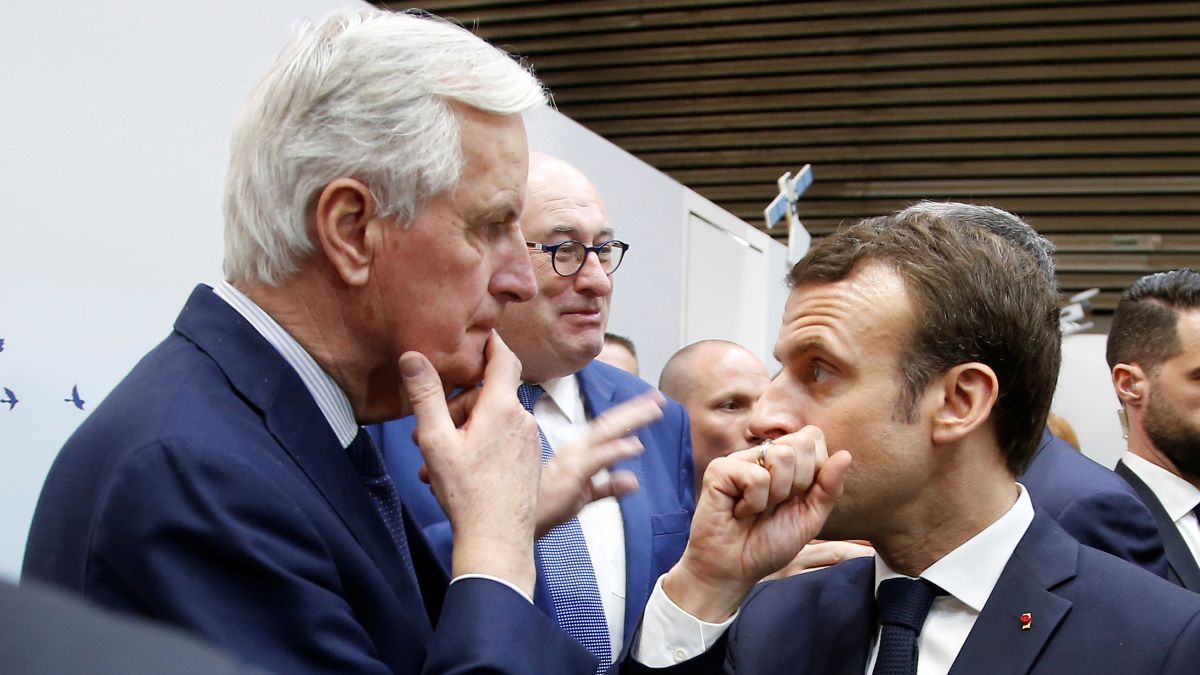
 "French President Emmanuel Macron speaks with then EU Chief Brexit Negotiator Michel Barnier as he visits the International Agriculture Fair (Salon de l'Agriculture) in Paris, France, February 23, 2019. File Image/Reuters")
French President Emmanuel Macron was pushed into a major political conundrum after his appointed Prime Minister Michel Barnier lost a no-confidence motion. The minority coalition led by the right-wing prime minister was toppled in just three months after a no-confidence motion was pushed by an alliance of left-wing parties supported by MPs from Marine Le Pen’s anti-immigration, far-right, National Rally.
On Wednesday, a total of 331 lawmakers in the French National Assembly decided to bring down the government. While Barnier might resign by Thursday, the French President’s office said that Macron will be delivering a televised address by today.
The voting was significant because it was France’s first successful no-confidence vote since a defeat for Georges Pompidou’s government in 1962 when Charles de Gaulle was president. Not only this, but the brief tenure of Barnier’s government has also become the shortest of any administration of France’s Fifth Republic, which began in 1958.
The ousting of Barnier has left the French leader facing the worst political crisis of his two terms as the country’s president. Here’s a look at the long road ahead for Macron as he clutches on to the power till 2027.
How did France get here?
The current crisis in France goes back to Macron’s major political gamble when he called early legislative elections. The inconclusive polls took place in June, leaving the country’s parliament radically divided.
While a left alliance took the largest number of votes but fell short of an absolute majority, Macron’s own centrist grouping suffered losses. Barnier, who is one of the EU’s former Brexit negotiators, was appointed by Macron in September after two months of political paralysis this summer.
Another interesting aspect of the polls was the fact that while the election more or less kept the far-right National Rally party out of government, it gave the party’s leader Le Pen, a kingmaker role in a bitterly fragmented political landscape. It is pertinent to note that in France, the president’s pick of prime minister must win lawmakers’ approval. However, Le Pen has maintained that her party would oppose any candidate from the left-wing alliance even though it got the most seats in the July election.
Impact Shorts
More ShortsWhile Barnier appeased the right, the left complained about his inclination towards the right. Socialist lawmaker Boris Vallaud went on to accuse Barnier of having “locked himself into a humiliating tête-à-tête” with the far right. Since the French parliament is so divided, similar issues will be faced by anyone who Macron picks next.
What happens next?
Just like former French Prime Minister Gabriel Attal, Macron can ask Barnier’s government to stay in power as a caretaker entity until he finds a replacement who wouldn’t immediately be censured by a majority of lawmakers.
With the divided parliament, this might not be an easy task. While the caretaker will have the power to expedite the current affairs, it cannot vote on new laws.
While Macron has no specific deadline to nominate a new prime minister, he has expressed his intention to act swiftly, within the next 24 hours. Macron has already maintained that he will remain in power until the end of his tenure, which is the spring of 2027. However, he can only call for the next parliamentary election next July. Until then, the parliament will continue to remain polarized.
France is currently in a pickle
- Why can’t France have another election before July?
Even if Macron wanted to, he cannot call a fresh parliamentary election in the country because he has already triggered the provision of a snap election in July. According to the Constitution of France, since Macron triggered a snap poll, he can’t call for new elections before next summer.
This means that France will continue to remain in political uncertainty until 2025. However, things can change if Macron himself throws in the towel and resigns. Since the office of the President can’t remain vacant in France, any form of resignation from the French leader would trigger the Presidential election.
However, Macron continues to remain adamant about staying in power. In the past, the French president has ruled out resigning, calling such a scenario “political fiction”. But part of the left and far right have called for his exit.
- The bigger question: What happens to the budget?
Barnier’s key task, which ultimately led to his downfall, was to vote through a budget for 2025 in which he pledged to tackle France’s deficit with €60bn in tax increases and spending cuts. After weeks of a political standoff, the French leader pushed through a social security financing bill, using Article 49.3 of the constitution. The clause allows the government to force through legislation without a vote in parliament.
The move angered the lawmakers, sparking a no-confidence motion brought by the left alliance, and another brought by the far right. While Barnier’s minority coalition was essentially propped up by Le Pen, she pulled back her support, saying that the French Prime Minister’s budget was a danger to the country.
What makes matters concerning is the fact that if no budget is voted on December 20, the government can use its constitutional powers to pass the budget by ordinance. The ordinance can be implemented after 50 days of deadlock while the national budget can be implemented after 70 days of debate.
Apart from this, the government can propose emergency legislation that would roll over spending limits and tax provisions from 2024. This will be in place until the arrival of a new government and a new budget in 2025. While France is not at risk of a US-style government shutdown, there is still a financial crisis looming over the European nation.
- The financial crisis is more than a political one
The ongoing situation in France is more of a financial crisis than a political one. The country is already facing a high budget deficit which, at above 6 percent of gross domestic product, is far above the EU’s 3 percent guideline.
France saw a buildup in debt and deficit after spending generously to protect incomes during the pandemic and the rise in energy prices following the Russia-Ukraine war.
The economic woes can be reflected by the fact that on Monday, French bond yields — the interest paid on debt — even surpassed those of the euro zone’s former problem child, Greece, the same country that sparked a region-wide debt crisis in the aftermath of the 2008 global financial crisis. Hence, it is unclear whether the 2024 budget layout can keep the country out of a major economic crisis.
Macron’s woes with PMs
It is pertinent to note that Barnier was the fifth French Prime Minister since Macron came to power in 2017. Each of the premiers under him has served a successively shorter period, and given the ongoing turbulence, the new nominee risks an even shorter term than Barnier.
Interestingly, 73-year-old Barnier will become the oldest individual to assume the role under the Fifth Republic and the shortest-serving premier in the same republic.
Ever since assuming power, Macron has been navigating through a divided parliament, where he was not that popular. This led to him welcoming and saying bye to five prime ministers. The list of premiers includes Édouard Philippe, Jean Castex, Élisabeth Borne, Gabriel Attal and Barnier himself.
In 2017, Macron became the youngest politician to be president of France. His first PM pick was Édouard Philippe, who served the office of the prime minister from 2017 to 2022. Castex held the office from July 2022 until the next election. However, turbulence for Macron started after the 2022 polls.
While the 2022 elections were historic, they became the root of all evil for Macron. The centrist French leader [was the] first French presidential candidate to win reelection since Jacques Chirac defeated Jean-Marie Le Pen in 2002. However, his centrist coalition lost its absolute majority in the same year, resulting in a hung parliament and the formation of France’s first minority government since the fall of the Bérégovoy government in 1993.
Macron then chose Elisabeth Borne to navigate through a turbulent parliament, making her the second female prime minister of the country. Amid a political crisis, Borne was replaced by Gabriel Attal, the youngest head of government in French history and the first openly gay man to hold the office. However, his coalition’s deplorable performance in the EU led to snap elections in the country and the advent of Barnier at the helm of things. With Barnier’s exit, it will be interesting to see how many more premiers Macron will have to appoint until 2027 and whether France will continue to remain in this political stalemate.
With inputs from agencies.