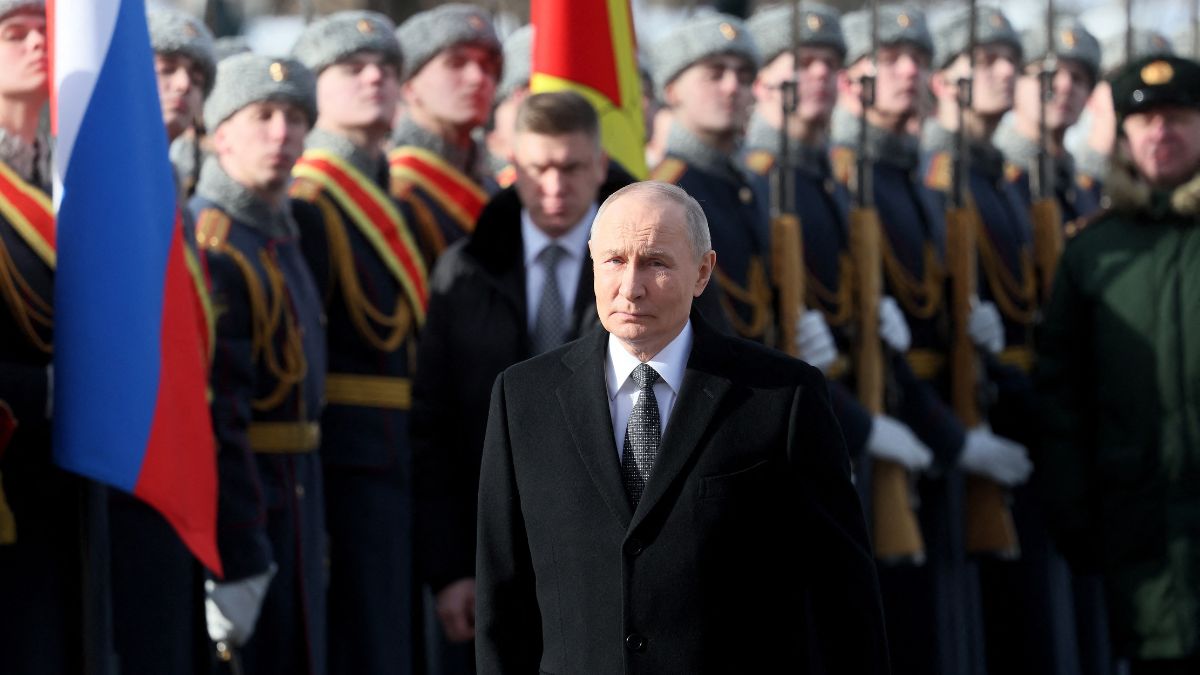
 "Russia's President Vladimir Putin attends a wreath-laying ceremony at the Tomb of the Unknown Soldier by the Kremlin Wall to mark Defender of the Fatherland Day in Moscow on February 23, 2026. (Photo: Maxim Shipenkov/Poold/AFP)")
As tens of thousands of Russian soldiers poured into Ukraine, President Vladimir Putin addressed the world on February 24, 2022, and outlined the goals of the ‘special military operation’: stopping Nato’s expansion, overthrowing Ukrainian President Volodymyr Zelenskyy, reshaping Ukraine’s cultural and national identity, and occupying the Donbas region in eastern Ukraine.
Four years and 1.2 million casualties later, Russia remains bogged down in a grinding war of attrition that was supposed to be over in weeks. But Putin has stuck to his maximalist terms.
Instead of halting Nato’s growth, the full-scale invasion revived the alliance’s expansion, which had essentially stalled in the 2000s — Finland joined Nato in 2023 and Sweden followed in 2024. The European Union (EU) also began rearmament and militarisation to tackle Russian aggression, and, since 2025, it has replaced the United States as Ukraine’s foremost supporter.
President Putin has failed to achieve any of the absolute goals he set out with, and the Kremlin has never clearly articulated what it seeks to accomplish in Ukraine after four years, according to Kseniya Kirillova, a Russia analyst at the Jamestown Foundation.
“Russia has failed to seize not only all of Ukraine but also Donbas. It has also failed to break Ukrainian resistance. From this perspective, not a single declared goal has been achieved,” Kirillova tells Firstpost.
Putin’s only victory came far from the battlefield, notes Kirillova.
“Under the pretext of war, President Putin attained a previously unimaginable level of control inside Russia, consolidated public support around the Kremlin, and thereby prolonged his tenure in power,” says Kirillova.
Quick Reads
View AllALSO READ: With Russia’s terms to Ukraine, Putin seeks surrender — not a peace deal
With the mysterious death of Alexei Navalny, which British and allied intelligence agencies have pinned on Russia , Putin has no political opposition left. That means he faces no domestic compulsion to end the war, despite the Russian economy facing stagflation.
“President Putin seems willing to keep the military machine humming along at almost any cost. The one thing that could change his thinking would be mass protests in opposition to deteriorating economic conditions, but I don’t see this as likely,” says Nicholas Lokker, an Adjunct Fellow for the Transatlantic Security Programme at the Center for a New American Security (CNAS).
Putin’s goals, in his own words, that he didn’t achieve
In its clearest admission of failures in the war, the Kremlin said on Tuesday that the “full goals of the special operation” have not yet been achieved and that is why the war continues.
In his address after launching the full-scale invasion, Putin delivered his interpretation of history to justify the war, comparing Nato and Zelenskyy’s administration to Nazi Germany and portraying them as an existential threat to Russia.
Putin compared any compromise with Nato to the Soviet appeasement of Hitler ahead of the Second World War and vowed never to let Nato “invade” Russia as the Nazis invaded the Soviet Union.
“We will not make this mistake the second time. We have no right to do so. Any further expansion of the North Atlantic alliance’s infrastructure, or the ongoing efforts to gain a military foothold on Ukrainian territory, are unacceptable for us,” he said.
Putin lamented the collapse of the Soviet Union and the loss of its sphere of influence in Europe. He described eastern Europe as “our historical land” and claimed the West had propped up “a hostile ‘anti-Russia’” in the region.
“Fully controlled from the outside, it is doing everything to attract Nato armed forces and obtain cutting-edge weapons,” said Putin, rejecting elections and referendums in the region that have elected pro-Western leaders in free and fair votes.
As with Georgia, which Russia invaded in 2008, Putin justified invading Ukraine as a response to an alleged “genocide perpetrated by the Kiev regime” in Donbas, and declared he would “seek to demilitarise and denazify Ukraine, as well as bring to trial those who perpetrated numerous bloody crimes against civilians” — a euphemism for overthrowing Zelenskyy, installing a loyal administration, and reshaping Ukraine’s identity.
Is Putin closer to restoring the Soviet Union — with Trump leading the US?
While Putin has failed in his primary goals in Ukraine, he has had mixed results in his decades-long quest to restore elements of the Soviet Union.
Despite failing to occupy Ukraine or even the whole of Donbas, Russia controls about 20 per cent of Ukrainian territory — land unlikely ever to be returned.
Elsewhere, Belarusian leader Aleksandr Lukashenko has turned his country into a Russian satellite and Russia remains a major sociopolitical force in Moldova where pro-EU President Maia Sandu has repeatedly alleged Russian meddling.
Putin’s refusal to soften his demands reflects his commitment to maximalist ideological goals rooted in restoring the Soviet Union. That suggests the war is nowhere near its end.
ALSO READ — 25 years of Vladimir Putin: When Boris Yeltsin resigned and asked his PM to ‘take care of Russia’
Putin is a product of the Cold War who firmly believes in Soviet Chekist ideology, says Kirillova.
Under this ideology, an external force —the KGB in the Soviet era— controls all spheres of life and individuals have no meaningful free will. Analysts say Putin’s framing of pro-EU sentiment in former Soviet states as a Western conspiracy stems from this worldview, which denies democratic agency.
“Putin has always sought to restore the Soviet Union, and all of his actions —such as the consolidation of power in Russia, the invasions of Georgia and Ukraine, and the political subjugation of Belarus— are part of the project to restore Soviet greatness and carve out a sphere of influence lost with the fall of the Soviet Union,” says Kirillova.
With far-right parties gaining ground across Europe, Putin may be edging closer to restoring elements of that influence. He may also have succeeded in undermining the European project and the trans-Atlantic partnership — aided knowingly or unknowingly by Trump, who has treated Russia as an ally and Europe as an adversary during his second term.
Putin’s European campaign is directly tied to the war in Ukraine, and its outcome will be highly significant for Europe’s immediate future, says Indrani Talukdar, a Fellow at the Chintan Research Foundation (CRF).
“In several EU member-states, pro-Russian narratives have gained visibility, partly driven by economic anxieties and war fatigue. As economic pressures persist, sections of European society appear increasingly reluctant to continue prolonged support for the war. The final outcome will there-fore influence not only Europe-Russia relations but also the cohesion of the broader Euro-Atlantic framework,” Talukdar tells Firstpost.
Trump has pushed the trans-Atlantic alliance onto life support, according to Lokker.
Trump may have given Putin a victory that neither the Soviet Union nor Russia achieved in decades. These partial successes —coupled with no domestic pushback— have encouraged Putin to hold to his goals, meaning the war will continue for now.
“President Putin is determined to curtail Ukraine’s sovereignty and its ability to forge its own political path, including its form of governance and its foreign policy. He also seems to care quite a bit about annexing territory in eastern Ukraine, although I do not think he feels it is necessary to attain formal territorial control over the rest of the country. But keeping Ukraine within Russia’s sphere of influence and preventing its Euro-Atlantic integration is paramount,” says Lokker.
I write on international affairs and India's foreign policy. I am a compulsive reader, occasional book reviewer, and an aspiring tea connoisseur. I tweet with @madhur_mrt handle on X. You can drop me tips at madhur.sharma@nw18.com. I am open to reading your feedback, or heeding Netflix recommendations. I have previously written for Outlook magazine, covering Indian politics, domestic policy, and law.