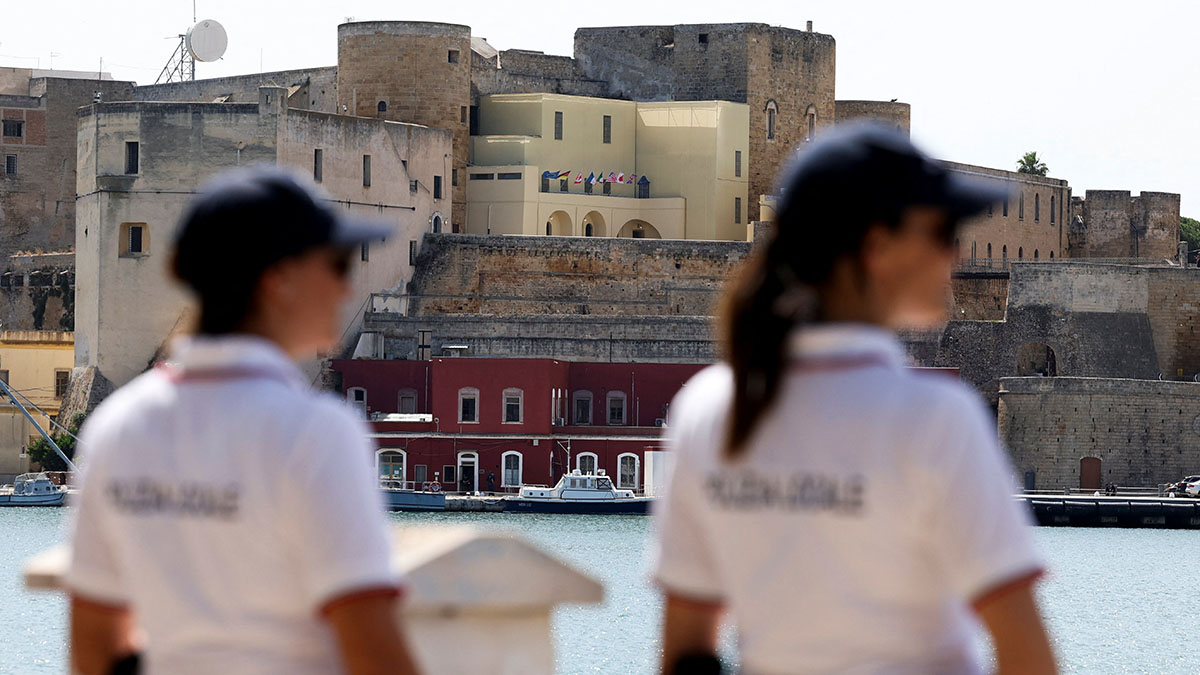
 "A view shows Castello Federiciano, the venue where the G7 summit's first dinner is scheduled to take place on 13 June, as local police personnel look on, in Brindisi, Italy. Reuters")
In the picturesque region of Apulia, Southern Italy, the stage is set for the arrival of world leaders for the G7 Summit. This significant event will see the gathering of representatives from some of the world’s richest economies including Canada, France, Germany, Japan, UK, US and the host nation, Italy.
A timely meeting
This year’s G7 meeting occurs against a backdrop of significant international events. Europe is experiencing political churn with a major election, US is approaching its own polls and conflicts in Ukraine and Gaza continue to affect global stability. Moreover, Western economies are still grappling with the repercussions of these conflicts.
Italy’s ambitious agenda
Italy has outlined a bold and comprehensive agenda for this summit. The priorities include addressing the ongoing wars in Ukraine and Gaza, redefining the G7’s relationship with developing nations and emerging economies—especially in the Indo-Pacific region—and tackling the challenges and opportunities presented by artificial intelligence.
Italian Prime Minister Georgia Meloni has additional priorities focussed on European issues such as combating illegal migration. She intends to push the G7 towards adopting a tougher stance on this matter engaging from a position of strength. Meloni said, “I am ready to welcome and I am proud that this nation presents itself at the G7 in Europe with the strongest government of all.”
An expanded guest list
In a notable shift, Italy has invited 12 other heads of state to the summit surpassing the number of invitees from previous hosts. Japan had invited eight additional countries last year while Germany and Britain each invited five during their respective turns as hosts. Among the invitees this year is India’s Prime Minister Narendra Modi, who will be making his first overseas trip in his third term.
Impact Shorts
More ShortsOther prominent leaders expected to attend include Brazil’s President Lula da Silva, Argentina’s President Javier Milei, Turkey’s President Recep Tayyip Erdogan, Jordan’s King Abdullah and Saudi Crown Prince Mohammad bin Salman. This marks the first time a leader from Saudi Arabia has been invited to a G7 summit. Additionally, a significant contingent from Africa is expected to participate.
Seeking consensus amid differences
The expanded guest list presents numerous opportunities for building consensus. However, the G7 must first navigate its internal differences to decide which issues to prioritise. For example, US is advocating for a $50 billion loan to Ukraine funded by frozen Russian assets in the West. This proposal has not yet achieved consensus among G7 members.
Ukraine’s President Volodymyr Zelensky has been invited to the summit and Russia is closely monitoring these developments. Recently, Russian Finance Minister Anton Siluanov warned that Moscow would respond in kind if the G7 proceeds with using frozen Russian assets for the Ukrainian loan.
“We have the same opportunities. We have frozen money in EU accounts. We have assets. We will also get income. If there is a decision we will act similarly. We will respond in kind,” said Siluanov.
The China challenge
China remains a significant topic of discussion. Last year, the G7 addressed Beijing’s economic coercion and pledged to take action. However, the measures taken were largely limited to information sharing. This year, there are calls to address China’s industrial overcapacity and its economic impact.
The US and France are pushing for steep tariffs on Chinese imports and for the G7 communique to express common concerns about Beijing’s industrial overcapacity. While punitive actions seem unlikely, a statement of condemnation is expected. In response, China has already criticised these moves, with Chinese Foreign Ministry spokesperson Mao Ning saying, “The G7’s hyping-up of China’s overcapacity and its attempts to impose restrictions on China’s new energy products are a complete departure from the facts and economic laws, and are protectionism in nature, which are not in the interests of any party.”
The summit ahead
The G7 Summit officially begins on Thursday. While the G7 strives to reinvent itself and address global challenges more inclusively, managing internal differences will be the true test of its effectiveness.