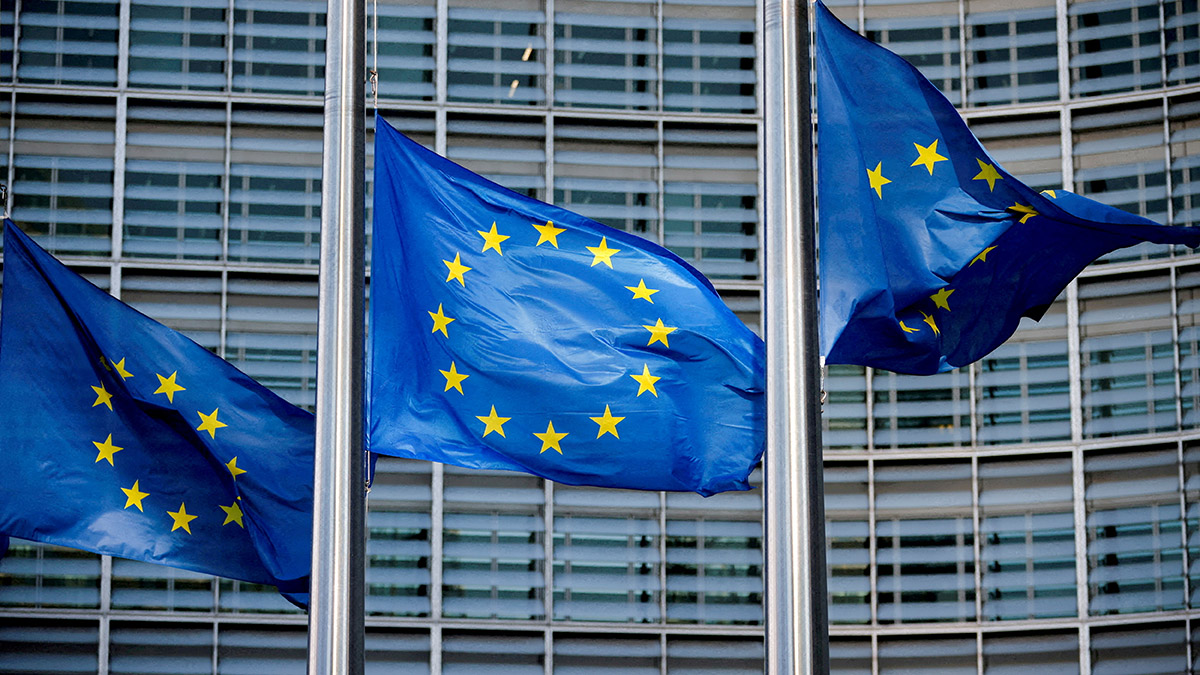
 "(File) European Union flags fly outside the European Commission headquarters in Brussels, Belgium. Reuters")
European Union chief Ursula von der Leyen last year tasked former European Central Bank President Mario Draghi, who also served as Italy’s prime minister, with finding ways to bolster the bloc’s competitiveness amid growing global insecurity and economic challenges.
Draghi’s long-anticipated report was finally released on Tuesday (September 10).
In the report, Draghi warns that the COVID-19 pandemic and the war in Ukraine have reshaped global trade to the EU’s disadvantage. To overcome these challenges, the EU would need to boost public investment by 4.4 per cent to 4.7 per cent of its annual economic output— roughly $828-$883 billion— to fund the transition to clean energy and enhance defence capabilities.
While acknowledging that this “unprecedented” level of investment would surpass even the post-World War II Marshall Plan to rebuild Europe, Draghi argued that it is necessary to confront the “existential challenge” the bloc faces.
Speaking at the report’s launch in Brussels, Draghi said Europe’s productivity is “very, very weak” and stressed that the energy crisis has exposed the EU’s overreliance on foreign sources for energy and raw materials.
Draghi also highlighted the impact of Europe’s declining fertility rates, which for the first time mean the region cannot rely on population growth to drive economic expansion.
“There is a significant gap in economic growth between the EU and the US, mainly due to slower productivity growth in Europe,” Draghi said. “For the first time since the Cold War, we must genuinely fear for our self-preservation, and the need for a unified response has never been clearer.”
Impact Shorts
More ShortsVon der Leyen, who secured a second five-year term in July, plans to use the 400-page report to guide her new cabinet’s agenda, which she is expected to unveil this week.
However, implementing Draghi’s recommendations could face resistance. France is the proposal’s strongest backer, but other nations, including Germany and the Netherlands, are concerned they may be asked to contribute more to support southern European countries.
With inputs from agencies