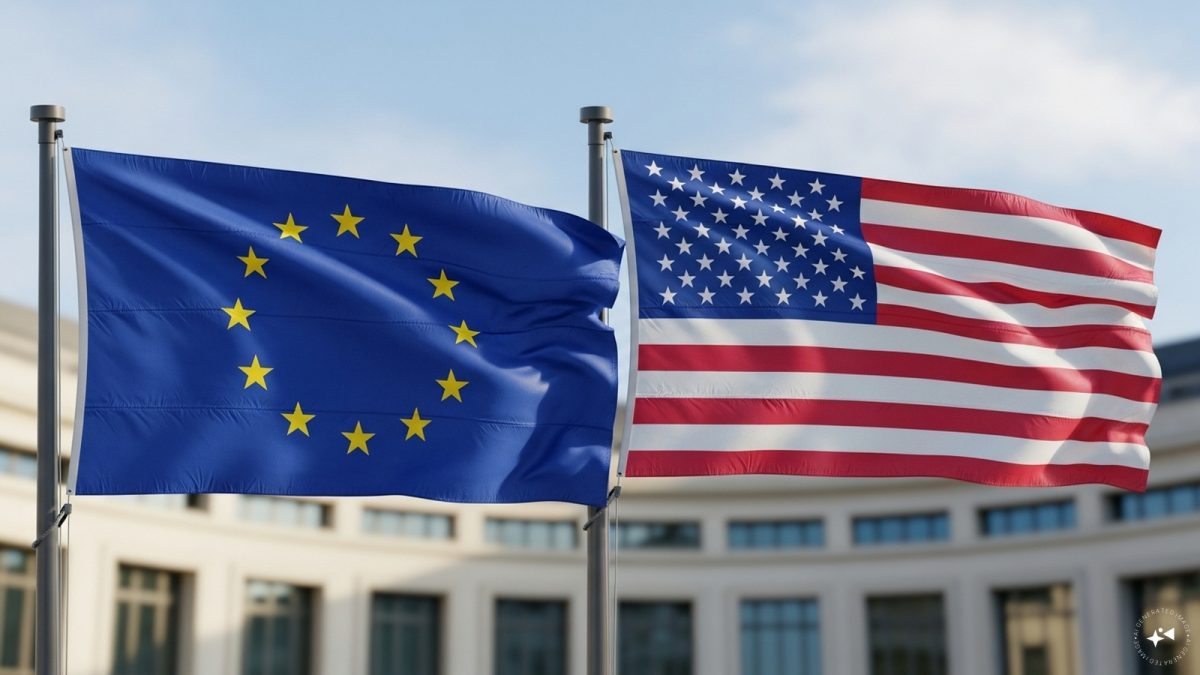
 "Europe falters as it struggles to break free of Trump’s world order")
Europe’s ambition to project itself as an independent economic power is colliding with political reality at home and with a global order increasingly driven by Donald Trump’s return to the White House.
As the European Union seeks to reduce its dependence on both the United States and China, its repeated failure to clinch the long-delayed Mercosur trade agreement has exposed the limits of its ability to act decisively in a more transactional world.
European Commission President Ursula von der Leyen was expected to sign the EU’s largest-ever free trade agreement on Saturday, sealing a deal 25 years in the making with Argentina, Brazil, Uruguay and Paraguay. Instead, the signing was postponed yet again after resistance from member states such as Italy which fears the pact would hurt domestic farmers. Officials say another attempt will be made on January 12, but the delays have already dented Europe’s claim to strategic autonomy.
A deal meant to prove Europe’s autonomy
The EU-Mercosur pact is not just about tariffs or exports. For Brussels, it has become a test of whether Europe can chart its own economic course at a time when its two largest partners are applying pressure from opposite directions. Relations with China have soured amid mutual tariffs and Beijing’s tightening control over exports of rare earths and critical materials. Across the Atlantic, Europe has been forced into what many see as an uneven trade arrangement with the US, accepting a 15 percent tariff on most of its exports while removing duties on American industrial goods.
Against this backdrop, Mercosur was meant to show that Europe could diversify its supply chains and partnerships. The agreement would create a market of about 780 million consumers, phase out tariffs on products such as cars, and offer European firms better access to South America’s agricultural output and raw materials. More broadly, it would signal that Europe can offer a credible alternative to countries wary of choosing between Washington and Beijing.
Quick Reads
View All“This is Europe’s independence moment,” von der Leyen said earlier this week, framing the deal as part of a wider strategy to escape a world order increasingly shaped by Trump-style bilateralism and power politics.
Domestic politics meets global ambition
That strategy has run into familiar obstacles. Securing approval for the Mercosur pact requires backing from a qualified majority of EU member states and opposition has hardened among governments facing pressure from farmers who fear cheaper South American imports. During a summit in Brussels this week, thousands of protesters blocked streets, set tyres ablaze and dumped produce in public spaces, highlighting the domestic costs of trade liberalisation.
Italy has emerged as the pivotal holdout. Prime Minister Giorgia Meloni has insisted she needs more time to secure domestic consensus, a stance Brazilian President Luiz Inacio Lula da Silva has described as political embarrassment rather than outright opposition.
While some in Berlin and Brussels believe Rome is using its position to extract concessions for its agricultural sector, others worry the delay reflects a deeper reluctance within the EU to absorb short-term political pain for long-term strategic gain.
Efforts to sweeten the deal by adding safeguards to protect European farmers from sudden price or import shocks failed to break the deadlock. For critics, this inability to close ranks highlights how internal divisions continue to undermine Europe’s global ambitions.
The cost of hesitation in a Trump-shaped world
The longer the Mercosur agreement drags on, the higher the geopolitical cost for Europe. Analysts note that while Mercosur economies may lose more in pure economic terms if the deal collapses, the reputational damage would fall squarely on Brussels. Other developing regions are watching closely, assessing whether the EU can still deliver on complex trade promises.
There is also a growing risk that South American countries will simply look elsewhere. Mercosur has already signalled interest in agreements with the United Arab Emirates and is exploring closer ties with Canada, the UK and Japan. Europe, meanwhile, is still struggling to conclude another long-running trade negotiation with India, itself nearly two decades old.
German Chancellor Friedrich Merz warned bluntly that Europe’s standing is at stake. If the EU wants to remain credible in global trade, he said, decisions cannot be endlessly postponed. Bernd Lange, chair of the European Parliament’s trade committee, went further, suggesting that failure to sign by late December would effectively kill the agreement and weaken Europe’s future negotiating position worldwide.
In a world increasingly driven by Trump’s preference for hard bargaining and transactional deals, Europe’s cautious, consensus-driven approach is being tested. The Mercosur saga shows a bloc that wants strategic autonomy but struggles to act with speed and unity when domestic politics intervene.
Whether the EU can still “bring it home” in January, as von der Leyen insists, will determine more than the fate of a single trade pact. It will signal whether Europe can adapt to a harsher global environment or remains constrained by the very internal divisions that its rivals are learning to exploit.