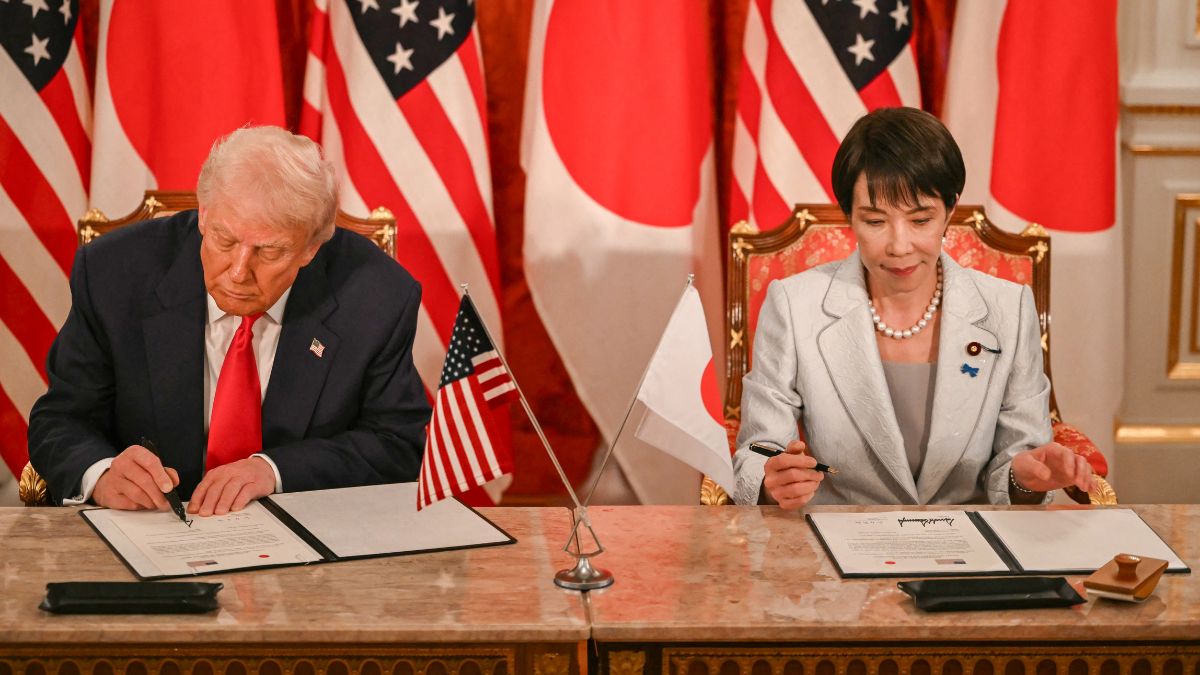
 "Japan's Prime Minister Sanae Takaichi (R) and US President Donald Trump attend a signing ceremony after a Japan-US Summit at the Akasaka State Guest House in Tokyo on October 28, 2025. (Photo: Andrew Caballero-Reynolds/AFP)")
In trade negotiations with the European Union (EU), Japan, and South Korea, US President Donald Trump has not only asked these countries to purchase more American goods and improve market access for US businesses. He has also demanded that they invest hundreds of billions of dollars in the United States.
Although these countries have agreed to substantial investment pledges, disagreements over the interpretation of the agreements and the nature of the funds to be poured into the United States have complicated these critical trade relationships.
For instance, Trump has claimed that the EU has given him a “gift” of $600 billion that he could use as he pleased. However, the claim is false.
Under the US–EU agreement, European companies are not obligated to invest $600 billion in the United States. They are merely “expected” to invest that amount, meaning the EU is not legally bound to make any investment under the deal.
Regardless of the agreement’s terms, Trump has demanded that the EU provide him with $600 billion. Failing that, he has threatened to impose a fresh 35 per cent tariff on the bloc.
Trump’s investment demands complicate Japan, South Korea deals
Under the US–Japan handshake trade deal in July, the United States would reduce its ‘reciprocal tariff’ to 15 per cent in exchange for Japanese investments totalling $550 billion. The deal also obligated Japan to open its market to American food products, automobiles, and defence equipment.
During his recent visit to Japan, Trump and Prime Minister Sanae Takaichi signed the deal along with a separate agreement concerning rare earth elements.
However, doubts remain over Japan’s ability to deliver such a large investment and questions persist regarding the nature of the pledged funds.
Impact Shorts
More ShortsAs with the EU, Trump has stated that $550 billion would be transferred to him and that he could use the amount however he wished. Moreover, he has claimed that 90 per cent of the profits generated from these investments would go to the United States. But Bloomberg has reported that the Japanese government views the pledge as a mix of investments, loans, and loan guarantees.
As with the EU, Trump and Japan appear to have very different understandings of the deals they have reached.
In South Korea’s case, Trump agreed to reduce the reciprocal tariff to 15 per cent in exchange for a $350 billion investment pledge. But concerns are mounting that South Korea may not be able to match such a commitment.
South Korean officials have warned that implementing the pledge could severely damage their economy and destabilise the national currency, the won, according to Politico.
Trump, however, seems undeterred. In a deal announced on Wednesday, he agreed to lower tariffs on South Korean automobiles to 15 per cent. But there was no announcement regarding any reduction or amendment to the investment pledge.
Moreover, it was not clear whether Trump and South Korean President Lee Jae-myung actually signed a deal or it was another handshake deal or merely an understanding reached during negotiations.
“The details of the investment is the major stumbling block. It’s not been decided what the sources of those funds will be —whether it includes loans or loan guarantees— and the process for investment project selection and profit sharing,” a person familiar with the matter told Politico.