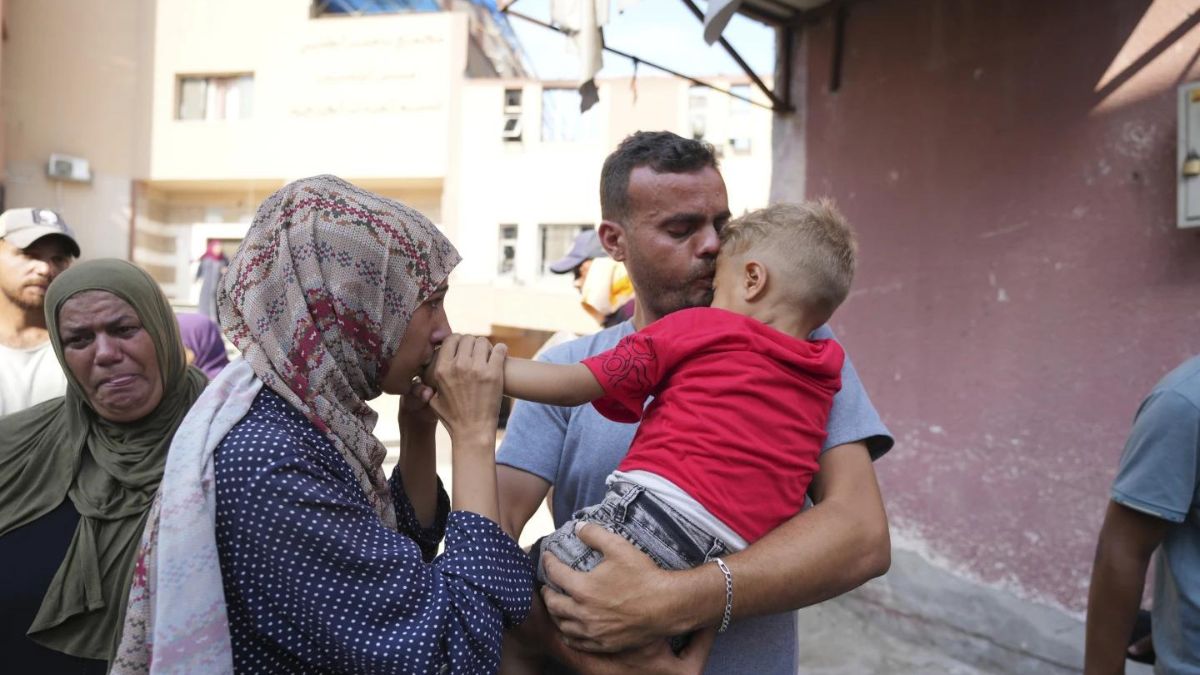
 "The sick were scheduled to fly to Egypt and other countries for medical care, while the children and their companions departed the Gaza Strip through the Kerem Shalom crossing Image Courtesy AP")
In the first medical evacuation since May, when the only gate into the region was closed, 68 persons, including sick and injured children and their companions, were reportedly allowed to leave the Gaza Strip and enter Egypt, according to Israeli authorities.
COGAT, the name for the Israeli military department in charge of Palestinian civilian affairs, announced on Thursday that the evacuation was completed in cooperation with representatives from the US, Egypt, and other international organizations.
The sick were scheduled to fly to Egypt and other countries for medical care, while the children and their companions departed the Gaza Strip through the Kerem Shalom crossing.
Gaza’s health system has been severely damaged, with the majority of its hospitals having to close, as a result of the nearly nine-month-long Israel-Hamas war. Thousands of people, including hundreds of critical cases, require medical treatment overseas, according to health officials.
Earlier, family members said a sorrowful goodbye to the children as they and their guards left the Nasser Hospital in Khan Younis, in the southern Gaza strip, headed for the Israeli border crossing at Kerem Shalom.
The sole border point open for anyone to enter or exit Gaza is Rafah, which was taken over by Israeli soldiers during their early-month campaign in the city. Egypt has declined to allow the crossing to reopen until the Gaza side is given back to Palestinian authority.
Impact Shorts
More ShortsEarlier this week, six of the kids were moved from Al-Ahli Hospital in Gaza City to Nasser Hospital. One has metabolic syndrome and five have cancer. The World Health Organization, which was in charge of organizing the evacuation, could not be immediately reached for comment.
Around 25,000 Gazan patients, including about 980 children with cancer, according to Zaqout, need treatment abroad; 25% of them require “urgent and immediate evacuation.”
He stated that the cases involved in the evacuation on Thursday are “a drop in the ocean” and that the difficult path into Egypt via Kerem Shalom cannot be used as a substitute for the Rafah border.
He stated that the cases involved in the evacuation on Thursday are “a drop in the ocean” and that the difficult path into Egypt via Kerem Shalom cannot be used as a substitute for the Rafah border.
Many of the families at Nasser Hospital earlier on Thursday seemed nervous. Most family members were forced to stay behind, and even those who were permitted to go with the patients were unaware of where they would end up.
Israel’s Supreme Court was petitioned by Physicians for Human Rights Israel and Gisha, an Israeli human rights organization, to establish a “permanent mechanism” that would permit Gazans in need of medical care to leave the area.
Before the Israeli military began their ground operation in Rafah on May 7 and gained control of the border, some fifty Palestinian patients per day entered into Egypt to receive medical care overseas, according to Adi Lustigman, an attorney with Physicians for Human Rights Israel.
Less than 70 persons left the region on Thursday, which Tania Hary, executive director of Gisha, described as “beyond tragic” given that the crossing had been closed for two months. “We believe that as a response, it’s just not sustainable.”
She demanded that the Israeli military restore the Rafah Crossing and for patients to leave the northern Erez Crossing, which served as the primary entry point for Palestinians into Israel.
Israel’s Supreme Court will hear a hearing on the case on Monday.
The regional director of the World Health Organization for the Eastern Mediterranean, Hanan Balkhy, expressed his gratitude for the news of the children’s evacuation in a post on the social media site X. However, he pointed out that over 10,000 patients still need medical attention outside of the Strip. Of the 13,872 people who have applied for medical evacuation since 7 October, only 35% have been evacuated.”
“Medical evacuation corridors must be urgently established for the sustained, organized, safe, and timely passage of critically ill patients from Gaza via all possible routes,” she said.
Over 37,700 Palestinians have died as a result of Israel’s war against Hamas, which controls the Gaza Strip. The Health Ministry in Gaza does not distinguish between combatants and civilians when calculating this number. Among the deceased are thousands of women and children.
On October 7, terrorists from Hamas launched a surprise attack on Israel, killing almost 1,200 people and capturing another 250. This marked the start of the war.
New evacuations from Gaza City neighborhoods that were badly attacked and mostly evacuated early in the conflict were ordered by the Israeli military on Thursday. The most recent directives are applicable to Shijaiyah and adjacent districts where locals on Thursday reported heavy airstrikes.
According to first responders from Gaza’s Civil Defense, at least three individuals were killed and six more were injured when airstrikes struck five different homes. It stated that searchers were still searching the debris for survivors.
During the first several weeks of the conflict, Gaza City was brutally attacked. Later that month, Israel issued an order for the evacuation of the whole northern Gaza region, including the major city there. Even though Israeli forces have surrounded and mainly isolated the north, hundreds of thousands of Palestinians have continued to live there.
Residents of Shijaiyah posted footage of a significant number of individuals leaving the area on foot, carrying their possessions in their arms, in a message group.
Given the acute and pervasive hunger experienced by Palestinians, Israel’s assault against Hamas has drawn increasing criticism from around the world. Due to the eight-month conflict, Gaza’s population is now entirely dependent on humanitarian aid as supplies of food, medicine, and other necessities have been cut off. Israel vehemently contests the top UN court’s conclusion that there is a “plausible risk of genocide” in Gaza.