

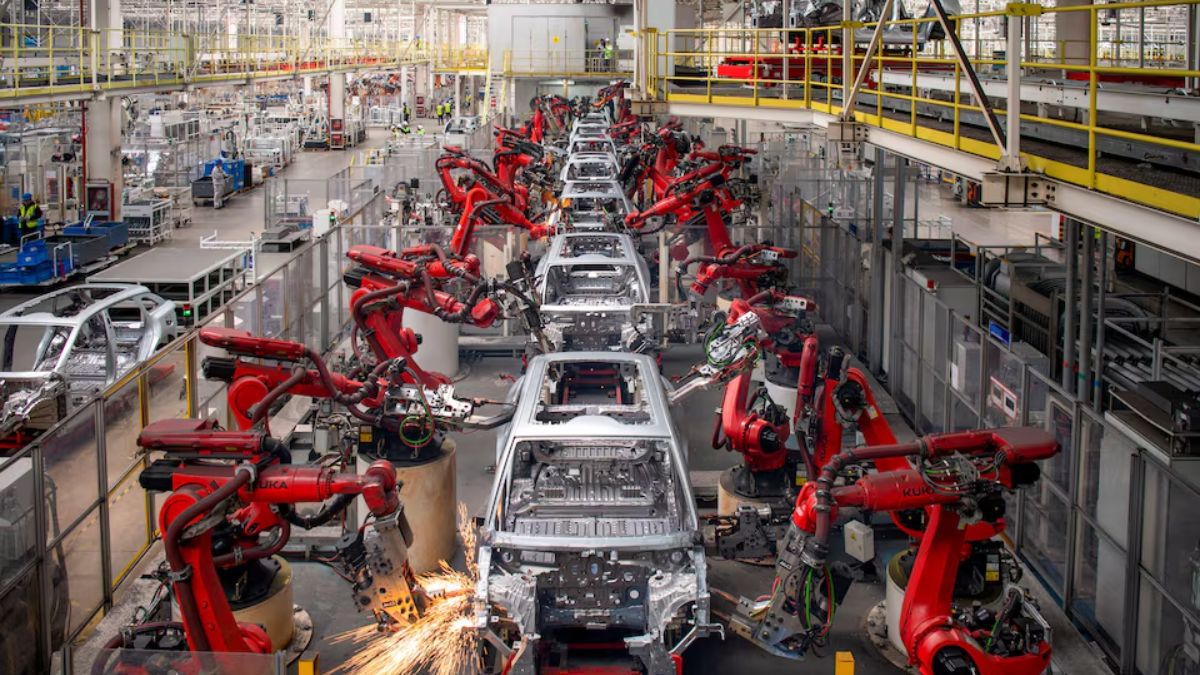
 "China’s economy remains shaky: Factory output, retail sales fall despite record trade surplus")
Even as China crossed the $1 trillion-mark in trade surplus in November, the economy continues to be shaky as nearly every other major indicator is in the red — factory output, retail sales, and fixed asset investment have fallen, and factory deflation has entered the 38th consecutive month.
Factory output growth, which refers to the growth of goods produced, slowed to 4.8 per cent year-on-year in November —the lowest since August 2024— against the economists’ projection of 5 per cent growth.
In November, retail sales, which is the clearest measure of consumption, grew just 1.3 per cent against the forecast of 2.8 per cent and factory deflation, which refers to the fall in prices for goods produced, entered 38th consecutive month and fell by 2.2 per cent month-on-month.
In the January-November period, investment in fixed assets fell by 2.6 per cent — more than 2.3 per cent drop projected by economists.
Such a state of affairs suggests the domestic demand is extremely weak and the economy is showing growth without any ‘heat’ as factories are producing more but earning less as a result of persistent demand weakness and structural overcapacity.
China’s economic crisis goes beyond housing crash
There are signs that the situation will continue to worsen for some time as the weak demand is not just limited to the real estate sector.
Last week, Golman Sachs last noted that falling auto sales have been a major drag on overall retail sales, coupled with the “negative distortion” effect from the earlier-than-usual start of the Singles-Day online shopping festival that pulled forward demand from November to October, according to CNBC.
Quick Reads
View AllIn November, car sales fell by 8.1 per cent year-on-year in a drop for the first time in three years and Singles’ Day sales grew just 12 per cent against the 20 per cent growth last year, as per CNBC.
As for the real-estate sector, home prices fell in 70 major cities in November by 1.2 per cent in tier-1 cities and resale prices fell by 5.8 per cent year-on-year.
Even for an export-oriented economy like China, such a scenario —persistently weak domestic demand, falling retail sales, producers’ profits falling, and producers bogged down with overcapacity— is very concerning and means that the fundamentals of the economy are concerning.
For one, the share of exports in China’s GDP has consistently fallen in the past two decades — falling to around 20 per cent from the peak of 35 per cent in 2006. This means that exports cannot sustain the economic growth beyond a point.
Moreover, if domestic demand does not pick up, producers will be forced to lay off workers at some point as their capacity to bear the brunt of falling profits or rising losses would be tested. Such a situation would increase unemployment and further reduce demand, laying the perfect ground for a recession.

 "Worry for Trump: Unemployment rises to 4-year high, says US jobs report")
 "From Trump’s ‘alcoholic personality’ to Musk’s ‘avowed’ drug use: Bombshells from Susie Wiles’ interview")
 "What do Virginia Giuffre, Shafali Verma and Zohran Mamdani have in common? They are the underdogs of 2025")
 "Trump can build ballroom in White House, rules US federal judge")
 "Worry for Trump: Unemployment rises to 4-year high, says US jobs report")
 "From Trump’s ‘alcoholic personality’ to Musk’s ‘avowed’ drug use: Bombshells from Susie Wiles’ interview")
 "What do Virginia Giuffre, Shafali Verma and Zohran Mamdani have in common? They are the underdogs of 2025")
 "Trump can build ballroom in White House, rules US federal judge")



