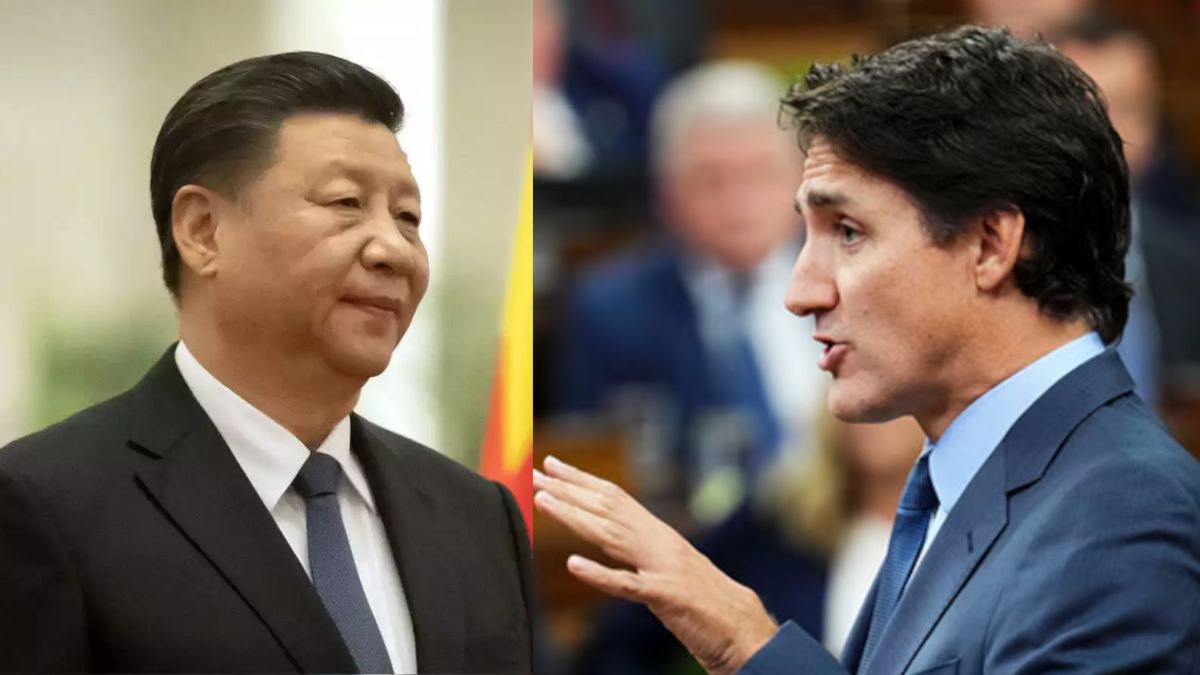
 "Chinese leader Xi Jinping (L) with Canadian Prime Minister Justin Trudeau. File image")
China announced Sunday (December 22) that it is imposing sanctions on two Canadian organisations and 20 individuals over their involvement in human rights issues concerning Uyghurs and Tibet.
The measures, which took effect Saturday (December 21), include asset freezes and entry bans, the Chinese foreign ministry said in a statement on its website.
The targeted groups are the Uyghur Rights Advocacy Project and the Canada-Tibet Committee.
Under the sanctions, China said it is freezing “movable property, immovable property, and other types of property” of the two Canadian organisations within its territory. The sanctions also freeze the assets of 15 individuals associated with the Uyghur group and five linked to the Tibet committee. All 20 individuals are banned from entering China, including the semi-autonomous regions of Hong Kong and Macau.
Rights groups have long accused Beijing of widespread abuses against the Uyghurs, a predominantly Muslim ethnic minority of about 10 million in the western Xinjiang region.
Allegations against China on Uyghur, Tibet issues
The Chinese government has been accused of detaining over a million Uyghurs and other Muslim minorities in what it describes as “re-education camps” in the Xinjiang Uyghur Autonomous Region. Reports indicate that detainees are subjected to forced labour, political indoctrination, and, in some cases, torture and sexual abuse.
Additionally, there are allegations of forced sterilisations and birth control measures aimed at reducing the Uyghur population, according to a report by BBC.
On the Tibet front, China took control of the territory in 1950, calling it a “peaceful liberation” from feudal serfdom. However, international human rights organisations and exiles frequently criticise Beijing’s policies in Tibetan regions as oppressive.
There are reports of forced relocations of Tibetan nomads and farmers into urban areas, undermining their traditional lifestyles. The Chinese government has also been accused of interfering in religious practices, including the selection of Tibetan Buddhist leaders, and detaining Tibetan activists who speak out against these policies.
Impact Shorts
More ShortsChina’s move regarding Canadian organisations is seen as a countermeasure against international criticism of its human rights record, which Beijing has repeatedly dismissed as interference in its internal affairs.
With inputs from agencies