

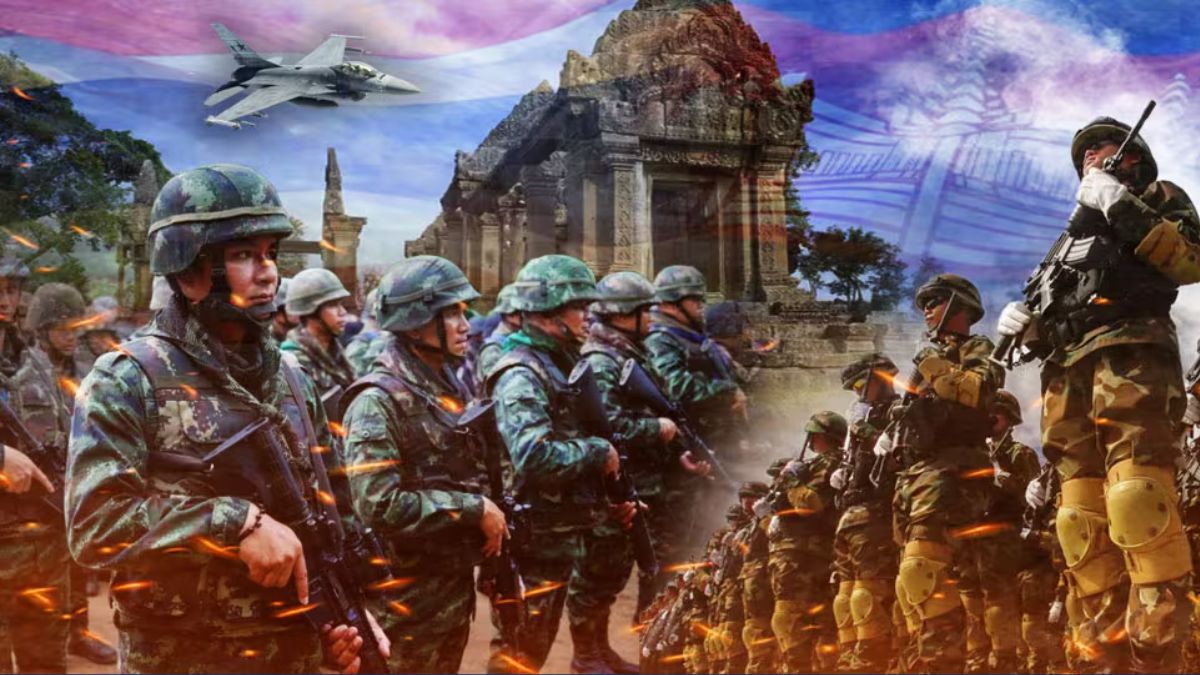
 "China offers to mediate Thailand-Cambodia conflict after Trump-brokered peace deal falls apart")
As fierce clashes along the Thailand-Cambodia border intensify, China has stepped forward with a fresh offer to mediate between the two Southeast Asian neighbours, moving into a diplomatic space previously occupied by the United States.
The intervention comes as a high-profile peace effort championed by US President Donald Trump has unravelled against a backdrop of renewed hostilities, civilian displacement and political mistrust.
A specialist envoy from Beijing has been dispatched to Bangkok and Phnom Penh to pursue talks aimed at de-escalation, the Chinese Foreign Ministry has confirmed. The move highlights Beijing’s broader aspirations to play a stabilising role in regional disputes even as the conflict tests the durability of externally brokered truces.
Trump’s peace process collapses amid fresh violence
Earlier this year, President Trump touted his role in brokering a ceasefire between Thailand and Cambodia following one of the most intense border flare-ups in over a decade. The agreement, formalised at a Kuala Lumpur summit in late October and known as the Kuala Lumpur Peace Accord was witnessed by regional leaders including Malaysian Prime Minister Anwar Ibrahim and Trump himself, and was intended to halt violence and lay the groundwork for lasting peace.
But despite Trump’s public claims, the ceasefire failed to hold. Skirmishes resumed in December with artillery exchanges, air strikes and ground operations along disputed border areas, displacing hundreds of thousands of civilians and inflicting civilian casualties on both sides.
Thai officials have directly rejected Trump’s assertions that an agreement is in effect, with Bangkok declaring it will continue military operations until it perceives no imminent threat from Cambodian forces. Cambodia, for its part, has denied charges of violating ceasefire terms.
Analysts say such breakdowns were foreseeable given the deep-seated historical territorial tensions and lack of robust enforcement mechanisms in the peace deal. Previous suspensions of thawed relations including an earlier truce collapsed after a landmine blast in November — had already signalled the fragility of diplomatic progress.
Beijing’s bid: a new peacemaker in Southeast Asia
Against this backdrop of lingering conflict, China’s mediation offer represents a bid to insert itself into a diplomatic breach. According to statements from Beijing, Deng Xijun, China’s Special Envoy for Asian Affairs will visit both capitals to pursue de-escalation talks and encourage parties to resume dialogue. China says it is following developments “closely” and aims to support efforts to end the hostilities.
Beijing’s involvement aligns with its broader strategic interest in Southeast Asia, where economic and security ties with Cambodia and Thailand have grown substantially. Analysts note that a successful Chinese diplomatic role could boost Beijing’s regional standing, particularly as major powers compete for influence in the Indo-Pacific.
Quick Reads
View AllHowever, China’s peace making track record in the region has had mixed success. While it played an observer role in earlier ASEAN-mediated talks that helped shape the original ceasefire framework, Beijing’s initiatives have sometimes been viewed with suspicion, particularly by ASEAN members wary of unilateral influence.
From Thailand’s perspective, offers of third-party mediation have occasionally been rebuffed, as Bangkok historically favoured bilateral negotiation before engaging in broader talks, a dynamic that complicated earlier truces.
Limits of mediation and implications for regional stability
China’s intervention arrives at a time of deep scepticism about external peace making efforts. Despite Trump’s prominent claims of brokering peace, observers argue that the recent Thailand-Cambodia deal collapsed in part because it lacked enforcement and failed to address the root causes of the border dispute.
Several of the peace deals touted by Trump in other regions have faced similar challenges, leading some analysts to question the efficacy of high-profile diplomatic declarations without follow-through.
For ASEAN and its member states, a successful Chinese mediation could signal shifting dynamics in regional diplomacy, where traditional US influence is contested by Beijing’s rising role. But sceptics warn that overly assertive Chinese intervention might unsettle regional sensibilities and complicate ASEAN’s central role in conflict resolution.
On the ground, the human cost of the violence is acute. Renewed border clashes have not only disrupted livelihoods but also strained bilateral trust, making a return to sustained peace difficult without genuine political will from both sides and effective third-party facilitation.
As China’s envoy begins consultations, the world will watch whether this latest diplomatic push can coax the warring neighbours back from the brink or whether the Thailand-Cambodia conflict will continue to escalate in spite of global peace making efforts.


 "Bangladesh Protests Live: Police, army on street as post-Hadi violence targets Indian missions, Awami offices")
 "Who was Claudio Valente, Brown University shooting suspect who also killed MIT professor?")
 "Ukraine to US midterms: Will 2026 seal Trump's place in history?")
 "Bill Gates, quotes from ‘Lolita’ on woman’s body: What newly released Epstein photos reveal")
 "Bangladesh Protests Live: Police, army on street as post-Hadi violence targets Indian missions, Awami offices")
 "Who was Claudio Valente, Brown University shooting suspect who also killed MIT professor?")
 "Ukraine to US midterms: Will 2026 seal Trump's place in history?")
 "Bill Gates, quotes from ‘Lolita’ on woman’s body: What newly released Epstein photos reveal")



