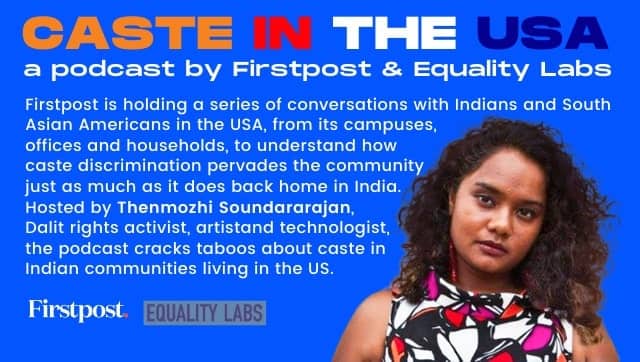
Editor’s note: Firstpost is holding a series of conversations with Indians in the US, across its campuses, offices and households, to understand how caste discrimination pervades the community just as much as it does back home in India. Hosted by Thenmozhi Soundararajan, Dalit rights activist, artist, technologist and executive director of Equality Labs, the podcast cracks taboos about caste among Indians in the US. Listen to more episodes
here
. *** In Episode 6: ~ I asked, ‘After you graduate would you care about your identity or would you reveal it if somebody is abusing Dalits in general?’ They said, ‘No, the Telugu community is very strong in the Tech circle. They will use this connection to get a job and if anybody in the Telugu community finds out they are Dalits, it is going to have major, major repercussions for their professional career as well.’ What was shocking to me was that, yes my peers were silently suffering casteist abuse by pretending to hide their identity, by pretending to be what they were not. Also, they were already scared before they’ve even entered the workforce. I further asked them if they would ever divulge their identity, eventually. They said, “No, we want to make sure we have a good career and good connections to get a job which will stay. If we out ourselves, they will kick us out of their niche tech circles.” ~ This is a conversation that took place between Suresh Attri and his peers, while they were studying at a university in the US. The students Suresh is talking to here, witnessed him getting into a confrontation with two Indians who were indulging in casteist behaviour. They later approached him and requested him not to get embroiled in such confrontations, as the repercussions would be severe. On further prodding, it dawns on Suresh that the ones warning him off were Dalits themselves. Listen to the full episode of Caste in the USA to find out more about Suresh’s experiences of casteism in American universities, within Telugu circles in the US and among friends. *** Listen to Caste in the USA, Episode 6 here: *** Read the complete transcript for Episode 6: Thenmozhi Soundararajan: Jai Bhim and Jai Savitri, everyone. I am Thenmozhi Soundararajan, and this is the podcast - Caste In the United States with Firstpost. Today’s episode is a conversation with Suresh Attri. Suresh is an American Ambedkarite leader whose leadership is impactful, both in the anti-caste movement and in Tech. Today he is here to talk about his experiences of caste in American universities and caste in friendships. Welcome, Suresh. Suresh Attri: Thank you for having me, Jai Bhim and Jai Savitri. Thenmozhi Soundararajan: So Suresh I wanted to ask you, I mean many North American universities are very immigrant-heavy and south-Asian, I wanted to see what was your experience among your peers? Suresh Attri: Sure and thanks for bringing this question up. I feel it is important to talk about academia here, in the US. We have seen what’s happening in CISCO and caste in general in the tech sector. What pokes no more is what happens in the industry and people are in the workforce, but in my experience, this discrimination happens - before our folks even enter the workforce and are preparing to go into the workforce in schools. I had a very troubling casteist interaction with caste-Hindus back in school. So what happened was, on one particular day, me and a bunch of other fellow Indians students were working in a lab in the summer. We had a summer job/internship and it was a pretty diverse lab, we had students from all over the world. We had Chinese students, Indians, Americans, Brazilians, Europeans and it was a mixed bunch. One day it so happened that after the lab was about to close for some reason in the lab it was just Indians remaining who were working at the time maybe because we were finishing up work, I think we were doing a bit of over-time, this a while ago. What happened was when all the other non-Indians excited the room, the lab, one PhD student from Kerala started talking about Indian politics, Indian culture in general, and he was joined by another Master’s student. While they were talking about Indian culture in general they switched to speaking in Hindi because they knew nobody else in the room was non-Indian, all the others were Indians. While they were talking about Indian culture, suddenly this guy, who was doing his PhD, he switched the conversation to caste. He started talking about his caste and ancestry and he started to talk about his proud Namboodri roots and how proud he was to be a Namboodri Brahmin and he quickly went from his proud casteist heritage that in his mind was superior, to berating and insulting Dalits. He started using words like, this is great that we don’t have these Dalits, these folks who seek reservation or affirmative action in India, who seek these facilities in India, it is great that we don’t have these people to pollute the US campuses in the American universities. And then he was joined by the other student, the student doing his Master’s, who said ‘you know what don’t worry about it these folks are not meritorious enough, not brainy enough to be able to even come to the United States in the first place to study on these campuses and even if they somehow manage to come here, because they are not capable enough, they will just fail all these academic courses, they will never complete their curriculum, they will end up working in blue-collar jobs here and maybe they will go back. And then to this the guy said ‘oh yea that’s great’, and then he used the word, ‘these lower-caste scums’ should remain back in India and they should do the job that they have been relegated to and that will be good, they shouldn’t come here because they don’t deserve to be here. I was listening, and I was reading the room. I was trying to look at the face of other Indian students who were also listening to the exchange, most of them were not reacting, they were just going about doing their job, pretending as if nothing was happening, and I was, my feelings were going from shock to horror to anger. I am listening to these two guys and they continue insulting and berating Dalits by saying ‘I am glad these scums don’t come here and if they do they are not smart enough’. They were demonising Dalits, and it was a terrible exchange. I reached a point where I could not bear to listen anymore so I decided to insert myself in their dialogue, and I said ‘hey guys we are all working in this lab, why are you trying to be casteist monsters’, so I choose my words carefully to challenge and to get them to stop. So the moment I said this both of them were shocked and they looked at me and said, why do you care? That’s when I realised that I now had the opportunity to try and change their understanding of Dalits and let’s see if that works. So I told them you guys are talking about Dalits not being brainy enough, intellectually capable enough to be in this country and go ahead and get a degree from a US university, I am here to tell you, I do care because as you said why do you care I am a Dalit? And I knew the second guy, the guy from his Master’s, a little bit more than I knew the guy who was doing his PhD, and I knew his grade point average because he would tell me, I knew his academic course work grade because he would casually mention that to me, so I told him, look at your grade point, he was 3.3 GP at the time, and I am almost at 4, I was at 3.9 GP so by every objective measure of educational outcomes I am better than you and I kept telling him that I am better than you, I have more intellectual ability than you based on this university’s system and that when I said that he was shocked, he was red-faced. So I told both of them, that you guys have an outdated, casteist, monstrous belief that folks who are Dalit cannot come here in the first place and even if they won’t be able to pass, and I told them I am getting better grades and not just grades you guys don’t do anything outside academics, I am a very active participant in a bunch of student organisations on campus and I am in a lot of extra-curricular and co-curricular activities, so by every objective measure I am better than you. So maybe now is the time for you to realise that what you are saying is outdated, it is cruel and it is wrong - morally wrong - we are all equal, and by the way, this university does not allow for discrimination, this campus does not allow for discrimination. So when I said this they went from being shocked to completely flabbergasted and then the guy, who was doing his PhD who started this conversation, was red-faced in anger and the guy, who was doing his Master’s, went from being shocked to being flabbergasted to completely embarrassed, and from there on he didn’t say a word, he was so flustered that he didn’t know what to say or how to react. But this PhD guy had so much vitriol, so much venom in him and he started saying you guys have also come to this campus and you are trying to humiliate us. And I said no, I am better because I am at least free from this casteist mentality and this slavery that you have in your mind, what a terrible way to live, what a reduced way to live your life and you come here in the US and you are talking about caste, if you are so happy why did you go back? I tried to challenge him and I tried to tell him that he was wrong, he got angrier at that point, his caste pride was kicking in, I could see him flinching his fists, he was really mad and he couldn’t do anything to challenge me, and that’s why he was getting angrier by the minute. So we went from having an exchange to having an altercation - he tried to badmouth me, he tried to abuse me - and I said just stop right here, I am not going to have any of this, this is not your village, which your ancestors dominate, this is the United States, if you go further I want you to know that this university has a strong commitment to equity and diversity, and if you say anything further this matter will go to the university administration, so he at that point, did not realise that I was telling him to stop, but he was so angry and it felt like his casteist ego was so bruised. For him it was like ‘how dare you Dalit challenge me?’ so this Master’s guy told him ‘hey, you need to stop, this may go to university authorities and we don’t want that’. So he essentially grabbed this PhD guy out of the room and with them all other Indian students as well. The other Indian students, when I told them I am Dalit they all looked at me as if they were not expecting it, they were all shocked as well so a bunch of them exited the room and I was just standing there finishing up my work. And then there were two other students who were standing in the room listening to all this quietly, they did not say a word, they did not bat an eyelid, they did not react. Then they came up to me and said ‘hey brother, that was brave but you shouldn’t have done that’. So I said, ‘okay, you called me brother, are you guys Dalits too?’ because the way they approached me, the way they were talking to me I had a sense that they had some sense of empathy about this whole altercation that had just happened, and then they said ‘yes we are Dalits’. They happened to be from the outskirts of Hyderabad and at the time it was part of Andra Pradesh, before the state became Telangana, so they were Telugu students and they said, ‘yes we are Dalits as well’. So I asked them how come you guys were listening to all of this silently, and why didn’t you guys react? They said, ‘brother we do not want any of this, trust me, these people have a very strong circle and now that you told them you are Dalit they will ostracise you from the Indian student community’. I told them that I don’t care, you can not stay silent anymore and listen to this casteist abuse, and they said ‘yeah but you know we don’t want this, we avoid all of that’ and I said ‘but what are you so afraid of?’ Then they said if we out ourselves, if we reveal our identity then our Telugu roommates will kick us out and I said, ‘what do you mean they will kick you out?’ They said, ‘well, when we came to the United States to do our Master’s, we were looking for accommodation and it is natural that you tend to go with folks that speak the same language, are from a similar background and culture because it is easy to live, because remember we don’t have any family here, we don’t have anybody that we know, so obviously, naturally we want to stay with somebody who understands us and is from the same geographical area,’ and I understood that. Then they said, ‘the problem was that the folks we found a room to live with, they were Telugu but they told us from day 1 that they would only allow people from the upper-caste or as I call them oppressor castes to live with them, they would not allow any Dalits live with them, so they asked them, ‘what is your caste?’ So these two Dalit Telugu students said they lied about their caste so that they would be able to get an accommodation with fellow Telugu students on an American university. I was shocked when I heard that, so they said ‘look they have their name on the lease for the apartment and if they find out about our caste, they will kick us out the same day because they said they will not allow Dalits or other lower castes to live them, because they don’t want to be polluted.’ So I asked them ‘how are you guys living?’, they said ‘you know, we have essentially blinded ourselves, we do not care whenever they bring up any casteist discourse, we just go about our business, we live in the house, we do our homework, we do our academic course work and we do our work, and in a semester we will graduate and off we go. And I said, ‘after you graduate would you care about your identity or would you reveal it somebody is abusing Dalits in general?’ And they said ‘no, the Telugu community is very strong in the tech circle, in the tech profession and they will use this connection to get a job, and if anybody in the Telugu community finds out they are Dalits it is going to have major, major repercussions for their professional career as well.’ So what was shocking to me was that, yes, they were silently suffering casteist abuse by pretending to hide their identity, by pretending to be what they were not and also they were already scared before they even entered the workforce. Because they knew even if they outed their identity after they graduated or revealed their identity in a matter of alleviating their burden, that was burdening them because I could tell while they were talking to me they felt burdened by those lies or by the burden of hiding their identity. So I asked them if you could be released, would you do that? And they said ’no, we want to make sure we have a good career and good connections to get a job and then stay working. If we out ourselves they will kick us out of their niche tech circles’. So that whole incident was shocking to hear from them.
Caste in the USA, Episode 6: Navigating casteism in the Telugu diaspora, universities and workplaces
Thenmozhi Soundararajan
• November 21, 2020, 14:56:47 IST
‘Caste In The USA’ is a podcast series examining the pervasiveness of caste discrimination among Indians in the US, hosted by Equality Labs’ Thenmozhi Soundararajan. This is Episode 6.
Advertisement
 "Caste in the USA, Episode 6: Navigating casteism in the Telugu diaspora, universities and workplaces")
Thenmozhi Soundararajan: It is shocking and it is outrageous, what people are saying out loud and you really used the best phrase here, Suresh, these people were casteist monsters. And the thing that is so remarkable is that there was not one Dalit, but there were many Dalits in that room, and the arrogance of the dominant caste students was that they assumed that were none in that space. I am so glad to hear of your courage Suresh and how bravely you confronted these people, and I am totally here for it and I am sure our listeners are too. It is also poignant to hear about many of our students who are first-generation learners, who are dreamers, and they are here on basis of those dreams to free themselves and their families, and they would rather hide than jeopardise those dreams, and so I just think the whole thing is really remarkable and painful, but really such a common situation. I am really glad you shared this story. I also want to go a little bit deeper in on understanding dominant caste students and who they are, because there can be this assumption that only first-generation students who are coming directly from India are the casteist ones, but I know that there is actually a lot of casteism even among second-generation students like myself. I actually faced caste discrimination as someone who grew up in the United States in my university, and this really speaks to something that Maya spoke about in her episode, which is that parents are teaching their children to be casteist, so second-generation people push casteist ideas on all South-Asian students, not even realising how much bigotry they are pushing. I remember in my undergrad in Berkley I would get so harassed by other dominant castes Indian students who would say ‘oh my gosh, you are so whitewashed, why don’t you go to the temple? Why are you eating meat, only Americans eat meat, weren’t you raised properly?’ They would idiotic things like that and I would just look at them with a withering stare, like what are you talking about? I am Dalit, we are not vegetarian, we are non-veg, and I don’t go to the temple because I don’t believe in the caste system. I am looking at my own religious practices before I adopt any religious practices. And I say that because college is such a formative time for you as a person, it’s where you are finding your identity, and for a lot of Americans, it’s where they explore and experiment. I think for caste-oppressed students, it’s really a place where on top of wanting to have other experiences other undergrads are having, we are also having to fend off these attacks that are very detrimental to us being able to have just a peaceful education and, you know, none of the experiences that I had were things that I necessarily wanted to report, but I do know in our work around the caste survey, we found that one out of three Dalits experience some form of caste discrimination. I remember at our congressional briefing, Suresh you were there, one of the testimony givers there was a very poignant story of a young woman who faced sexual assault and was targetted because she was Dalit, and there was very little recourse, because caste was not a protected category at her university. So these inter-caste relationships between students and the lack of caste-oppressed faculty that people can turn to mean that there is a very vulnerable population of caste-oppressed students that are facing these highly discriminatory environments without a lot of policy remedies that can lead to, and Suresh you have spoken about this, these casteist networks create casteist alumni networks that create casteist industries. I am wondering, Suresh, moving away from education and looking a little into caste in tech, can you talk a little about your experiences with contractors from IBM that were Brahmin and you know were casteist in the shared lunchroom? Suresh: Yes, certainly. So what happened was our company found a very big implementation, a tech implementation, a software implementation contract with IBM and the contract was structured in a way that it was IBM’s responsibility to staff the resource needed and get the work delivered, in that sense our company had no decision or say in the hiring of contractors, it was totally IBM’s responsibility. So IBM brought in over a dozen contractors into our office, and instantly all of them were sitting on my floor where I used to sit, not too far from my sitting area, and what I noticed was in the break room, we had quite a big break room, where you could go for coffee, snacks, tea and whatnot, and these six or seven of them they would congregate in the break room when they were getting coffee and they would make all these casteist jibes on lower castes or Dalits. I was shocked to hear that and they would speak in Hindi and they would be loud, and oblivious to the other folks in the room and some of them were Indians as well, like myself. They would go about making these casteist jibes and remarks on Dalits without any sense of morality or any sense of shame. They would talk about their Brahmin identity, and they would start by making comments like, ‘oh I am Saraswat Brahmin’ and then somebody would say ‘yea I am an Iyer’ and they would talk about their sub-castes and sub-lineages within Brahmin,s which to me was quite amusing to hear them say that while they would talk about projects. What was shocking was they would then talk about Dalits and say ‘you know what this is good that we only have Brahmins in in this project, we don’t have Dalits here.’ They would say ‘yup, they just belong in our offices back home, they shouldn’t come here.’ They would be so loud when they made these statements it was quite shocking to hear what they said. What I realised was that a company like IBM, a large multi-national company, has then failed to institute policies and procedures to ensure that their employees are firm on the principle of equality, human dignity and do not practice such kind of casteism any sort of inequality or injustice around their peers. When they would make comments like only Brahmins are staffing this project, that was clear to me that they were either trying to systematically shut down a Dalit or they had already shut down a Dalit from working on this project which is quite prestigious for IBM, and also for all the professionals who were going to work on that, it had very high visibility and they would get to work on some of the most fantastic technologies. That is what I saw and heard in my own office. Thenmozhi Soundararajan: It’s so interesting too, Suresh, because I can’t imagine a scenario in which white colleagues would be allowed to openly talk about how great white people are and how much smarter they are compared to other people, and yet you have dominant caste people doing this openly in the lunchroom. And I just think even outside of it being discrimination, it just sounds so boorish, why would people do that? It just seems, psychologically people need to understand that their cultures of impunity have allowed them to behave badly for so long that they can’t even realise that they are behaving badly. So Suresh, our last question for you is about caste and friendships, can you tell us if there was one incident that came up in the diaspora where there was a caste slur and how you handled that? Suresh: Sure, as you had started off saying earlier that we have a huge Indian diaspora. A lot of that is made up of these dominant castes or caste-Hindus in the US. Now what happened with me was a lot of my friends or folks that I used to meet and hang out with, many of them were from upper-caste communities and not that they would bring up these conversations or discussions with me, but one time there this one incident where a casteist slur was used and I then had to do a sort of course on caste for them. So what happened was we were all sitting together in a room, it was a weekend, it was Friday night and there were a bunch of us, about seven or eight of us, we had just finished dinner and then one of our friends showed up and when that friend showed up, he was just taking his shoes off to come to the carpet in the living room, and this one particular friend looked at the friend who had just come into the room and said ‘hey look at the way you are dressed, are you bhangi or what’, at that point when I heard that from my friend I was shocked because I had known this guy for a few years, I had known him to be a very nice and kind person who wasn’t casteist, to say the least. So when he said ‘bhangi hai kya?’ in Hindi, what he basically meant was ‘why are you dressed up like a bhangi?’ That slur was very offensive and almost cruel, so at that point, I decided again that it’s time to now essentially educate my friend and make the other friends realise what was said was wrong, because all the other friends in the room just laughed it off casually and they said, ‘oh look at the way you are dressed’. I said, ‘why are you calling him a bhangi?’ Then he said it’s not like you are one, and I said, ‘okay, look, I am a Dalit,’ and when I said that, he instantly got shocked and he had a lot of remorse. With that expression, he said ‘oh, I am so sorry,’ and I said, ‘That’s okay, just hear me out now,’ so then I told him, ‘when you use these words for anybody who is a Dalit who is listening to you, you are essentially making them relive the history of injustices of the past, which went on for two to three millennia,’ then I told them how caste system was developed, how the Manusmiriti came into the picture, and how these casteist institutions shut down opportunities, have discriminated, have killed, have murdered, have raped, have butchered and denied opportunities for all these centuries. I told my friends, ‘when you say these things, it is a trigger, it is a trigger for all of those incidents for any Dalit, and it can be traumatising for some of them, it can make someone get really angry, upset or all of these feelings. So when you say these things, you are perpetuating this horrible, unequal injustice and the system. Then I gave them some parallels with the Jim Crow laws here in the US, the African American struggle and the racism in the US. So they, at least this friend who made this slur, this casteist slur, the bhangi slur, he understood it, the other friends, they said, ‘oh wow, we didn’t know’ which I felt they almost gave lip service to, they were disinterested in that or maybe in their mind they agreed to the bhangi slur but they didn’t say explicitly to me, but when my friend said that and I told him all of this, and gave him almost a lecture, he said ‘hey, thanks for educating me, I am really sorry’ and he apologised. That was that. And after that, I didn’t notice any particular changes in that person or his behaviour towards me, or his outlook in general so we stayed still stayed friends and he believes in the Dalit cause. Thenmozhi Soundararajan: That’s such a powerful story. The challenge that I think comes around breaking the silence around caste is that the burden of breaking that silence often falls only upon Dalit or caste-oppressed people’s shoulders, and the call of this moment is that we really want dominant caste people to start making it their problem as well, because it actually originated from their community networks of privilege. What’s so wonderful about this example is that you know Suresh, as listeners you guys are listening, Suresh is like a force of nature, he is not going to let any caste discrimination happen on his watch, and he is an articulate and very fierce advocate for our people but that said, I think we don’t need to always wait for a Dalit person to speak up when there is caste discrimination happening. Everyone can actually be an active participant in disrupting caste bigotry when it happens in front of you, and often times when you do that, when you come up against Savarna or dominant caste fragility and the experience of caste stress is so much for dominant caste people who have the privilege of not engaging with it they might cry or shut down the conversation, they might turn it against you and I think the point here is that we are not going to let this issue go away. Caste is here, there are millions of people whose lives are being impacted by it, and it is now our responsibility as a society to collectively address it and the outsize burden of taking this on has fallen on Dalit people, but in 2020 we are saying no more. It is now your problem, dominant caste people, you need to take this on because again you don’t want your children to grow up watching you be bigoted. You don’t want to live in a world where we are dismissing hundreds of millions of people and sentencing them to, you know, wide-spread oppression so it’s time, people are hungry for change, like you were saying, Suresh. Your friend, out of his care for you and also because he is a genuinely thinking person, felt I don’t want to be part of this violent system, that’s gross, right? Suresh: Yes, absolutely, I’ll agree with what you just said, a time has come when we cannot let this happen, we cannot let these casteist monsters keep oppressing us further. We need to stand up, we need to be fearless. Our folks are beautiful, our folks are strong and they are everywhere in the world and not just in India but abroad as well. As long as we have self-respect, dignity and we can tell ourselves that we are equal nobody can stop us. These casteist monsters, it’s time for them to change as well. As Babasaheb or Dr Ambedkar said, once when you start seeing yourself and others as equals and you are free from this mental slavery of caste, it’s a beautiful world to live in, and it is as much an onus on us, but also on these caste Hindus to free themselves of their mental slavery, which also makes them live a limited life as long as they have this mindset that it is their (caste oppressed people’s) problem, it perpetuates that vicious cycle, that cruel cycle, so once we start treating everyone equal, the Dalits lead the charge, spearhead this there is no reason why we cannot break these shackles in the 21st century. Thenmozhi Soundararajan: I would like to end our time with Suresh with that thought and thank him and all our listeners for tuning in and to join us for our next episode of Caste in The United States. Until then, Jai Bhim everyone and see you soon. (Transcription by Pritha Bhattacharya)
End of Article