

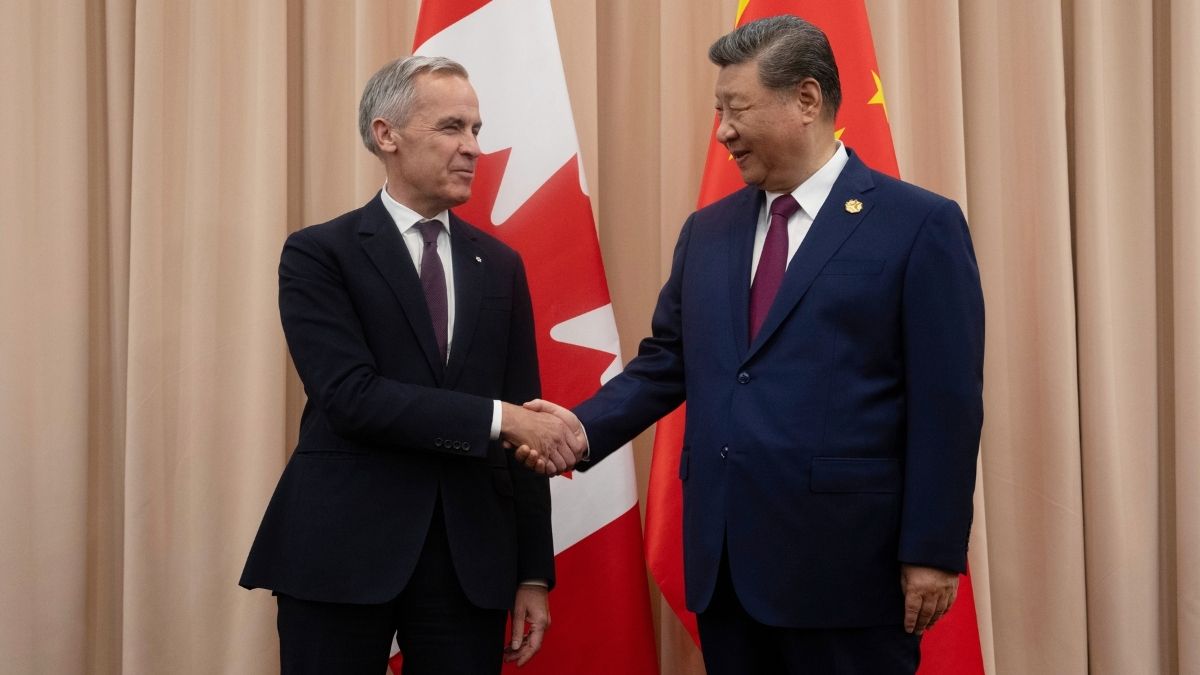
 "Carney in China as Canada looks to reset ties after years of strain amid Trump pressure")
Canadian Prime Minister Mark Carney is on his way to Beijing in an attempt to mend diplomatic ties after years of tensions as US President Donald Trump’s tariffs on Ottawa threaten its economy.
Amid pressure from the US, Canada and China are facing disagreement among each other, with the former imposing steep levies on Chinese electric vehicles and Beijing declaring reciprocal tariffs on agricultural products.
A Canadian official told CBS News that the Canadian government is hoping to make progress in Beijing, but not secure a “definitive elimination” of China’s “unfair” tariffs.
This will be the first time a Canadian prime minister has flown to China since 2017.
Meanwhile, Trump has said, “We don’t need Canadian product… I want to build the cars here, not in Canada… Now, the Canadians are moving here to build cars. Same thing with Mexico and Japan. Japan paid us billions and billions of dollars for the privilege of making cars here and selling cars here… We have a tariff on Chinese autos… Everybody now admits that I was right on tariffs.”
What can be expected?
Carney is scheduled to meet with Chinese President Xi Jinping and Premier Li Qiang, among other government and business leaders.
Canada’s relations with China have been among the worst of any Western nation. But Carney and Xi in late October held the first formal talks between the countries’ leaders since 2017, with the Chinese president inviting the Canadian to visit.
Carney’s visit will aim to “elevate engagement on trade, energy, agriculture, and international security”, his office said in a statement on Wednesday.
While the Canadian official declined to specify the exact options being considered or whether a formal deal is currently under development, they confirmed that a “concerted effort” is underway between Canada and China.
Quick Reads
View AllThe official emphasised that both nations are working collaboratively to address the matter, with the primary goal of achieving “progress over time” through sustained diplomatic engagement.
Ottawa is also looking to expand its petroleum and liquefied natural gas (LNG) markets in locations including China.
How are Canada-China ties now?
The first sign of warming ties came in late October with Xi and Carney’s meeting on the sidelines of the Asia-Pacific Economic Cooperation (APEC) summit in October.
The Canadian premier called it a “turning point” in relations, and said he raised tricky topics such as the alleged Chinese interference in Canadian elections, saying it was “important to have that discussion” to get relations “back on track”.
The leaders discussed “respective sensitivities regarding issues including agriculture and agri-food products, such as canola, as well as seafood and electric vehicles”, according to a Canadian statement.
With inputs from agencies


 "‘Trump's policy negotiable… Iran unlikely to meet Venezuela fate’: Tehran professor to Firstpost")
 "'Are selectors and coaching staff not aligned?': Gambhir and selectors slammed over India star's handling")
 "'They better behave': Trump mocks Iran's 'will retaliate US strikes' remark amid growing unrest")
 "'Greenland chooses Denmark over US', says PM Nielsen in joint presser with Danish counterpart")
 "‘Trump's policy negotiable… Iran unlikely to meet Venezuela fate’: Tehran professor to Firstpost")
 "'Are selectors and coaching staff not aligned?': Gambhir and selectors slammed over India star's handling")
 "'They better behave': Trump mocks Iran's 'will retaliate US strikes' remark amid growing unrest")
 "'Greenland chooses Denmark over US', says PM Nielsen in joint presser with Danish counterpart")



