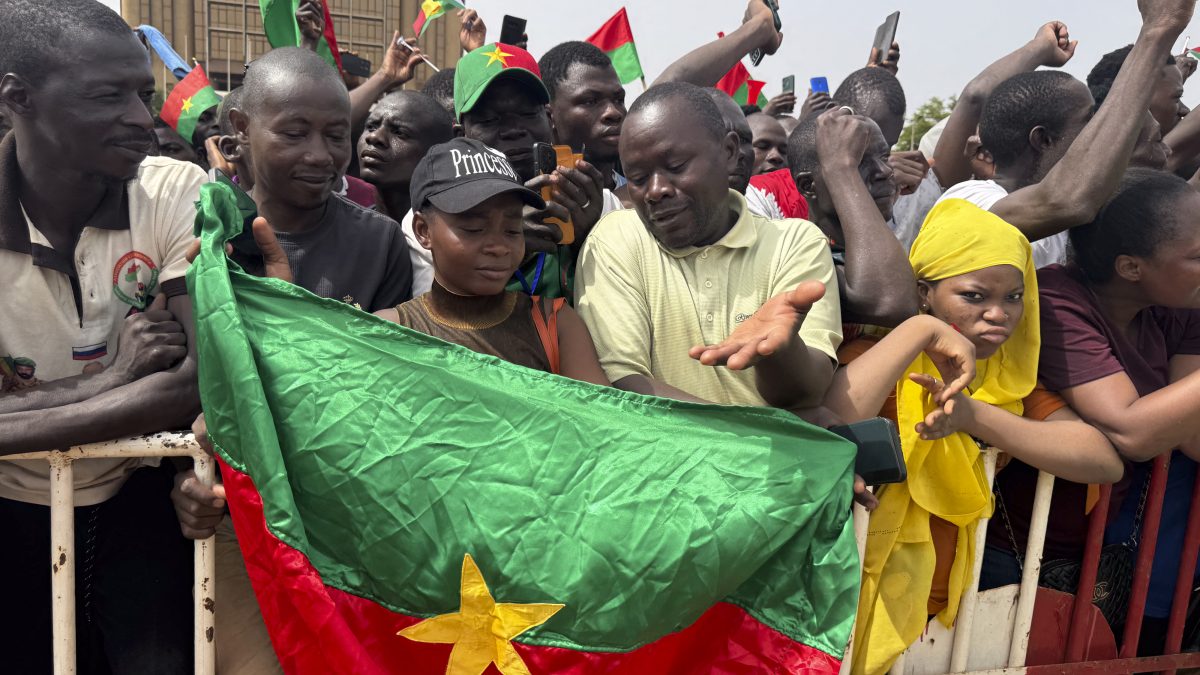
 "Supporters of Burkina Faso's strongman Captain Ibrahim Traore wave Burkina Faso flags during a rally in support of Traore at Place de la Nation Ouagadougou on April 30, 2025. (AFP)")
Burkina Faso’s military ruler has dismissed democracy as harmful, saying it “kills” and urging citizens to “forget” it in a televised interview, while defending his government’s sweeping political changes.
Captain Ibrahim Traoré, who seized power in a 2022 coup, argued that democracy was not suited to his country and claimed it brings violence. He added that many Africans do not want the system and that Burkina Faso would follow its own path, without outlining a clear alternative.
Democracy rejected as “not for us”
Traoré, who had initially pledged to restore civilian rule by July 2024, instead extended military rule by five years just months before the deadline. In January, authorities went further, banning all political parties as part of what they described as a plan to “rebuild the state.”
“People need to forget about the issue of democracy. Democracy is not for us… it kills,” he said, pointing to Libya as a cautionary example.
Libya was ruled for decades by Muammar Gaddafi, whose authoritarian government provided state benefits such as subsidised housing, free education and healthcare. Following his overthrow and death during a Western-backed uprising, the country has struggled to stabilise, remaining divided between rival administrations and armed groups.
“Wherever Western powers try to establish democracy, it is always accompanied by bloodshed,” Traoré added.
Despite a recent wave of coups across parts of Africa, most countries on the continent still hold elections, though some have faced criticism over fairness. In countries such as Gabon and Guinea, military leaders have organised and subsequently won elections.
Quick Reads
View AllCrackdown and shift in alliances
Traoré defended his decision to dissolve political parties, describing them as divisive and incompatible with his “revolutionary project.”
“The truth is, politics in Africa – or at least what we’ve experienced in Burkina – is that a real politician is someone who embodies every vice: a liar, a sycophant, a smooth-talker,” he said.
While he did not present a detailed replacement system, he emphasised building a model centred on sovereignty, patriotism and grassroots mobilisation, with a key role for traditional leaders.
The junta leader also highlighted the need for economic and military self-reliance, arguing that standard working hours would not be enough for Burkina Faso to catch up with wealthier nations.
However, his rule has been marked by a crackdown on dissent, with opposition figures, journalists and civil society groups facing increasing pressure. The government has also been accused of punishing critics by sending them to front lines in the fight against Islamist insurgents.
Despite this, Traoré has gained popularity among some across Africa for his pan-Africanist rhetoric and criticism of Western influence.