

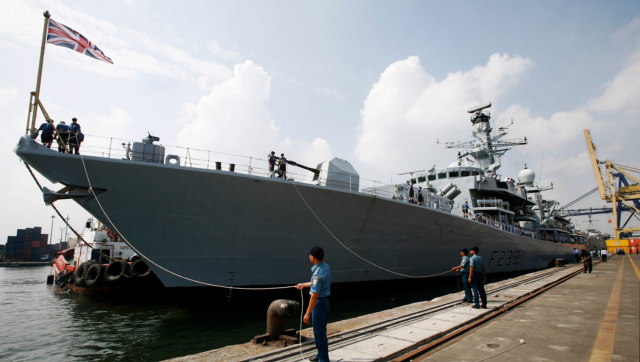
 "British Navy replacing Chinese laundrymen with Nepali Gurkhas to prevent spying")
The British Royal Navy has ceased the long-standing practice of employing Chinese laundry workers on its warships due to concerns that they may engage in espionage on behalf of Beijing, as reported by a recent source. For several decades, hundreds of Chinese laundrymen were hired, primarily from Hong Kong, to launder and press sailors’ uniforms and officers’ white tablecloths on British ships since the 1930s. The Navy has now chosen to replace them with Nepalese Gurkhas, citing apprehensions that Beijing might exert pressure on the Chinese laundry workers in China to extract sensitive Navy information, according to a report from The Sun. The move was highlighted when three Chinese nationals were denied access to HMS Queen Elizabeth, the Navy’s largest and most formidable vessel, during its deployment to the contested South China Sea as part of a carrier strike group journey. In a separate incident, a fourth Chinese laundryman with 39 years of service was released from duty this month because his family resides in Hong Kong, according to the newspaper’s account. Former First Sea Lord Admiral Lord West expressed his perspective, stating, “If security is at stake, the Navy’s hands are tied. Nevertheless, it is a somber occasion as many Chinese laundrymen have served alongside us, with some even making the ultimate sacrifice.” These developments come in the wake of a warning from MI5’s chief, Ken McCallum, who expressed concerns about China’s attempts to steal nuclear technology secrets from Britain, considering it a “high priority” for Beijing to disrupt the AUKUS security partnership between the UK, the United States, and Australia, aimed at constructing a new fleet of nuclear-powered submarines. As part of these security efforts, Britain is constructing a fleet described as “the largest, most advanced, and most potent attack submarines ever operated by the Royal Navy,” featuring cutting-edge sensors, design, and weaponry. Recent contracts worth a combined £4 billion have been awarded to three British firms for the design and manufacture of the SSN-AUKUS submarines, touted as being virtually undetectable to adversaries. Furthermore, the UK is sharing its nuclear technology, cyber capabilities, artificial intelligence, quantum technologies, and undersea systems with its allies, as part of the trilateral pact that emphasizes collaboration in security and defense-related science, technology, industrial capabilities, and supply chains, which was initiated in 2021. Nonetheless, Mr. McCallum has emphasized that China is determined to undermine the partnership and engage in extensive espionage activities. Speaking at a joint conference of the Five Eyes intelligence alliance, he pointed out that it would be logical to assume that China views understanding the inner workings of AUKUS and the potential to disrupt it as a high-priority objective. China has strongly criticized the AUKUS agreement, accusing the three nations of pursuing a perilous path. It is essential to note that China possesses a considerable number of its own nuclear-powered submarines and has the world’s largest navy, as outlined in the Pentagon’s 2020 China Military Power report, with a battle force comprising over 350 ships and submarines, including more than 130 significant surface combatants. To address the Indo-Pacific threat, Australia is currently working on developing a more stealthy and advanced submarine fleet over the next decade, capable of faster speeds and extended underwater operations, with reduced exhaust emissions for reduced detectability. It is noteworthy that the last formal collaboration between the UK and the US for building nuclear submarines was in 1958. Although the UK has been operating nuclear-powered submarines for over six decades, Australia has never produced its own, and the initiative is seen as vital to counter China’s regional influence, particularly in the contested South China Sea. The initial SSN-AUKUS submarine is scheduled for delivery in the late 2030s, and both the UK and Australia will deploy vessels based on a British design.
The Navy has now chosen to replace them with Nepalese Gurkhas, citing apprehensions that Beijing might exert pressure on the Chinese laundry workers in China to extract sensitive Navy information
Advertisement
End of Article


 "Russian drones over Poland: Trump’s tepid reaction a wake-up call for Nato?")
 "As Russia pushes east, Ukraine faces mounting pressure to defend its heartland")
 "Why Mossad was not on board with Israel’s strike on Hamas in Qatar")
 "Turkey: Erdogan's police arrest opposition mayor Hasan Mutlu, dozens officials in corruption probe")
 "Russian drones over Poland: Trump’s tepid reaction a wake-up call for Nato?")
 "As Russia pushes east, Ukraine faces mounting pressure to defend its heartland")
 "Why Mossad was not on board with Israel’s strike on Hamas in Qatar")
 "Turkey: Erdogan's police arrest opposition mayor Hasan Mutlu, dozens officials in corruption probe")



