

 "Will Indus Waters Treaty be abrogated? Here's why it's a key factor in India-Pakistan ties")
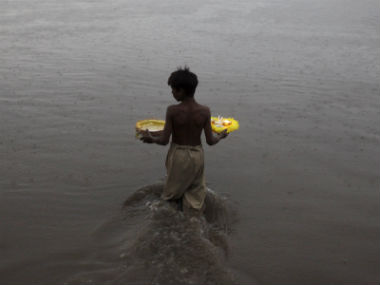
The latest issue to crop up in the strained ties between India and Pakistan is the 1960 Indus Waters Treaty. India on Thursday made it clear that “mutual trust and cooperation” was important for such a treaty to work. The assertion came amid calls in India that the government should scrap the water distribution pact to mount pressure on Pakistan in the aftermath of the audacious Uri terror attack earlier this week. [caption id=“attachment_3017214” align=“alignleft” width=“380”] A boy enters river Ravi to release oil lamps and candles in water. Reuters[/caption] “It cannot be a one-sided affair,” Ministry of External Affairs spokesperson Vikas Swarup said when asked if the government will rethink on the Treaty given the growing strain between the two countries. He also noted that the preamble of the Treaty itself said it was based on “goodwill”. The Indus Waters Treaty was brokered by the World Bank between India and Pakistan and was signed on 19 September, 1960. Under the treaty, control over six north Indian rivers were divided between the two countries. India got control over the rivers Beas, Ravi and Sutlej whereas Pakistan got control over Indus, Chenab and Jhelum. Pakistan has been complaining of not receiving enough water and gone for international arbitration in couple of cases. Swarup also noted that there were differences over the implementation of the treaty between the two countries. Despite these differences, the Indus Waters Treaty is considered to be one of the most successful water-sharing agreements in the world today. Even an article in Pakistani newspaper
The Nation said that the advantages of the treaty outweigh the drawbacks. This is true despite the fact that even the rivers which come under Pakistani control do not originate in Pakistan and enter the country from India. Indus originates in China, and Chenab and Jhelum originate in India. All the three rivers enter Pakistan from India. Moreover, more than half of the territory of Pakistan is part of the Indus basin which means that it is highly dependent on the three rivers coming from India for its water supply. The treaty also gives India the right to use the waters of Indus, Chenab and Jhelum in a limited manner. India can use the water from these rivers for irrigation, transport and power generation, but of course, to a limited extent. Despite these facts, the article in The Nation said that the construction of two mega dams due to the treaty “facilitated control of floods, provided water for irrigation and production of cheap and clean hydelpower. Pakistan became independent in matters of irrigational needs and the interlinking of rivers by canals provided more rational utilisation of waters in all six rivers.” Perhaps this is why the treaty has survived despite the 1965 and 1971 wars and the Kargil war of 1999. The fact that India is even considering the option to abrogate a treaty which has survived two full-fledged wars and a limited war shows exactly how strained the ties between India and Pakistan are right now. In an article in
The Indian Express, BJP leader and former external affairs minister Yashwant Sinha said that India should abrogate the treaty with Pakistan “with immediate effect”. Many analysts are also of the opinion that the three rivers under Pakistani control are the lifeline for the southern Punjab region in Pakistan, which is the “nursery of terror groups” like Lashkar-e-Taiba and Jaish-e-Mohammad. “If Pakistan wishes to preserve the Indus treaty, despite its diminishing returns for India, it will have to strike a balance between its right to keep utilising the bulk of the river system’s waters and a corresponding obligation (enshrined in international law) not to cause palpable harm to its co-riparian state by exporting terror,”
DNA
quoted analyst Brahma Chellaney as saying. According to Nitin Gokhale, strategic affairs expert of the
Bharatshakti.in defence portal, India could revisit the treaty because it was signed out of Pakistan’s fear that since the source rivers of the Indus basin were in India, it could potentially create droughts and famines in Pakistan during times of war. However, it is not as simple as turning off a tap to cut off the water supply to Pakistan. In fact, stopping the waters from flowing into Pakistan could harm India as this could cause floods in Jammu and Kashmir and Punjab. The DNA report also said that the three rivers under Pakistani control could not be connected to the other rivers because the Pir Panjal mountains insulated them from the rest of the country. Even the UN is of the opinion that the treaty should not be abrogated. “In the second half of the 20th century, more than 200 water treaties were successfully negotiated. The 1960 Indus Waters Treaty between India and Pakistan has survived two wars, and remains in force today,” PTI quoted UN Deputy Secretary-General Jan Eliasson as saying. The abrogation of the Indus Waters Treaty might also end up increasing the intensity and frequency of terror attacks by Pakistan-based terrorists instead of reducing it. With inputs from agencies
The latest issue to crop up in the strained ties between India and Pakistan is the 1960 Indus Waters Treaty.
Advertisement
End of Article


 "Charlie Kirk, shot dead in Utah, once said gun deaths are 'worth it' to save Second Amendment")
 "From governance to tourism, how Gen-Z protests have damaged Nepal")
 "Did Russia deliberately send drones into Poland’s airspace?")
 "Netanyahu ‘killed any hope’ for Israeli hostages: Qatar PM after Doha strike")
 "Charlie Kirk, shot dead in Utah, once said gun deaths are 'worth it' to save Second Amendment")
 "From governance to tourism, how Gen-Z protests have damaged Nepal")
 "Did Russia deliberately send drones into Poland’s airspace?")
 "Netanyahu ‘killed any hope’ for Israeli hostages: Qatar PM after Doha strike")



